
REVIEW · HIROSHIMA
Hiroshima: Peace Cycling Tour with Local Guide
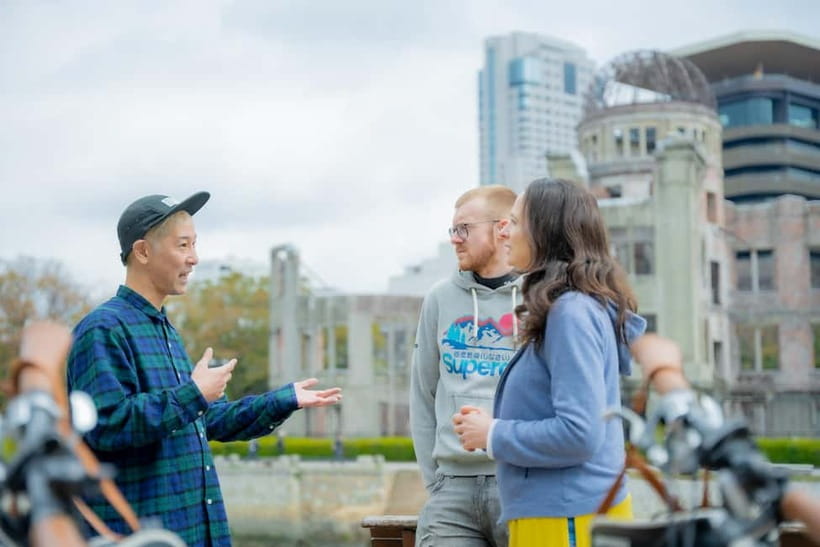
Hiroshima’s atomic-bomb story reaches far beyond the Atomic Bomb Dome. This small-group e-bike tour takes you through Peace Memorial Park and into ordinary streets where the bombing’s effects are easier to grasp. I like the personal approach, especially when guides such as Shin, Kana, and Moe connect the city’s past with stories passed down through their families.
I also like the easy pace and the chance to cover more ground than you can on foot. The bikes are comfortable, and the electric assist helps in warm weather or if you are not a strong cyclist. The main drawback is that the tour stays focused on Hiroshima’s bombing history and central area, so it is not a general city sightseeing ride. Tall riders should also note that one review found the adult bike small-framed.
Key points to know before you book
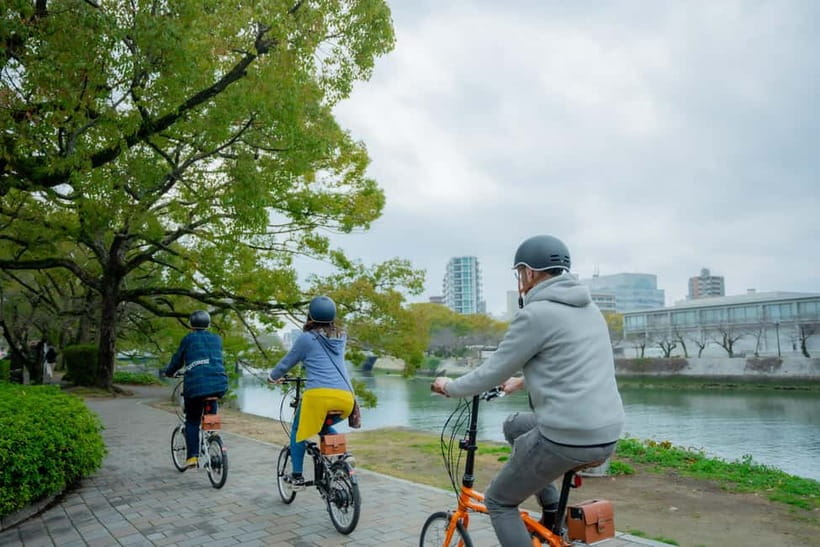
- See beyond Peace Memorial Park: Ride to suburban sites, bridges, hospitals, parks, rail lines, and surviving trees linked to August 6, 1945.
- Hear local family stories: Guides including Shin, Kana, Moe, and Bella bring personal connections and memories passed through parents and grandparents.
- Electric bicycles keep the route manageable: You do not need to be exceptionally fit, but you must be able to ride a bicycle safely.
- Choose two or three hours: The shorter route concentrates on Peace Park and nearby A-bomb sites, while the longer route adds Hiroshima Castle and more of the city.
- Small groups make questions easier: The shared tour accepts up to 10 people, with the pace adjusted for children or less confident cyclists.
- The message is serious but hopeful: The tour covers destruction plainly, then turns to Hiroshima’s recovery and its continuing call for peace.
Why cycling adds meaning to Hiroshima’s story
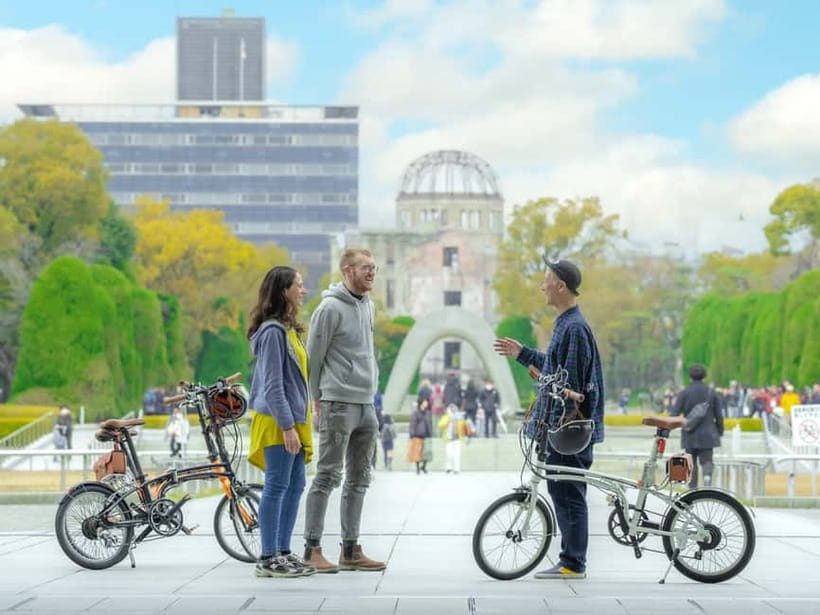
Hiroshima is often visited in a straight line: Peace Memorial Park, the Atomic Bomb Dome, the museum, then perhaps lunch. That route is essential, but it can leave you with an impression of a memorial district separated from the modern city.
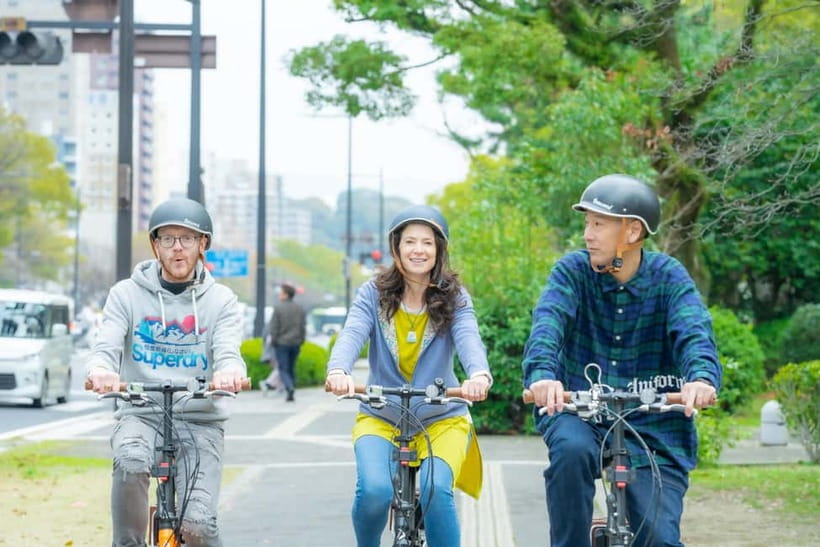
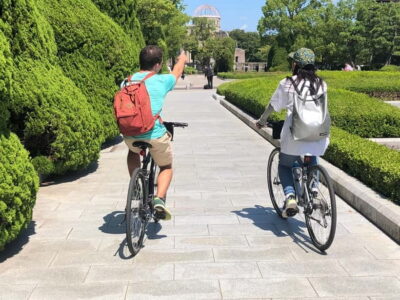
This bicycle tour helps connect the two. You ride through streets where people now live, commute, shop, and wait for trams, while your guide points out places tied to the bombing. The contrast matters. Hiroshima was devastated within roughly 2.5 kilometers of the hypocenter, yet the city has been rebuilt with broad roads, green spaces, rail service, and ordinary neighborhoods.
I find the bicycle useful here for more than speed. You can move from a famous memorial to a less obvious site in a few minutes, then stop without the awkwardness of organizing a bus or taxi. The route also gives you a physical sense of distance. You are not only looking at a map or reading a caption. You are riding between the places where the city’s story unfolded.
The electric assistance keeps the focus on the guide rather than on your legs. Still, this is a cycling activity, not a sightseeing bus with bicycles as decoration. You should be comfortable steering, braking, and riding in a group.
More Guided Rides in Japan:
- Tokyo Guided Small-Group Biking Tour
★ 5.0 · 1,250 reviews - Tokyo Top Highlights 3h Guided E-bike Tour
★ 5.0 · 714 reviews - 3h Tokyo E-Bike Tour: Hidden Gems, and Local Life with guide
★ 5.0 · 670 reviews
The two-hour route: Peace Park, trams, and the rebuilt city
The two-hour course begins at the Rest House in Hiroshima Peace Memorial Park. Meetings are scheduled at 11:00 or 15:00, with the tour finishing around 13:00 or 17:00.
The opening stop explains what Peace Memorial Park is and why its monuments matter. Your guide discusses the Atomic Bomb Dome, the memories attached to the park, and what happened roughly 70 years before the tour was created. The wording can sound simple, but this is important groundwork. Without it, the Dome can become just another photograph. With context, its damaged frame becomes a marker of the city’s destruction and survival.
The route then leaves the most familiar tourist area. This is one of the tour’s best features. You ride into local streets and see Hiroshima away from the main memorial paths, visiting sites connected with the atomic bombing while your guide explains episodes preserved in the city’s memory.
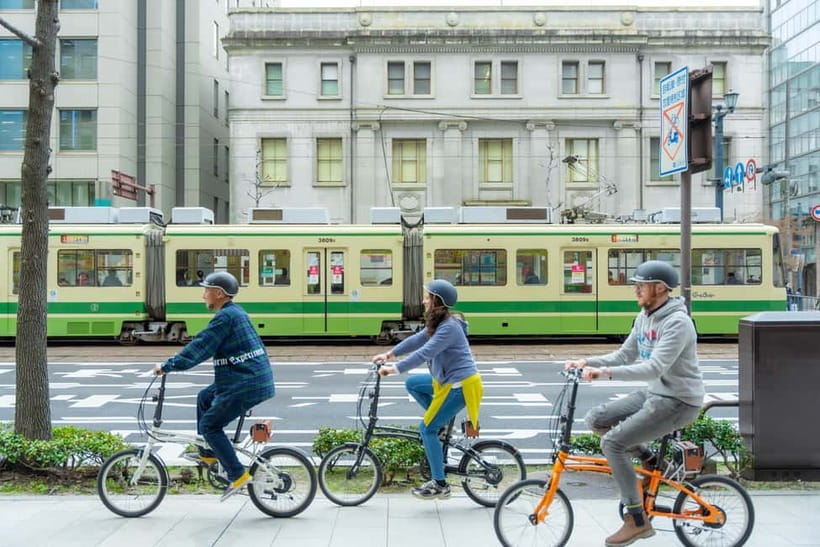
One memorable detail is the A-bombed streetcar. A tram that survived the bombing is still part of Hiroshima’s working rail system. Seeing an active train linked to that history gives the subject an unusual immediacy. This is not an object sealed away behind glass. It is part of the transport system people use today.
The shorter tour works well if you have only a morning or afternoon in Hiroshima. It gives you the central memorial area, a few less-touristed locations, and a ride through the city’s recovery without taking over your day. The tradeoff is simple: you will not see as many stops as on the three-hour course.
The three-hour route: a wider circle of A-bomb sites
The three-hour ride starts at 10:00 or 14:00 and returns around 13:00 or 17:00. It adds a more detailed sequence of locations, so I would choose it if Hiroshima’s history is a main reason for your visit.
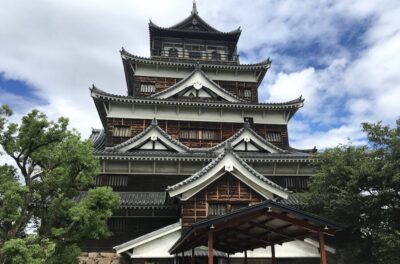
The route opens at Hiroshima Castle, followed by Hiroshima Gokoku Shrine and its shrine gate. These stops place the bombing story in the city’s earlier setting. The castle was destroyed in 1945, and seeing this area before reaching Peace Park helps show that Hiroshima was not simply a memorial city. It had older civic, religious, and military layers that were also swept away and rebuilt.
From there, you pass through Hiroshima Central Park and cross the Aioi Bridge, the distinctive T-shaped bridge near the Atomic Bomb Dome. The bridge is closely associated with the bombing because of its visibility from the air. Your guide can explain why this part of the city became central to the event and to later remembrance.
The Atomic Bomb Dome follows at about the 1-hour-25-minute mark. You will have already approached the subject through the castle, shrine, park, and bridge, so the Dome becomes part of a broader story rather than the only focus.
Next come the Motoyasu River and Peace Bridge. Rivers were central to Hiroshima’s geography and to the experience of the bombing, and the bridges help you understand how the city is arranged. The bicycle makes these connections easy to follow.
The route continues to Higashisenda Park and the Hiroshima Red Cross Hospital. These are especially useful stops for understanding the bombing’s effect on medical care and daily life. The tour then reaches Hiroshima Railway, where the surviving tram connection returns to the story. The mix of parks, hospital grounds, rail lines, and bridges keeps the experience grounded in real places rather than only monuments.
Later stops include Miyuki Bridge and the Kobayashi River, a surviving weeping willow tree, and Peace Boulevard. The willow is a small detail, but that is exactly why it can be powerful. A single surviving tree offers a different scale from the Dome or a large memorial. Peace Boulevard then brings you back to one of Hiroshima’s main public spaces and its modern identity as a city committed to peace.
The three-hour route includes many stops, but the timetable may shift during the day. You should expect a moving overview rather than long museum-style talks at every location. If you want detailed time inside the Peace Memorial Museum, this ride does not replace that visit. It complements it by taking you across a wider area.
Local guides make the history personal
The strongest part of this experience is the guide. The guide roster changes, but names praised in the supplied material include Shin, Kana, Moe, Bella, Mai, and Hugo.
Shin is repeatedly described as energetic, warm, and easy to understand in English. He has shared family connections to the bombing, including stories passed from grandparents and parents. Kana is praised for mixing clear explanations with personal family experiences and a hopeful message. Moe and Bella are also noted for thoughtful storytelling and careful attention to the group.
Those personal connections do not turn the tour into a family memoir. The best guides use them to add human scale to the larger history. You hear about the effects of the bombing on people and families, then connect those stories to the places you are seeing.
The subject is heavy. A good guide needs to avoid both cold recitation and easy sentiment. This tour appears to aim for a steady balance: explain the destruction honestly, allow room for emotion, then show how survivors and later generations carried the idea of peace forward.
English ability is important on a history tour, and the feedback points to guides who speak clearly and engage well with questions. Since the tour is shared, your exact guide and group are not guaranteed. The group can include up to 10 people, and the pace may be adjusted if children or less confident cyclists are present.
More Cycling Trips in Japan:
- Hidden Kyoto E-Biking tour
★ 5.0 · 1,843 reviews - Bike Tour Exploring North Kyoto plus Lunch
★ 5.0 · 1,087 reviews - Tokyo Great Cycling Tour
★ 5.0 · 811 reviews - Arashiyama Bamboo Forest & Hidden Gems Bike Tour (Early Bird)
★ 5.0 · 613 reviews
What the e-bikes are like on this route
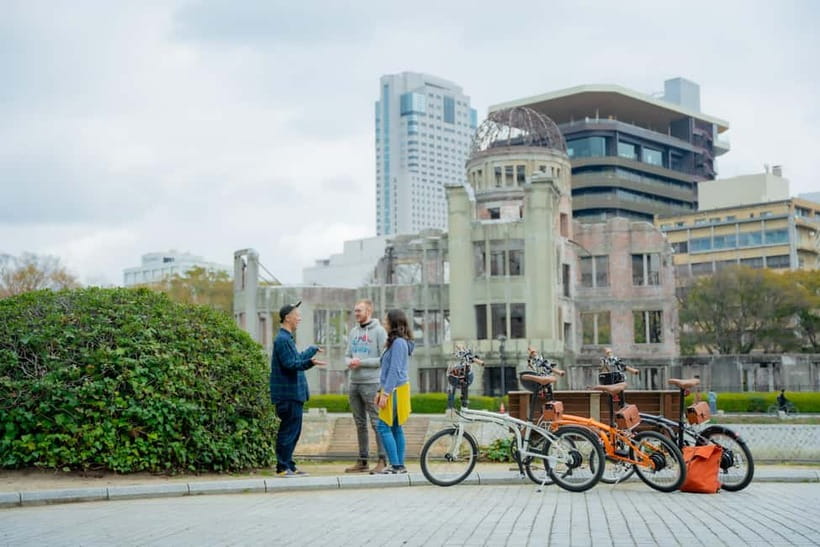
The electric bicycles are one of the tour’s practical strengths. The route covers a modest area, and the motor assistance means you are unlikely to spend the whole time worrying about effort. Several guides have also been praised for keeping the group together and choosing a comfortable pace.
You still need basic cycling ability. The tour does not suit someone who cannot ride, and it is not suitable for anyone under 145 centimeters, or about 4 feet 8 inches, for the adult electric bicycle.
Children have several possible arrangements, but availability is limited. Infant seats are free for infants between ages 1 and 3, provided the child is under 22 kilograms and 115 centimeters. Children from 110 to 145 centimeters may use a children’s cross-bike, with two children’s bicycles available for one booking. Contact the operator before reserving if you need an infant seat or child bicycle.
The bikes may feel small to very tall riders. One 6-foot-1 participant specifically noted the small frame, so ask about fit if you are tall or particular about riding position.
Wear comfortable clothes and shoes. High heels are not allowed. Bring water and a towel, especially in summer. A few guides have carried cold towels, salt candies, wet wipes, ice packs, or similar comfort items during hot weather, but you should not rely on that for your own preparation.
Weather, safety, and the group pace
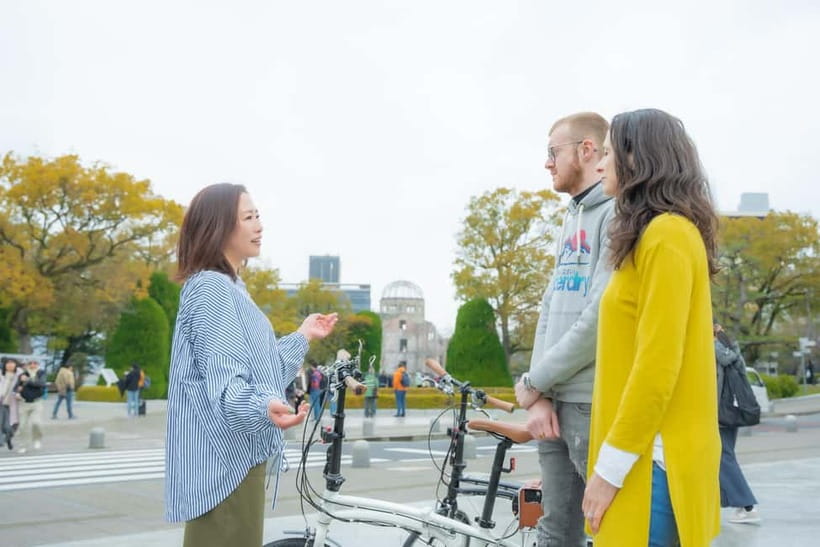
Hiroshima can be hot, and cycling adds sun and humidity to the calculation. In warm months, carry your own drink and expect regular stops. The tour includes bicycle accident insurance, which is useful, but it does not remove the need to ride carefully.
The group rides together, and the guide may slow the pace for children or people unused to cycling. That is good for safety, though strong cyclists may find the pace conservative. You should not book this expecting a fast ride.
A guide may also stop in shaded areas or near a convenience store if someone feels unwell. That kind of flexibility has been part of the care shown on difficult hot-weather outings, but conditions vary by day.
Photos taken during the tour are provided as data afterward. This is a pleasant extra, particularly because the guide can take pictures of you at stops instead of leaving you to manage every image yourself.
Is $52 a fair price?
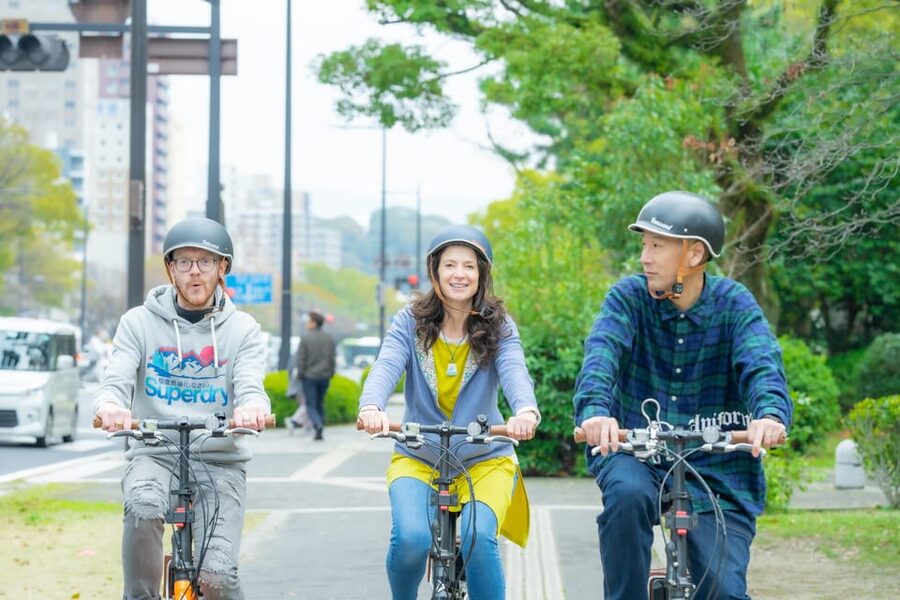
At $52 per person, the tour sits in a reasonable range for a two to three-hour guided experience that includes an electric bicycle, an English-speaking guide, and bicycle accident insurance.
The value is strongest if you want interpretation rather than simple transport. You are paying for the route design, the bike, the guide’s local knowledge, and access to sites you might pass without recognizing. The personal stories also give the tour something that a map or guidebook cannot provide.
The price is less compelling if you plan to spend only a few minutes at Peace Park and do not care about the outer stops. You also need to budget separately for food, drinks, and any museum admission, since those are not included.
I would choose the three-hour version when the price difference is acceptable and Hiroshima is a central part of your trip. The two-hour ride is the better fit for a tight schedule, families with younger children, or anyone who wants a focused introduction before visiting the museum on foot.
Free cancellation is available up to 24 hours before the start time, and you can reserve while paying later. Do not arrive late without contacting the operator. Missing the meeting time can cancel the tour and result in a same-day, nonrefundable charge.
Who should book this Hiroshima cycling tour?
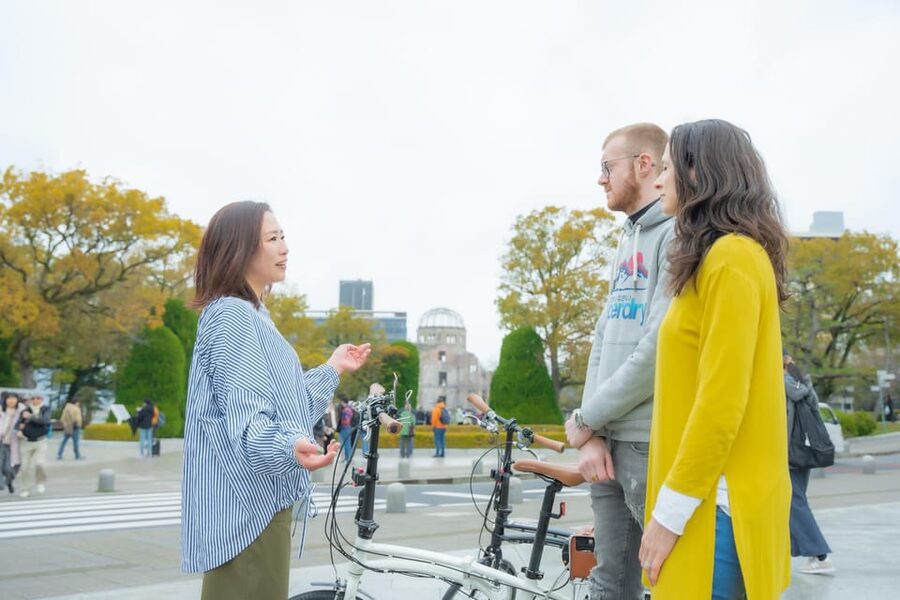
I recommend it most to first-time visitors who want to understand how the atomic bombing shaped the whole city, not just the memorial district. It also suits solo visitors, couples, and families with older children who can ride safely.
The tour is a good choice if you prefer learning outdoors, asking questions as you go, and seeing several locations in one compact outing. It is especially useful when you have one day in Hiroshima and want a guided orientation before deciding where to spend more time.
You may want another format if you dislike bicycles, have mobility needs that make cycling difficult, want extensive time inside museums, or are looking for food, shopping, or Miyajima. This is a focused history ride, not an all-purpose Hiroshima tour.
FAQ
Where does the Hiroshima cycling tour meet?
The meeting point is the Rest House in Hiroshima Peace Memorial Park. From Hiroshima Station, take the Hiroshima Electric Railway to Atomic Bomb Dome Station, which takes about 20 minutes, then walk about five minutes.
How long does the tour last?
You can choose a two-hour or three-hour route. The two-hour departures are scheduled for 11:00 and 15:00. The three-hour departures are scheduled for 10:00 and 14:00, subject to availability.
Is the tour conducted in English?
Yes. The tour includes a live English-speaking guide.
How many people can join the tour?
It is a shared small-group tour for up to 10 participants. The pace may be adjusted when children or people who are less accustomed to cycling are in the group.
What does the price include?
The price includes an electric rental bicycle, an English-speaking guide, and insurance for bicycle accidents. Food and drinks are not included.
Can children join the tour?
Children aged 1 and older can be reserved. Infant seats and children’s bicycles are limited, so contact the operator before booking if you need one. Children under 15 can use adult or children’s bicycles at the child rate, subject to height and equipment limits.
What height is needed for an adult electric bicycle?
The adult electric bicycle is intended for people at least 145 centimeters tall. Children between 110 and 145 centimeters may use a children’s cross-bike if one is available.
What should I bring?
Bring comfortable shoes, comfortable clothing, a towel, and drinks. High-heeled shoes are not allowed. You should also arrive on time, since arriving late without notice can lead to cancellation and a nonrefundable same-day fee.
Should you book it?
Book this tour if you want Hiroshima explained through its streets, bridges, rail lines, parks, and surviving landmarks, not only through the best-known memorials. The electric bike makes a wider route practical, while local guides such as Shin and Kana add family stories and a clear message of hope.
Choose the two-hour course for a compact introduction. Choose three hours for the fuller city route, especially if you want the surviving streetcar, Red Cross Hospital, Hiroshima Castle, the willow tree, and other sites beyond Peace Park. If you can ride a bicycle and are ready for a serious subject presented with care, $52 is a fair price for a memorable and useful introduction to Hiroshima.
Newest rides we have reviewed in Japan
- Best of Kyoto: Ginkakuji & Path of Philosophy E-Bike Tour★ 4.9 · 79 reviews
- Kyoto: Tailored E-Bike Tour to Highlights & Hidden Gems★ 4.9 · 32 reviews
- Kyoto: Full Day Bike Tour★ 4.9 · 39 reviews
- Kyoto: Half-day Guided Bike Tour with Fushimi Inari★ 4.9 · 21 reviews
- Kyoto: Early Bird E-Bike Tour with Lunch★ 5.0 · 14 reviews
- Kyoto: Full-Day City Highlights Bike Tour with Light Lunch★ 5.0 · 52 reviews
- Kanazawa Half Day E-bike Tour★ 5.0 · 81 reviews
- Hiroshima: Best of Hiroshima Guided Bike Tour★ 4.9 · 89 reviews
Hiroshima Cycling Tours, compared.
Hiroshima in a Nutshell: Morning Bike Adventure
Read our review →
Hiroshima 2hr Peace Cycling Tour with Local Guide
Read our review →
Other lists this ride turns up in