
REVIEW · JAPAN
Bike Tour in Fukuoka City【Bike is Life】Fukuoka ” Hakata ” Ride
Fukuoka’s most interesting story is split by the Naka River. Hakata grew as an international port and merchant town, while Fukuoka developed around a castle built by Kuroda Nagamasa and his father, Josui. This bicycle tour links both sides in one afternoon, using quiet lanes, riverside paths, and streets that are hard to cover on foot.
I like two things right away: you cover a lot of ground without rushing, and the route mixes major sights with ordinary city scenes. Cycling through Fukuoka Castle’s stone walls and Ohori Park gives you space to breathe, while Shofukuji and Kushida Shrine add cultural depth. The main consideration is the distance. The ride is about 17 km, so you should be comfortable on a bicycle and ready for several hours outdoors.
The essential points before you book
- Two sides of Fukuoka in one ride: See the old Hakata port town and the castle-centered Fukuoka area.
- About 17 km over 3.5 hours: The pace is relaxed, with stops and breaks rather than a race through the city.
- Four meaningful stops: Fukuoka Castle remains, Ohori Park, Shofukuji Temple, and Kushida Shrine each show a different part of local history.
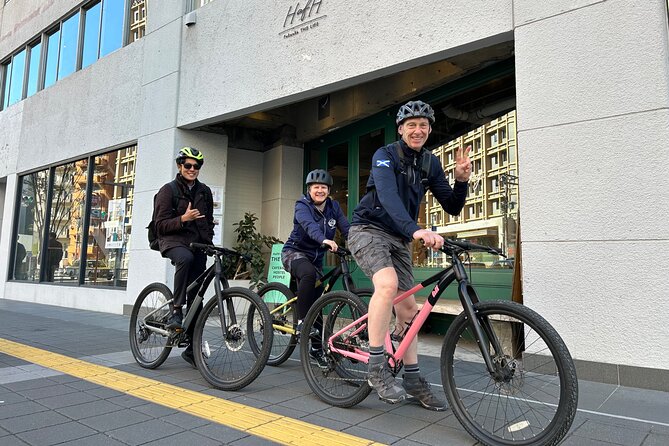
- Small groups capped at 10 people: The guide can keep the group together and adjust the pace more easily than on a large bus tour.
- Haruka and Haru receive strong praise: They are described as friendly, safety-conscious, and good at explaining the city in English, with an interpreter used on some departures.
- The price includes useful basics: At $72.26 per person, you get the bicycle, insurance, drinks, and snacks, not just guiding.
Why cycling fits Fukuoka so well
Fukuoka is large enough that walking between its historic areas can eat up much of your day, yet compact enough for a bicycle to connect them naturally. You get the practical advantage of covering distance while still moving slowly enough to notice narrow lanes, river crossings, stone walls, and changing neighborhoods.
The route also gives you a better sense of the city’s layout. Hakata and Fukuoka are often treated as one destination today, but their origins were different. Hakata was a port and trading center with old ties to China and Korea. Fukuoka, across the Naka River, was shaped by its castle and its ruling family.
That contrast is the heart of the tour. You are not simply ticking off four attractions. You are seeing why the modern city developed in two distinct parts.
The ride is generally described as calm and manageable. Haruka is praised for choosing a comfortable pace, offering rest breaks, and helping riders feel safe on narrow lanes and city streets. That matters if you have not cycled in Japan before or if you are visiting during a busy season.
The route is not a pure sightseeing stroll, though. You need to pedal for much of the afternoon, and city cycling requires attention. If you want a short ride with only a few minutes between stops, this is not the right choice.
More Cycling Trips in Japan:
- Hidden Kyoto E-Biking tour
★ 5.0 · 1,843 reviews - Tokyo Guided Small-Group Biking Tour
★ 5.0 · 1,250 reviews - Bike Tour Exploring North Kyoto plus Lunch
★ 5.0 · 1,087 reviews
Starting at Kushida Shrine Station
The meeting point is Kushida Shrine Station, at 7 Gionmachi in Hakata Ward. The tour begins at 1:00 p.m. and returns to the same location after about three and a half hours.
Starting in Hakata makes sense. This is the older merchant side of the city, and Kushida Shrine is one of its best-known religious landmarks. It also gives the route a clear historical progression: begin near Hakata’s traditional center, cross toward the castle town, then return to the old district.
The meeting point is near public transportation, but allow a little time to find the exact place. One rider had trouble locating the start but was helped by Haruka, who waited. That is a useful reminder to arrive early, especially if you are unfamiliar with Fukuoka’s station exits.
The tour is limited to 10 people. That is small enough for the guide to notice if someone falls behind, explain things without shouting, and keep the ride together. Some departures may be very small. One solo participant still took the tour when nobody else joined, which suggests the operator may keep the appointment rather than cancel simply because the group is tiny.
Fukuoka Castle remains and three kilometers of stone walls
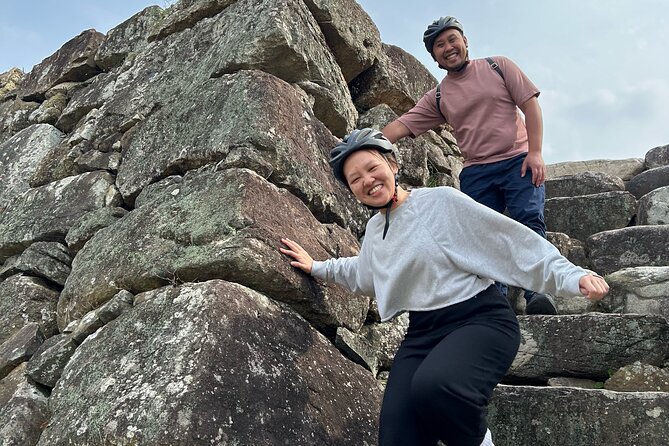
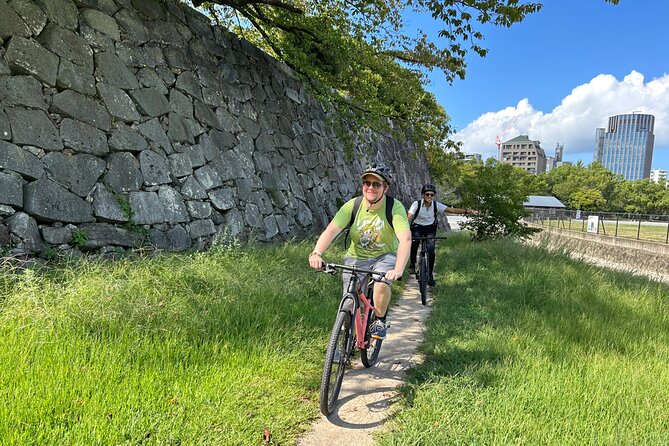
The first major section follows the remains of Fukuoka Castle, beginning near the Uenobashi Imperial Gate and continuing toward the castle tower area. The ride lets you see more than a single gate or viewpoint. You follow stone walls that total more than 3 km, getting a feel for the scale of the old fortification.
There is no admission charge for this stop. That keeps the focus on the setting rather than on a formal museum visit. You can watch the castle grounds unfold as you ride, with the guide explaining how the castle and town were linked.
This is one of the strongest parts of the afternoon for anyone interested in Japanese history. The ruins are not presented as a fully restored castle complex, so you should expect walls, remains, and traces of the former structure rather than grand buildings. That may feel modest if you are hoping for a preserved castle interior.
The bicycle makes a real difference here. You can cover more of the wall line than you would on foot, and you can stop at points that would be awkward to reach by car. The route also gives you a physical sense of how the castle area spread across the city.
Spring can add extra appeal. One rider described cycling during cherry blossom season, when the city was lively and the blooms were out. The tour runs in all seasons when conditions allow, so the atmosphere will depend on your date.
Ohori Park and a well-timed break
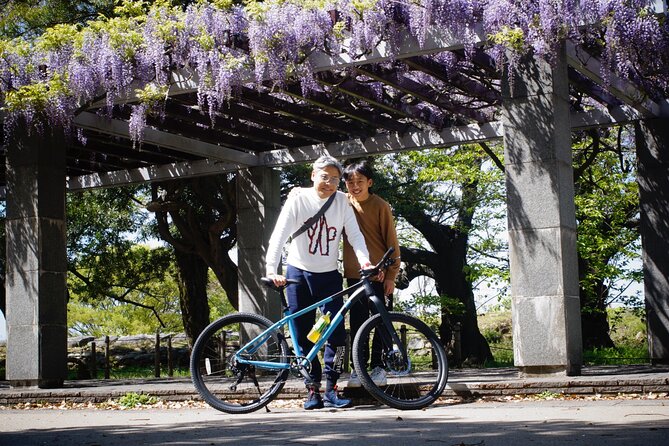
From the castle area, you ride through Ohori Park, which occupies the former outer moat of Fukuoka Castle. This is the most relaxing section of the route. The park gives you open space after city streets and castle walls, with time to slow down and take a break.
The stop is planned for about 15 minutes. That is enough to stretch your legs, look around, and enjoy the park without turning the tour into a long café visit. A sweet snack and drink are included, and the break has been especially appreciated after the cycling.
Ohori Park is valuable because it shows how old defensive structures have been folded into modern city life. The former moat is no longer simply a military feature. It is now a public park, and riding through it gives you a clear example of Fukuoka’s past and present occupying the same space.
You should not expect a long free period here. If you want time to sit by the water, take many photographs, or visit every corner of the park, 15 minutes will feel brief. The tradeoff is that the tour keeps moving and still reaches the Hakata sights within the same afternoon.
Same roads, a different saddle:
- Tokyo Great Cycling Tour
★ 5.0 · 811 reviews - Tokyo Top Highlights 3h Guided E-bike Tour
★ 5.0 · 714 reviews - 3h Tokyo E-Bike Tour: Hidden Gems, and Local Life with guide
★ 5.0 · 670 reviews - Arashiyama Bamboo Forest & Hidden Gems Bike Tour (Early Bird)
★ 5.0 · 613 reviews
Shofukuji Temple, the birthplace of Japanese Zen
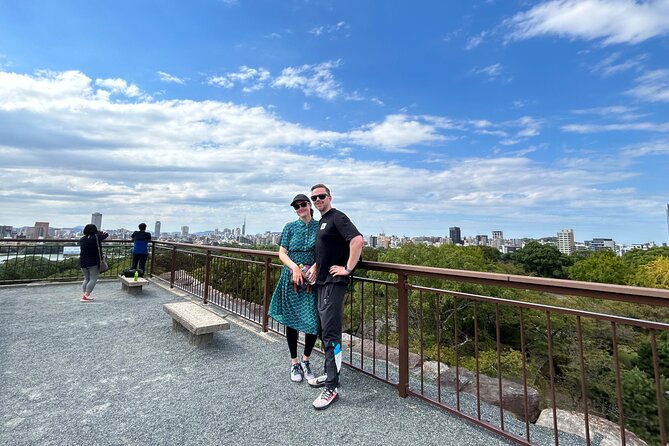
The next stop is Shofukuji Temple, identified as Japan’s first Zen temple and the birthplace of Japanese tea. The visit lasts about 15 minutes, so this is an introduction rather than a full temple exploration.
That short stop still carries real weight. Shofukuji connects the city to the arrival and development of Zen Buddhism in Japan, while the tea reference links religious practice with one of the country’s most familiar cultural traditions.
The temple is also a welcome change after the broad castle grounds and park. Here, the interest is less about distance and more about atmosphere, religious history, and the details the guide points out. Haruka and Haru are praised for explaining each stop clearly, which is important at a place where a quick look alone may not tell you why it matters.
Keep your expectations realistic. The tour schedule does not provide time for a long temple visit, meditation session, or extended independent exploration. You will get context and a brief look, then continue by bicycle.
Kushida Shrine and Hakata’s traditional center
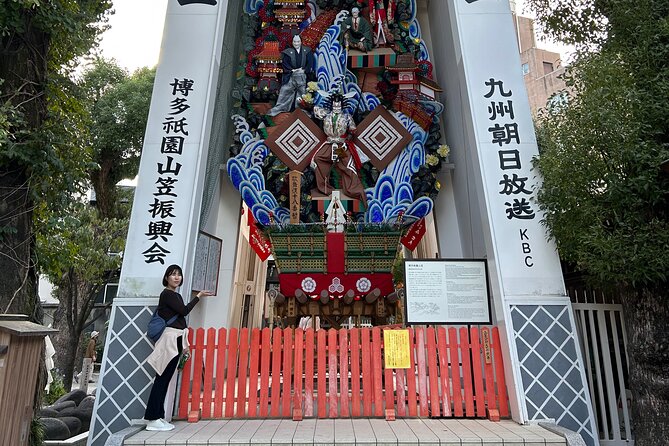
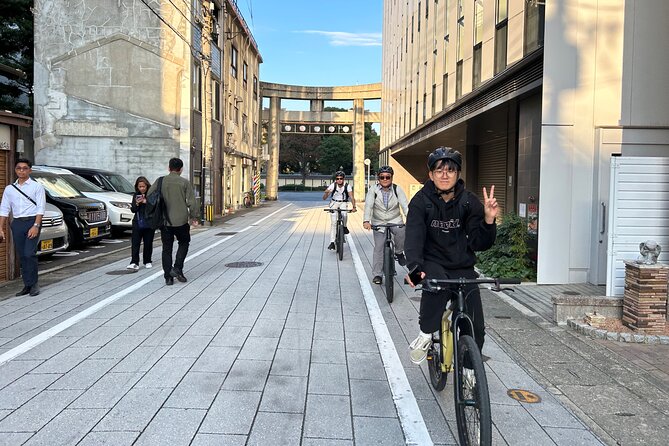
The final listed stop is Kushida Shrine, where you pause to pray for safety. The shrine is closely tied to Hakata and is described as a religious center that has gathered different traditions around the city’s local deity.
The planned visit is about five minutes. That makes it a compact closing stop, but it also brings the ride back to the place where the afternoon began. After seeing the castle town and park, you return to Hakata’s older side with a better understanding of how the districts relate.
For some people, five minutes will be enough for a quick visit and a prayer. If you want a detailed shrine tour, time to study every feature, or a long photographic stop, you may find this portion too short. The benefit is that Kushida Shrine works as a final marker rather than another long interruption.
The tour ends back at the meeting point. That simplifies the rest of your afternoon and avoids the need to arrange a ride from a distant neighborhood.
Guides, language, and group size
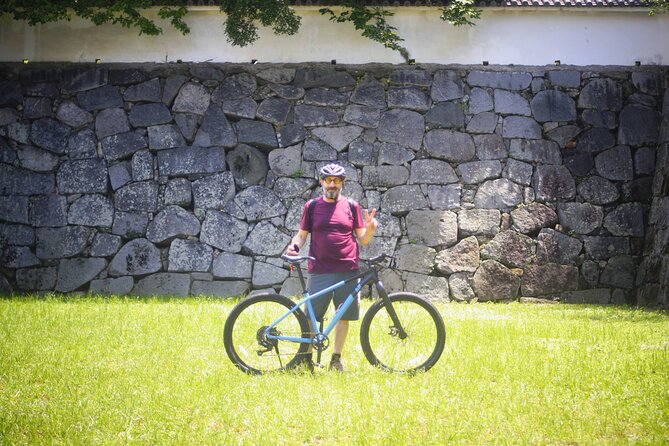
Haruka, also referred to as Haru in some tour comments, receives particularly strong praise. The useful qualities are not just historical knowledge. He is described as patient with older riders, alert to group safety, funny, and willing to adjust the pace.
English support is available, though the level may vary by departure. Some tours use a guide and interpreter together, and that pairing has been praised for making the explanations easy to follow. The activity is offered in Japanese and English.
The small-group limit of 10 helps. A cycling group can become awkward if it stretches across intersections or narrow lanes, so a compact group is safer and easier to manage. The guide also has a better chance of answering questions and checking that everyone is comfortable.
The tour is for ages 16 and older, with a stated minimum height of over 145 cm. You should also be able to ride a bicycle. The information specifically asks if you are over 140 cm and able to cycle, but the plan lists over 145 cm as the requirement, so I would use the stricter figure when deciding if the tour fits.
What the $72.26 price includes
At $72.26 per person, this is not the cheapest way to see Fukuoka. The value depends on how much you want from the afternoon.
The price includes:
- Bicycle rental
- Insurance
- Drinks
- Snacks
- Guide service
- The planned sightseeing route
You are paying for more than transportation. The guide connects the castle remains, park, temple, and shrine into one story, and the bicycle lets you reach them efficiently. If you were to rent a bicycle separately, plan your own route, and research the historical background, the price may look more reasonable.
The strongest value comes from the route design. Fukuoka Castle and Ohori Park are easy to connect, but adding Shofukuji and Kushida Shrine gives the ride a wider cultural range. You see old port-town traditions, castle history, Zen Buddhism, and a local shrine in a single half-day.
The price is less compelling if you already know Fukuoka well, prefer to travel independently, or want to spend a long time inside each attraction. This is a guided overview with active sightseeing, not a slow private exploration of every site.
Who will enjoy this ride most
I would recommend the tour to first-time visitors who want to understand Fukuoka’s layout quickly. It is also a good fit if you enjoy learning a city through movement rather than sitting on a bus.
You are likely to enjoy it most if you:
- Can comfortably cycle for roughly 17 km
- Like a relaxed but active afternoon
- Want historical context at each stop
- Prefer a small group
- Appreciate a guide who watches the pace and safety
- Want to see both Hakata and the castle area
- Have already spent time on foot and want to cover more ground
It can also suit older riders who are comfortable cycling. Haruka has adjusted the pace for seniors and included breaks, but you should still be honest about your stamina.
This is less suitable if you dislike cycling in city streets, have limited mobility, want a fully indoor activity, or need a tour with long unscheduled breaks. The activity depends on good weather, and cycling comfort matters more than simply being able to ride a short distance.
Weather, cancellations, and practical planning
The tour requires good weather. If poor conditions cause a cancellation, you are offered another date or a full refund. You can also cancel for a full refund if you do so at least 24 hours before the start time.
Changes or cancellations made less than 24 hours before the 1:00 p.m. start are not accepted for a refund. The cut-off follows local Fukuoka time.
Wear clothing that lets you pedal comfortably and prepare for an outdoor afternoon. The supplied details do not list a dress code or special equipment, but the included bicycle, insurance, drinks, and snack mean you do not need to arrange the basic cycling package yourself.
The mobile ticket is convenient, and the starting point is near public transportation. Still, I would arrive with time to spare. Kushida Shrine Station is the stated meeting location, and station exits can take longer to sort out than expected.
Should you book the Hakata Ride?
Book this tour if you want a clear introduction to Fukuoka’s two-part identity and like the idea of seeing the city from a bicycle. The best parts are the castle walls, Ohori Park, the calm pace, and the strong attention to safety from guides such as Haruka.
Skip it if you want a short, effortless sightseeing trip or several hours inside individual temples and shrines. At $72.26, the tour earns its price through the bicycle, insurance, refreshments, guide service, and carefully linked route. For a first afternoon in Fukuoka, it is a practical way to get your bearings while learning why Hakata and Fukuoka became one city.
FAQ
How long does the bike tour last?
The tour lasts approximately 3 hours and 30 minutes, from 1:00 p.m. to about 4:30 p.m.
Where does the tour start?
It starts at Kushida Shrine Station, 7 Gionmachi, Hakata Ward, Fukuoka, 812-0038, Japan.
Where does the tour end?
The activity ends back at the meeting point at Kushida Shrine Station.
How far do you cycle?
The ride is approximately 17 km.
Which places are included?
The route includes Fukuoka Castle remains, Ohori Park, Shofukuji Temple, and Kushida Shrine.
Is bicycle rental included?
Yes. Bicycle rental is included in the tour price.
Are drinks and snacks included?
Yes. The price includes drinks and snacks, including a break during the route.
What languages are available?
The tour is offered in Japanese and English. Some departures may include an interpreter.
Is there an age or height requirement?
The activity is for people aged 16 and older and lists a minimum height of over 145 cm. You must also be able to ride a bicycle.
What happens if the weather is poor?
The tour requires good weather. If it is canceled because of poor weather, you can choose another date or receive a full refund.
Newest rides we have reviewed in Japan
- Afternoon Adventure: Okinawa Local Cycling with Spectacular Views★ 5.0 · 92 reviews
- Zodiac Shrines and Naha Backstreets Cycling Tour★ 5.0 · 29 reviews
- Iya Valley BROMPTON Slow Cycling Tour★ 5.0 · 28 reviews
- eTour de Matsumoto – Electric Bike Tour★ 5.0 · 16 reviews
- ONLY YOU in the Bamboo Forest! 4 hours E-bike tour with a local★ 5.0 · 45 reviews
- South Kyoto in a Nutshell: Gentle Backstreet Bike Tour!★ 5.0 · 225 reviews
- Pedal Adventure Kyoto’s iconic landmarks on an e-bike tour★ 5.0 · 189 reviews
- The Beauty of Kyoto by Bike: Private Tour★ 5.0 · 47 reviews
Japan Cycling Tours, compared.
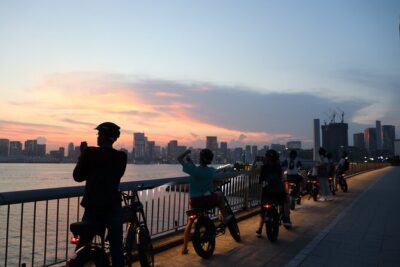

3h Tokyo E-Bike Tour: Hidden Gems, and Local Life with guide
Read our review →
Arashiyama Bamboo Forest & Hidden Gems Bike Tour (Early Bird)
Read our review →
Hiroshima in a Nutshell: Morning Bike Adventure
Read our review →Other lists this ride turns up in