
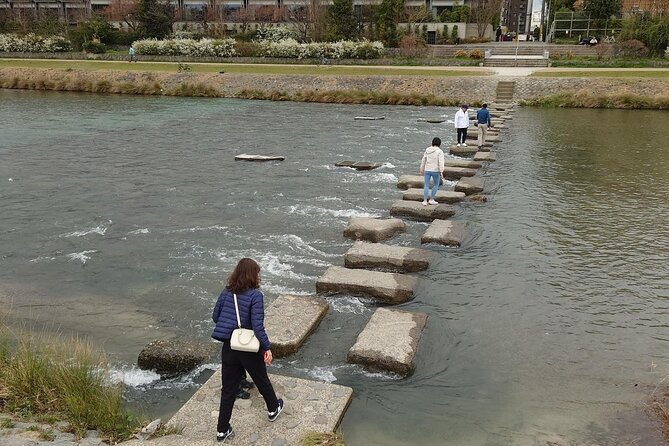
REVIEW · E-BIKE TOURS IN KYOTO
Start from Kyoto Station: Early Morning E-Bike Tour with Kyotoite
Kyoto is at its best before the day gets noisy. This early-morning e-bike ride lets you cover several major sights without squeezing onto a subway or walking long distances between them. You move from Fushimi Inari to Gion, Nanzen-ji, and Heian Shrine, with quieter backstreets and river paths tying the route together.
I like the small group of no more than six and the local feel supplied by guides such as Aki, Sato, and Ryuto. I also like that the bikes, helmets, water, raincoat, and liability insurance are already handled. The main drawback is that the tour still includes some hills and city riding, so it is not a completely effortless pedal.
Key points to know before you book
- Start near Kyoto Station: Meet at Kyoto Eco Trip Flagship shop on Higashikujo Muromachi, a practical starting point for an early ride.
- Fushimi Inari comes first: You reach Kyoto’s famous torii gates before the busiest part of the day.
- The route mixes icons and quiet streets: Gion back lanes, Miyagawa-cho, Tatsumi Bridge, and the Shirakawa River add local texture between major temples.
- Guides shape the experience: Aki, Sato, and Ryuto are praised for clear explanations, city navigation, photos, and helpful food suggestions.
- It is active but manageable: The ride is not described as strenuous, though some hills appear along the way.
- Everything ends where it starts: After Heian Shrine, you follow the Kamogawa River back to the rental shop.
Why an e-bike works so well in Kyoto
Kyoto’s main sights spread across a broad area. You can walk between a few of them, but doing the full circuit on foot takes time and leaves less energy for temples and neighborhoods. Public transport helps, yet subway and bus rides can feel like a poor trade when you are trying to see the city itself.
The e-bike gives you another option. You travel faster than a walker, but slowly enough to notice narrow lanes, traditional buildings, streams, and changing neighborhoods. The bike also makes it possible to link Fushimi Inari in the southeast with Gion, Nanzen-ji, and Heian Shrine farther north.
This is not a race. The advertised duration is about three hours and 30 minutes, including riding between stops. You are given time at the main sights, with roughly 50 minutes at Fushimi Inari and 20 minutes each at Nanzen-ji and Heian Shrine. The smaller stops and street sections fill in the spaces between the headline attractions.
The early start matters. The tour begins at 8:30 a.m. from January through February, and at 7:30 a.m. from March through June. That schedule puts you on the road before Kyoto’s most popular places reach their daytime peak. It also leaves much of the afternoon open.
More E-Bike Tours in Japan
- Hidden Kyoto E-Biking tour
★ 5.0 · 1,843 reviews - 5 Top Highlights of Kyoto Full Day Bike Tour (E-bike option)
★ 5.0 · 511 reviews - Kyoto: Memory Kyoto E-Bike Tour
★ 4.8 · 297 reviews
Meeting at Kyoto Station and getting set up
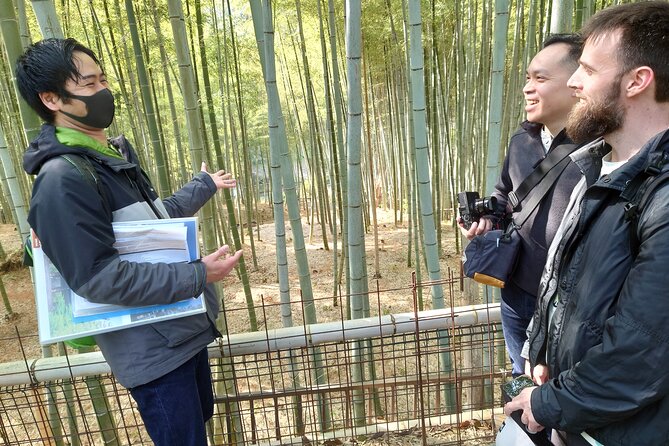
The meeting point is Rental Bicycle Kyoto Eco Trip Flagship shop at 58 Higashikujo Muromachi, in Kyoto’s Minami Ward. The tour ends at the same place, which keeps the logistics simple and means you do not need to arrange a separate return journey.
The price is $84.92 per person. That is not the cheapest way to see Kyoto, especially if you already know how to rent a bicycle and plan your own route. But the value improves if you want a guide, a planned route, included equipment, and a small group rather than a large sightseeing party.
Your fee includes the bicycle, helmet, bottled water, raincoat, and liability insurance. Snacks are not included, so eat before you arrive. An early start and several hours of cycling make breakfast a sensible part of your planning.
The bikes are described as traditional-style e-bikes that are not too bulky. The motor assistance should help with the route, but the ride still requires basic comfort on a bicycle. Some hills are part of the experience, and the activity is not designed for someone who wants to remain completely inactive.
Fushimi Inari before the torii gates fill up
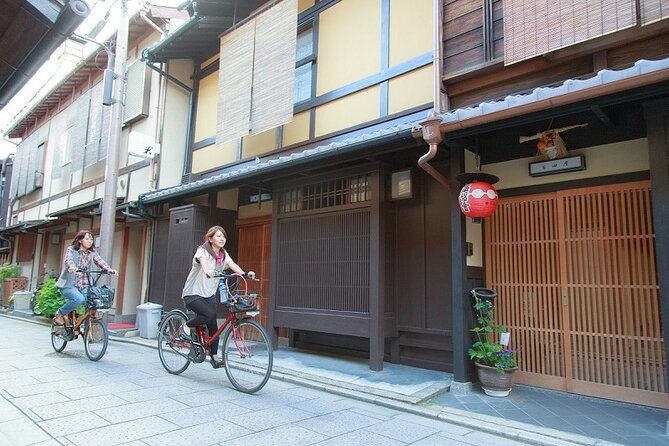
After about 20 minutes of riding from the shop, you reach Fushimi Inari-taisha, one of Kyoto’s essential stops. The shrine is famous for its thousands of orange torii gates, which climb through the wooded hills behind the main shrine grounds.
The tour allows about 50 minutes here. That gives you enough time to see the major approach, walk beneath a section of gates, and take photographs without trying to complete the entire mountain route. Fushimi Inari can occupy far more than an hour if you walk deep into the hills, so you should treat this stop as an introduction rather than a full exploration.
The early timing is one of the route’s best decisions. Fushimi Inari is popular throughout the day, and the torii-lined paths become harder to enjoy when packed with people. Arriving early gives you a better chance to see the shrine with fewer interruptions.
Your guide can also add context about Shinto practice and the meaning of the shrine. Ryuto, in particular, is praised for explaining Shinto, Buddhism, and Kyoto’s past in clear terms. The quality of this stop depends partly on your guide, but the small group makes it easier to ask questions.
Sanjusangendo adds a powerful indoor stop
About 15 minutes by bike from Fushimi Inari, the route passes through Sanjusangendo Temple. The temple is known for its 1,001 statues of Kannon, the Buddhist goddess of mercy, displayed inside the main hall.
The supplied timing does not specify a separate stop length or admission arrangement here, so you should not assume the same visit format as at the other listed sites. The itinerary presents Sanjusangendo as part of the route, giving you a chance to see this important Kyoto sight between Fushimi Inari and Gion.
This section is useful because it breaks up the outdoor riding. After the open shrine grounds and torii gates, Sanjusangendo offers a very different experience, centered on a large interior display and Buddhist art. If you are especially interested in the statues, ask your guide how much time is available before the group moves on.
More E-Bike Tours in Kyoto
- E-Bike Tours of the highlights of Kyoto!!!
★ 5.0 · 291 reviews - Kyoto: City Secrets eBike Tour
★ 4.9 · 196 reviews - Pedal Adventure Kyoto’s iconic landmarks on an e-bike tour
★ 5.0 · 189 reviews - Kyoto: Hidden Gems E-Bike Tour with Local Japanese Guide
★ 4.9 · 189 reviews
Gion by the Shirakawa River and old backstreets
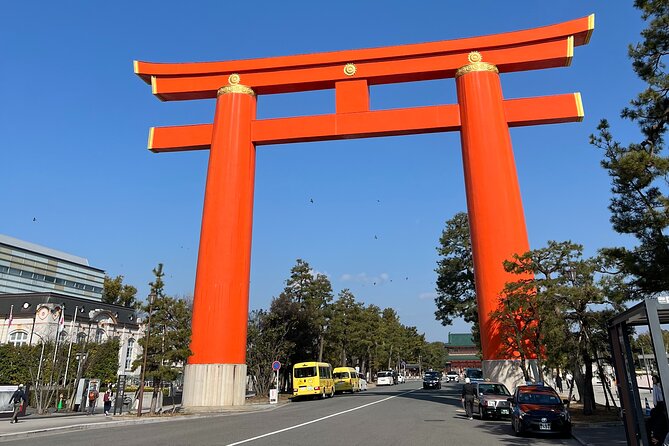
From Sanjusangendo, the ride takes about 10 minutes before following the Shirakawa River toward Miyagawa-cho and Tatsumi Bridge. This is one of the most appealing parts of the route because it shifts away from a checklist of famous monuments and into Kyoto’s older street fabric.
Miyagawa-cho and Gion are associated with Kyoto’s geisha districts. Tatsumi Bridge and the nearby lanes offer a more atmospheric look at the area than simply arriving at a major temple entrance. The route is designed to avoid as much pedestrian traffic as possible while still giving you strong views and explanations.
You should keep expectations realistic. Gion is not an open-air stage, and a bike tour cannot promise a private encounter with geisha or a completely empty street. What you get instead is a guided ride through an historic district, with the advantage of seeing small lanes and waterways that are easy to miss from a bus or taxi.
This is also where the guide’s navigation matters. City cycling requires attention, and a guide who knows the streets can keep the group moving while pointing out details along the way. Sato is praised for choosing a route that limited pedestrian trouble, while Ryuto is praised for handling the city confidently.
Nanzen-ji and the eastern foothills
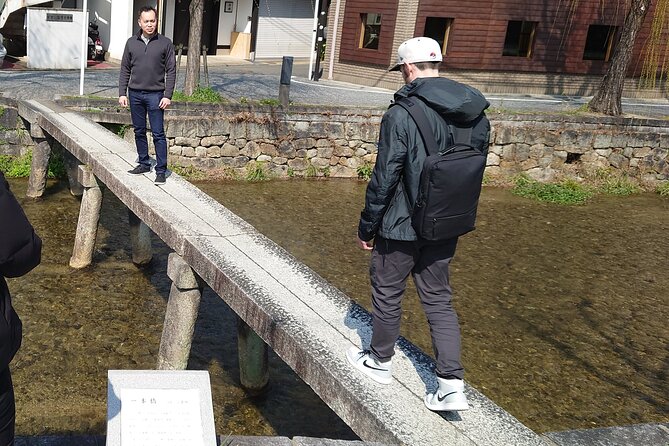
After about 15 minutes from Gion, you reach Nanzen-ji Temple. It is one of Kyoto’s major Zen temples, with broad grounds and a quieter setting near the eastern hills. The visit lasts about 20 minutes.
Nanzen-ji works well on this itinerary because it gives the ride a calmer middle section. Fushimi Inari is famous for its dense rows of gates, while Gion is defined by narrow streets and cultural associations. Nanzen-ji offers a more open temple setting and a chance to consider Zen architecture and gardens.
Twenty minutes is enough for an overview, not a detailed visit to every corner. If Nanzen-ji is high on your personal list, you may want to return later for a slower look. The tour’s aim is to connect several parts of Kyoto, not to provide a full temple study at each stop.
The route may include hills in this area. The e-bike assistance helps, but you should still expect to pedal and steer. One direct account describes the ride as not too strenuous while noting some hills, which is a useful description for most reasonably active riders.
Heian Shrine closes the sightseeing loop
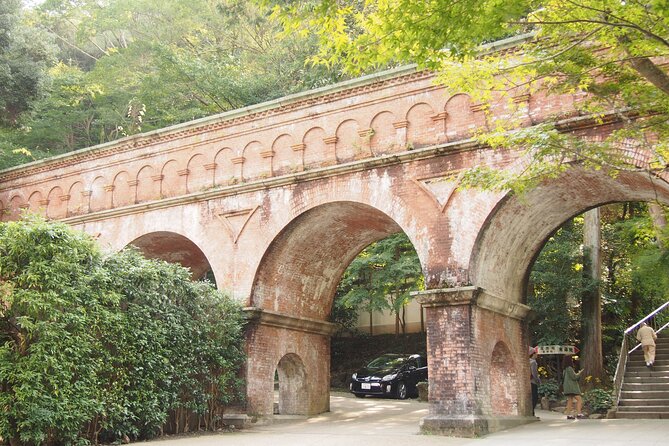
About 10 minutes after Nanzen-ji, the group reaches Heian-Jingu Shrine. The shrine is known for its large vermilion torii and broad grounds, and it represents Kyoto’s role as Japan’s capital for roughly 800 years.
The scheduled visit lasts about 20 minutes. That gives you time to take in the scale of the shrine and hear why it matters, though it is not enough for a slow visit to every garden area. The stop works as a visual change after Nanzen-ji, with a grander Shinto setting and a more spacious feel.
The route then follows the Kamogawa River for about 20 minutes back to the starting shop. This final stretch is more than simple transport. A river ride gives you a relaxed way to finish, and it avoids retracing the busiest streets.
What the guides add to the ride
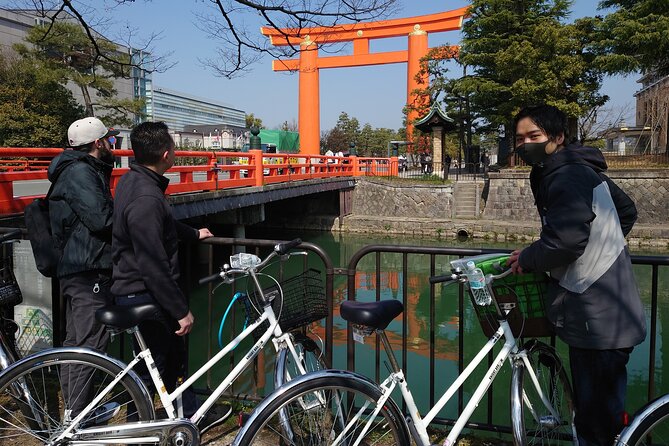
The guide can make or break a city cycling tour. Here, the strongest praise centers on local knowledge, friendly conversation, navigation, and photography. Aki is noted for taking family photos at several stops, a useful touch if everyone in your group wants to appear in the pictures.
Sato is described as kind and helpful with food suggestions after the tour. That makes the early finish practical. You can ask for ideas for lunch or snacks while the day is still young.
Ryuto receives especially strong praise for explaining Shinto, Buddhism, and Kyoto’s history, answering many questions, and managing the streets well. One group’s three-and-a-half-hour tour lasted almost four and a half hours, so the pace may sometimes stretch when conversation is lively. Do not count on extra time, but understand that a friendly guide may not rush you out at the exact minute.
The group limit of six is important. You can hear the guide more easily, ask questions without holding up a large crowd, and stay connected at intersections. Families with teenagers have found the format appealing, and the route suits people who want more explanation than a self-guided rental provides.
Price, pace, and practical limits
At $84.92, this is a guided sightseeing product rather than a simple bike rental. You are paying for the e-bike, helmet, water, raincoat, insurance, route planning, and a guide who knows how to connect distant sights.
I would consider it good value if you have only a short stay in Kyoto and want to cover several districts in one morning. It is also useful for families and small groups that want a shared activity with built-in explanations and photos.
I would think twice if you prefer to spend an hour or more inside each temple, dislike cycling in city streets, or already have a carefully planned Kyoto route. The itinerary moves at a steady pace, and the 20-minute temple visits are introductions rather than full explorations.
The tour is generally open to most participants, but the information does not give a specific fitness test, age rule, or accessibility arrangement. You should be comfortable riding a bicycle and prepared for some hills. Confirmation arrives at booking, and mobile tickets are available.
Free cancellation applies if you cancel at least 24 hours before the local start time. Changes or cancellations inside that window are not accepted for a refund.
Who should book this Kyoto e-bike tour
I would recommend it to first-time Kyoto visitors who want an efficient morning with real street-level movement. It suits families with older children and teenagers, couples, and small groups who like asking questions as they go.
It is also a good pick for visitors staying near Kyoto Station or anyone who wants to avoid starting the day on a crowded subway. The route gives you famous sights, but its best moments may be the connections between them: the Shirakawa River, Gion lanes, Miyagawa-cho, and the Kamogawa ride home.
I would skip it if your priority is a slow, solitary temple visit or if riding is uncomfortable for you. For everyone else, this is a smart way to get an early sense of Kyoto, with enough structure to save planning time and enough local detail to keep the morning from feeling like a simple photo circuit.
FAQ
Where does the Kyoto e-bike tour start?
It starts at Rental Bicycle Kyoto Eco Trip Flagship shop, 58 Higashikujo Muromachi, Minami Ward, Kyoto, 601-8001, Japan.
Where does the tour finish?
The tour ends back at the same meeting point near Kyoto Station.
How long does the experience last?
The advertised duration is approximately three hours and 30 minutes, including travel time between stops.
How many people can join?
The tour has a maximum of six participants.
What sights are included?
The route includes Fushimi Inari-taisha Shrine, Sanjusangendo Temple, Miyagawa-cho, Tatsumi Bridge, Gion, Nanzen-ji Temple, Heian Shrine, and the Kamogawa River.
Is the bicycle included?
Yes. Use of the bicycle is included in the price.
Is a helmet provided?
Yes. A helmet is included.
Is bottled water included?
Yes. Bottled water is provided. Snacks are not included.
What happens if it rains?
A raincoat is included as part of the tour equipment.
What is the cancellation policy?
You can cancel at least 24 hours before the local start time for a full refund. Cancellations or changes made less than 24 hours before the start are not accepted for a refund.
Newest rides we have reviewed in Kyoto
- ONLY YOU in the Bamboo Forest! 4 hours E-bike tour with a local★ 5.0 · 45 reviews
- South Kyoto in a Nutshell: Gentle Backstreet Bike Tour!★ 5.0 · 225 reviews
- Pedal Adventure Kyoto’s iconic landmarks on an e-bike tour★ 5.0 · 189 reviews
- The Beauty of Kyoto by Bike: Private Tour★ 5.0 · 47 reviews
- Kyoto Bamboo Forest & Golden Pavilion E-Bike Tour★ 5.0 · 50 reviews
- Kyoto Shogun Cycling Tour★ 5.0 · 13 reviews
- Secret Eastern Kyoto Biking Adventure★ 5.0 · 44 reviews
- Arashiyama Bamboo Forest E-Biking Tour★ 5.0 · 183 reviews
E-Bike Tours, compared.

3-Hour Porto Highlights on a Electric Bike Guided Tour
Read our review →
Hills, Alfama, and Mouraria Tour by Electric Bike
Read our review →
Athens Scenic Electric Bike Tour with optional Acropolis visit
Read our review →
City Highlights 3-Hour Guided Electric Bike Tour
Read our review →
Rome EBike Tour: Appian Way, Catacombs & Roman Aqueducts
Read our review →
Top Highlights & Hidden Gems Tour by Cannondale E-Bike
Read our review →Other lists this ride turns up in