REVIEW · CYCLING TOURS
Bucharest: Communist Bike Tour
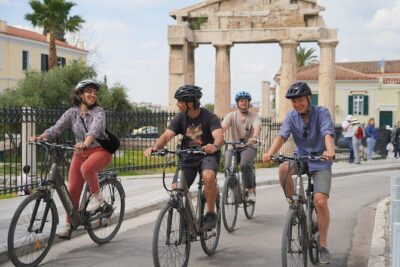
Bucharest’s communist past is too spread out for a tidy walking tour. This four-hour bike ride connects the Old Town, Coral Temple, the first Romanian parliament, a Stalin-era district for Soviet officials, Casa Radio, and Revolution Square into one clear story. It shows not just grand buildings, but how power reshaped daily life and the city itself.
I like the way cycling gives you a much wider view than a standard central walking tour. I also like the guides’ broad approach: Horia has covered everything from the communist period to Bucharest’s founding, the Orthodox Church, and modern city life, while Alex has explained the political and economic setting behind the buildings. The main drawback is simple: you need to feel comfortable riding a bicycle through city traffic.
Key points to know before you book
- The route links several distant communist-era sites: You cover more ground than on foot, including Casa Radio and Revolution Square.
- Coral Temple adds an unusual angle: The stop connects Bucharest’s Jewish community with the early communist movement of the 1920s.
- The first Romanian parliament is tied to a bombing: You visit the site of the communist attack against the democratic government.
- The Soviet period gets its own chapter: The route passes the former neighborhood of Russian army generals who helped rule Romania.
- The final stop is Revolution Square: You finish at the former Communist Central Committee, where Ceaușescu gave his last speech and the December 1989 uprising began.
- The $53 price buys a full half-day outing: Bikes, helmets, locks, and a live English-speaking guide are included, but food and drinks are not.
Why a bicycle suits Bucharest’s communist story
Bucharest is a large city with communist landmarks scattered across its central districts. A walking tour can explain the Old Town well, but it would struggle to reach the former elite neighborhood, Casa Radio, and Revolution Square in a useful four-hour route.
The bicycle solves that problem. You can move between areas while keeping the city around you as part of the lesson. Instead of seeing one isolated monument, you notice how streets, institutions, housing, and grand public projects fit together.
This is not mainly a sightseeing ride for pretty views. The point is to understand how the communist period damaged parts of historic Bucharest, altered important buildings, and left behind projects that were never completed. You will spend time listening, then cycling, then listening again.
The tour begins across from Hanu’ Berarilor, also known as Casa Oprea Soare, in or near the old city center. You receive a bicycle, helmet, and lock as part of the $53 price. Comfortable shoes are the only stated item to bring, though you should also dress for several hours of riding.
More Cycling Trips in the world:
- Lion City Bike Tour of Singapore
★ 5.0 · 6,211 reviews - Big Bike tour Amsterdam – See all in 3 unforgettable hours
★ 4.7 · 4,929 reviews - 3-Hour Porto Highlights on a Electric Bike Guided Tour
★ 5.0 · 4,392 reviews
Bucharest’s Old Town and the cost of communist rebuilding
The first section looks at the Old Town and the damage done to this historic area during the communist period. Your guide gives the wider setting before the route moves into its more specific political stops.
That opening matters because it keeps the tour from becoming a parade of disconnected buildings. You begin with the city’s older identity, then see how communist planning and redevelopment weakened parts of it. The contrast between historic Bucharest and the later political order gives the rest of the ride a useful frame.
Do not expect every corner of the Old Town to be presented as a preserved museum district. The tour’s point is that the area suffered serious disruption. Your guide can show how communist decisions affected the character of the center, rather than treating the old streets as scenery alone.
I especially like this start for first-time visitors. It gives you an outline of Bucharest before the tour moves into more specialized political history. One past participant described the ride as a good way to begin a city visit because it offered useful context for the rest of the stay.
Coral Temple and the early communist movement
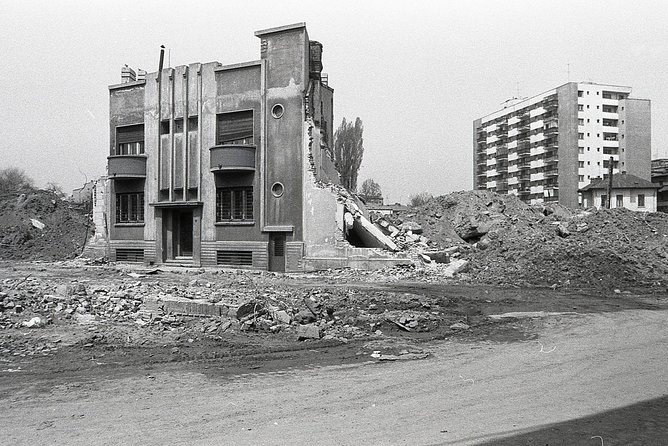
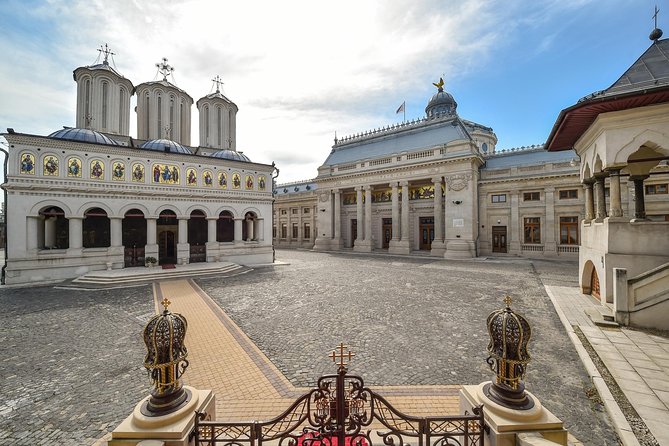
The next stop is Coral Temple. This is an unusual choice, and it gives the route a social and political dimension that many city tours skip.
The Jewish community is presented as one of the groups involved in initiating the communist movement in Romania in the early 1920s. That does not reduce the story to one community or one building. Instead, it points you toward the complicated political currents that existed before the Soviet occupation and the later communist state.
The stop also reminds you that Romanian communism did not simply appear after the Second World War. The tour separates the early movement from the later period of Soviet control, allowing you to follow the change from political activism to a state backed by occupation and power.
Coral Temple is valuable because it widens the story beyond Ceaușescu. If you only associate Romanian communism with the 1980s, this stop helps you see that the roots go back much earlier.
The first Romanian parliament and the bombing
The route continues to the site connected with the first Romanian parliament. This is one of the tour’s sharper moments: you hear about the communist bomb attack against the democratic Romanian government.
That event gives physical meaning to the political conflict. Rather than discussing ideology in the abstract, you are brought to a place associated with an attempt to strike at Romania’s democratic institutions.
The wording of the historical story matters here. The tour treats this as part of the early communist period, before Romania’s long Soviet-backed rule. You therefore get a useful sequence: the movement’s early activity, the attack on the democratic government, and then the postwar occupation that changed the country’s direction.
This stop may be more rewarding for you if you like political history and cause-and-effect stories. If you prefer only architectural sights, it may feel less immediately visual. The value is in the explanation from the guide, not simply in looking at a building.
Same roads, a different saddle:
- Ninh Binh Full-Day Tour from Hanoi to Hoa Lu, Tam Coc & Mua Cave Via Boat & Bike
★ 5.0 · 4,384 reviews - Small Group Guided Bike Tour of Amsterdam’s Hidden Gems
★ 5.0 · 3,936 reviews - 3-hour Complete Prague Bike Tour
★ 5.0 · 3,674 reviews - Bangkok: Temples, Canals & Local Life Bike Tour
★ 4.9 · 3,511 reviews
The Soviet occupation and the generals’ district
After the early communist period, the tour moves to the years after the Second World War, when Romania was occupied by the Soviet Union for 12 years. The route passes through the neighborhood where Russian army generals in charge of ruling the country lived.
This section helps explain how control worked in practice. You are not only hearing that Romania came under Soviet influence. You are seeing the kind of district associated with the people who helped direct that new order.
The neighborhood was built for communist elites during the Stalin era. That makes it an important contrast with the public promises of equality often linked with communist politics. The existence of a special district for senior officials shows how rank and privilege operated inside the system.
I find this part particularly useful because it connects policy with place. An elite neighborhood is not just a collection of residences. It shows who had power, who received better housing, and how the new political class made itself visible in the city.
The supplied route information does not give a precise distance or cycling difficulty for this stretch. Still, the full four-hour timing tells you to expect a substantial ride, not a short spin between nearby monuments. If you are unused to city cycling, this is the section where your comfort and stamina will matter.
Casa Radio and the unfinished ambition of communism
One of the major sights on the route is Casa Radio, described as the biggest unfinished communist urban project. It is a strong example of the gap between grand plans and lived reality.
Large communist projects were meant to reshape cities on a dramatic scale. When such a project remains unfinished, the result says something about the limits of the system as well as its ambition. Casa Radio lets you consider the money, labor, planning, and political will that went into these schemes, and what it means when the promised future never arrives.
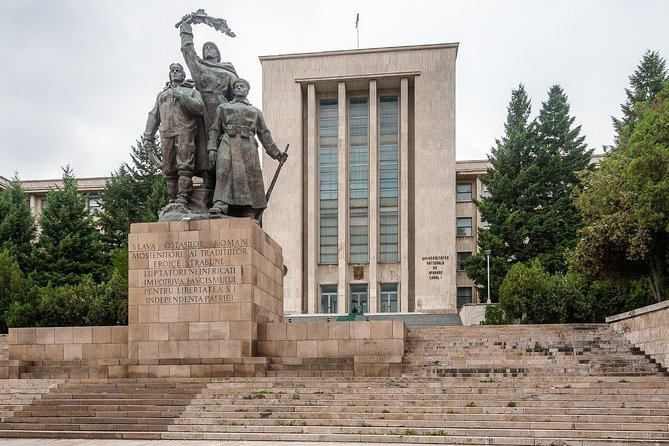
The tour also refers to the National History Museum in connection with buildings completely reshaped by the communist regime during its strongest period. The supplied description places this late section of the route alongside Casa Radio and the museum, so your exact viewing point may depend on the day’s route and guide’s explanation.
This part is not simply about admiring architecture. You are looking at buildings as evidence of political priorities. The guide’s job is to explain how the regime used urban construction to display authority, redirect movement, and replace older parts of Bucharest with its own vision.
For me, this is where the bicycle format earns its price. You can reach a major unfinished project and connect it with other altered buildings in the same half-day. On foot, that would take more time and energy, leaving less room for explanation.
Revolution Square and Ceaușescu’s final speech
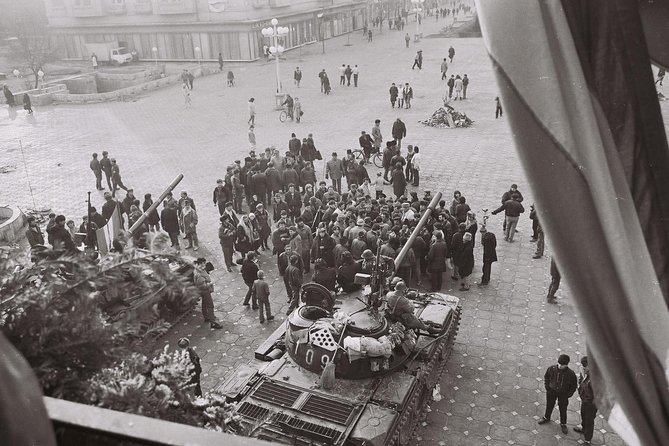
The last stop is Revolution Square, in front of the former Communist Central Committee. This is the emotional and political endpoint of the tour.
Ceaușescu held his last speech here, and the December 1989 Revolution began at this site. The square therefore links the final years of communist rule with the moment the system began to collapse.
Ending here gives the tour a clear shape. You start with the effect of communism on historic Bucharest, move through the movement’s early roots and Soviet control, then finish at the end of Ceaușescu’s rule. The route covers decades without pretending that every part of the story can be explained in one sentence.
You may want to spend extra time in the square after the tour ends, but the supplied information does not promise a separate free period or a guided visit inside a building. The experience is focused on the outdoor route and the guide’s interpretation.
Revolution Square is also a useful place to return later on your own. After hearing the story, you will understand why this location matters beyond its appearance.
What the guides add to the ride
The guide makes a major difference on this tour because many of the stops need explanation. The activity is offered in English, with a live guide. Horia led several outings, and Alex is another named guide associated with the experience. Chorea is also mentioned in connection with a stop across Bucharest, though the spelling of that name may vary in the booking information.
Horia’s approach has included more than communist history. You might hear about Bucharest’s founding days, the Orthodox Church, and city life today. That wider context is useful because Romania’s communist period did not happen in isolation.
Alex’s style has included historical, economic, and political background, as well as information about different population groups. That matters when a building alone cannot explain why it exists or who it served.
You should not book this expecting a silent ride with occasional facts. The guide is central to the experience. The best use of your time is to listen closely at each stop, ask questions when the group pauses, and treat the cycling sections as links between chapters.
Is $53 a fair price for four hours?
At $53 per person, this is not the cheapest way to see central Bucharest. It is a reasonable price if you want a guided half-day route with equipment included and prefer to cover several districts in one outing.
The value comes from four things:
- You get four hours rather than a quick introductory ride.
- A live English-speaking guide provides political and historical context.
- The bicycle lets you reach more sites than a walking tour.
- A bike, helmet, and lock are included.
Food and drinks are not included, so plan around that. The tour is long enough that you may want water or a meal before or after, but the provided information does not list a scheduled food stop. One outing did include a pit stop across Bucharest, though you should not treat that as a guaranteed meal or refreshment arrangement.
The price makes the most sense for a first or second day in Bucharest. You get a working map of the city and a historical framework that can improve later visits to museums and neighborhoods.
Who should book this Communist Bike Tour?
I would recommend it to you if you:
- Are comfortable riding a bicycle in dense city traffic.
- Want to understand Bucharest rather than only photograph it.
- Have an interest in twentieth-century political history.
- Prefer a half-day activity that combines movement and explanation.
- Want to see sites spread across the city without arranging separate transport.
- Are starting a Bucharest visit and want useful orientation.
I would hesitate if you have limited mobility, cannot ride comfortably for several hours, or strongly dislike urban cycling. The tour is specifically not recommended for people with mobility impairments.
It also may not suit you if your main goal is a relaxed food tour, an interior museum visit, or a short scenic ride. Food and drinks are not included, and the emphasis is historical interpretation.
Practical details for a smoother ride
Meet across from Hanu’ Berarilor, Casa Oprea Soare. Check the available starting time when booking, since the tour runs for four hours and the exact departure time is not fixed in the supplied information.
Wear comfortable shoes. Bikes, helmets, and locks are provided, so you do not need to arrange those separately. Since the route passes through city streets, choose clothing that lets you pedal and listen comfortably.
The activity is in English. The booking terms allow free cancellation up to 24 hours before departure for a full refund, and you can reserve now and pay later. Those options are useful if your Bucharest schedule is still changing.
The overall rating is 4.8 from 15 ratings, with repeated praise for the guides, the amount of context, and the way cycling makes it possible to cover more of the city. The strongest pattern is clear: this is valued as an informative city orientation, not merely as a bicycle rental with a few stops.
Should you book it?
Book this tour if you want Bucharest’s communist past explained through real places, and if you are happy to ride in city traffic for four hours. The combination of Coral Temple, the first Romanian parliament, the Soviet generals’ district, Casa Radio, and Revolution Square gives you a wider story than a single palace or square can offer.
Skip it if cycling is difficult for you or if you want a slow walking tour with lots of indoor visits. For everyone else, $53 is a fair buy for the distance covered, the included equipment, and the guide-led context. I would choose it early in a Bucharest stay, then use the rest of the visit to return to the places that caught your attention.
FAQ
Where does the Bucharest Communist Bike Tour meet?
The meeting point is across from Hanu’ Berarilor, also known as Casa Oprea Soare.
How long does the bike tour last?
The tour lasts four hours.
What language is the tour offered in?
The live guided tour is offered in English.
What equipment is included?
A bicycle, helmet, and bike lock are included in the ticket price.
What should I bring?
Bring comfortable shoes. Food and drinks are not included.
Which major places does the route visit?
The route includes Bucharest’s Old Town, Coral Temple, the site of the first Romanian parliament, a Stalin-era neighborhood for communist elites, Casa Radio, the National History Museum area, and Revolution Square.
Is the tour suitable for people with limited mobility?
No. The tour is not recommended for people with mobility impairments.
Can I cancel the booking?
Yes. You can cancel up to 24 hours in advance for a full refund. You can also reserve now and pay later.
Newest rides we have reviewed in the world
- Ljubljana by E-Bike: Guided City Highlights Tour★ 4.8 · 28 reviews
- London Christmas Lights Bike Tour★ 4.5 · 70 reviews
- Lisbon: Portuguese Petiscos Tasting Tour by E-Bike★ 5.0 · 16 reviews
- Liverpool: The Beatles Tour on Electric Pedal-Assist Ebikes★ 5.0 · 17 reviews
- Lisbon Bike Tour: Langs de rivier van Belém naar Lissabon★ 4.7 · 59 reviews
- Lisbon: E-Bike Adventure Through the City of Seven Hills★ 5.0 · 28 reviews
- Lisbon: 7 Hills Panoramic Guided Tour by E-Bike★ 4.8 · 50 reviews
- Lisbon: Guided E-Bike Tour to Belém★ 4.8 · 115 reviews
Tours, compared.
Big Bike tour Amsterdam – See all in 3 unforgettable hours
Read our review →
3-Hour Porto Highlights on a Electric Bike Guided Tour
Read our review →
Small Group Guided Bike Tour of Amsterdam’s Hidden Gems
Read our review →
Hills, Alfama, and Mouraria Tour by Electric Bike
Read our review →