
REVIEW · E-BIKE TOURS IN ATHENS
Ancient Athens E-Bike Tour
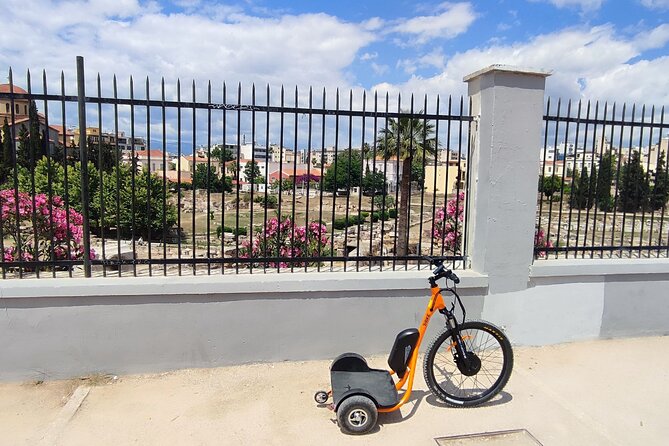
Athens has a lot of ancient ground packed into a small area, and this tour gives you a fast way to connect the pieces. You ride a motorized standing trike, not a conventional bicycle, so there is no pedaling and much less effort on hot streets. In roughly two hours, you reach the Acropolis area, Pnyx, the Agora, Kerameikos, Plaka, and more.
I like the small group size, capped at 12 people, and the way guides such as Dimitris adjust the route around places you have already seen. I also like the practical design: helmet, insurance, and an electric motor let you cover hills and longer stretches without using up your energy for the rest of the day.
The main consideration is that this is a sightseeing ride, not a full archaeological visit. You see the sites from nearby and may enter some areas, but admission tickets are generally separate, and the short stops leave little time for a close look at every monument.
Key points to know before you book
- A motorized standing trike covers Athens without pedaling, a useful advantage in summer heat and on hilly streets.
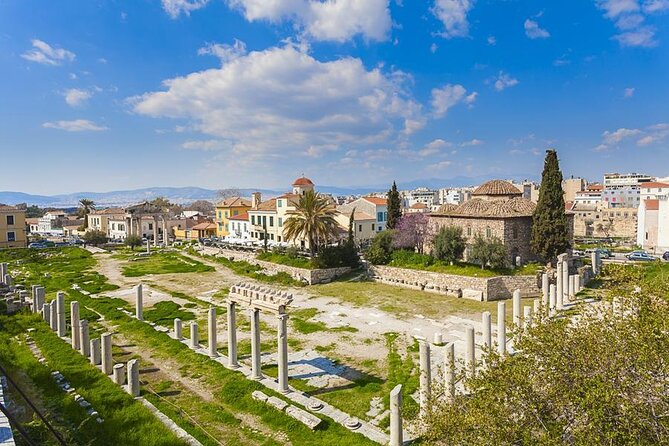
- The route links the Acropolis, Pnyx, Ancient Agora, Kerameikos, Roman Agora, Plaka, and Monastiraki in one compact outing.
- Dimitris is one of the named guides associated with the experience, and the tour can be adjusted around sights you have already visited.
- The group is limited to 12 people, giving the guide room to explain the city and help riders feel comfortable.
- The tour lasts about two hours, so it works best as an orientation ride or a first look before returning to the sites you want to explore properly.
- Archaeological admission is not generally included, so budget extra if you want to enter the Acropolis or other ticketed areas.
Why an electric trike works well in Athens
Athens is walkable in theory, but the ancient center includes slopes, uneven pavement, crowded lanes, and long open stretches with little shade. In warm weather, a short ride can save your legs for the Acropolis itself.
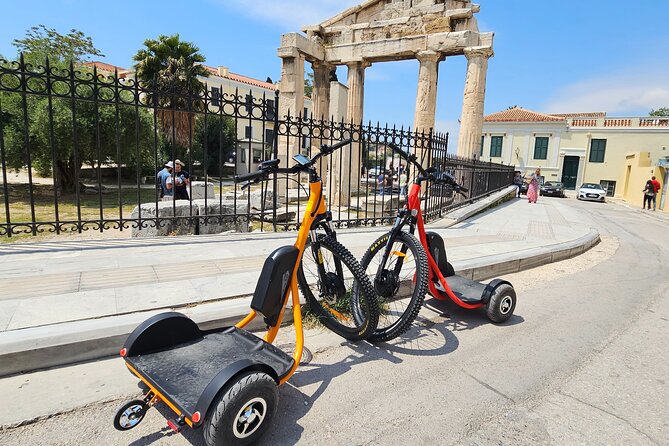
These vehicles are described as standing e-bikes, though the experience is closer to riding a motorized tricycle. You do not pedal. That matters because the route includes the hills around the Acropolis and Pnyx, along with several stops spread across the old city.
You will receive a helmet, and the tour includes customer insurance. Most people can participate, but you should still be comfortable standing and riding in an urban setting. The provider emphasizes ease and safety, while several tour accounts describe the trikes as quick to learn.
The format also gives you a better view than a car or enclosed vehicle. You are close to the street, so you can take in the stone lanes around Plaka, the open spaces near the ancient sites, and the busy squares of central Athens. The tradeoff is that you are exposed to the weather, and the tour requires good conditions to operate.
More E-Bike Tours in Athens
- Athens Scenic Electric Bike Tour with optional Acropolis visit
★ 5.0 · 3,350 reviews - Athens: City Electric Bike Tour with Acropolis Visit Option
★ 4.9 · 1,017 reviews - Athens Small Group E-Bike Tour
★ 5.0 · 1,013 reviews
Starting near the Acropolis at Leoforos Andrea Siggrou 22

The meeting point is at Leoforos Andrea Siggrou 22, Athens 117 42, near public transportation. The tour runs Monday through Saturday, with listed departures between 10:00 a.m. and 4:00 p.m.
This location works well for a first-day introduction because it places you close to the Acropolis district. You return to the same meeting point at the end, which makes planning easier. You do not need to arrange a separate ride across the city afterward.
Allow a little time before departure to get oriented, meet the guide, and become comfortable with the trike. The short training period is important, especially if you have never used this type of vehicle. A good guide will help you settle in before the group moves into busier streets.
Dionysus Theatre and the Odeon of Herodes Atticus
The first part of the route focuses on the southern side of the Acropolis. The Theatre of Dionysus is traditionally associated with the beginning of Western theatre and was one of the most important performance spaces in ancient Greece.
You will not get a full theatre visit in a short outdoor stop, but seeing the site gives useful context before you explore the Acropolis. The theatre is included in the Acropolis Hill ticket, listed at 20 euros.
Nearby, the Odeon of Herodes Atticus is a Roman-era theatre still used for performances. Herodes Atticus built it in the second century A.D. as a memorial for his wife. Its curved seating and dramatic position beneath the Acropolis make it one of the city’s most memorable views from street level.
The Odeon is also included in the Acropolis Hill ticket, listed at 20 euros. The tour allocates about 10 minutes here, so think of this as a guided introduction rather than time to examine every detail.
Seeing the Acropolis without climbing the hill
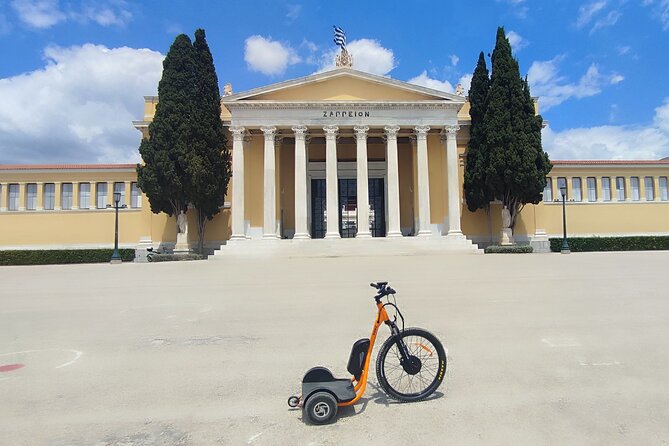
The tour brings you close to the Acropolis and gives you a clear view of the rock and the Parthenon above. This is useful if you want to understand how the ancient center fits together before committing several hours to a full visit.
The important distinction is that you are not taking the place of an Acropolis admission. The tour shows you the hill from a nearby position, while a separate visit lets you pass through the gates and spend time with the Parthenon, Propylon, Erechtheion, and other monuments.
The Acropolis Hill ticket is listed at 20 euros, but admission is not included in the tour price. Check the conditions when booking, since ticket rules and prices can change.
I would use this ride as an orientation. If the Acropolis is your main reason for visiting Athens, keep another part of the day free for the full archaeological site. The trike tour helps you locate it and understand its setting, but it cannot replace the climb.
More E-Bike Tours in Greece
- Historic Athens: Small Group Electric Bike Tour
★ 4.9 · 966 reviews - Athens Electric Bike Tour
★ 5.0 · 836 reviews - Athens: Discover the City Electric Bike Tour
★ 4.9 · 544 reviews - Athens: 2-Hour Highlights Tour by E-Bike After Sunset
★ 4.9 · 532 reviews
Pnyx and the origins of democracy
The route then reaches Pnyx, one of the most meaningful stops in the city. This hill is linked with the early practice of democracy, and it sits inside an archaeological area that also functions as a green open space.
The stop lasts about 15 minutes and is free. Its value is less about a perfect monument and more about the idea attached to the place. You are looking at a setting connected with public meetings and civic life, while the guide explains why this hill mattered to ancient Athens.
This is also one of the places where the electric trike earns its keep. The Pnyx is not always on a first-time walking route, especially when visitors are focused on the Acropolis. A ride makes it easier to include without turning your morning into a long uphill trek.
The National Observatory and the Hill of the Nymphs

The National Observatory of Athens is the city’s first observatory, located on the Hill of the Nymphs. Like Pnyx, the hill forms part of an archaeological area and park.
The scheduled stop lasts about 15 minutes, and admission is included. The observatory adds a different note to the ancient circuit. Instead of another temple or market, you get a place connected with astronomy and the later scientific life of Athens.
Do not expect a long indoor tour based on the information provided. The appeal here is the hill, the setting, and the guide’s explanation of how the area fits into the city’s story.
Ancient Agora, the heart of civic life
The Ancient Agora is one of the strongest stops on the route. It was the main market and public center of ancient Athens, so it helps you picture daily life beyond the grand temples.
You have about 20 minutes here. That is enough for an introduction and perhaps a short look around, but not enough for a detailed archaeological visit. If you want to study the site, budget a separate entry and return later.
The Ancient Agora ticket is listed at 4 euros. The tour information describes admission here as included in the route, but the general conditions also say archaeological tickets are not included. Treat the 4-euro ticket as an extra cost unless your booking confirmation clearly says otherwise.
This stop is especially useful after Pnyx. The two places show different sides of Athenian public life: one linked with political meetings and the other with commerce, administration, and everyday activity.
Kerameikos, a quieter archaeological corner
Kerameikos is close to the Ancient Agora and has a more restrained feel than the major squares. The name comes from the pottery production once associated with the area.
The stop lasts about 10 minutes and is free according to the tour details. That short time makes it a quick introduction rather than a complete visit.
I like having this stop in the route because it adds a neighborhood and working-life angle to the better-known monuments. You are not only seeing royal or religious remains. You are also passing through an area tied to production and the ordinary business of an ancient city.
Monastiraki and the modern pulse of Athens
Monastiraki is described as one of Athens’ busiest squares and a central meeting point, surrounded by restaurants, bars, and other choices. The tour gives you about 10 minutes here.
This is not an archaeological stop in the same sense as the Agora. Its value is modern Athens. After several ancient sites, Monastiraki shows you how the old center functions today, with people moving through the square and businesses filling the surrounding streets.
Admission is listed as included, though there is no normal archaeological ticket for simply passing through the square. Your guide can help connect the modern street scene with the older parts of the city.
The trike is handy here because Monastiraki can be crowded. You should expect a slower pace and careful movement, not a fast ride through the square. The guide’s role matters most in this part of the route.
Roman Agora and the Tower of the Winds
The Roman Agora was built in the second century A.D. as a later counterpart to the Greek Agora. Its best-known feature is the Tower of the Winds, an ancient structure connected with time, weather, and measurement.
The planned stop is about 10 minutes. The ticket price is listed at 4 euros, although the itinerary also marks admission as free, while the general tour information says archaeological tickets are not included. Again, confirm the admission arrangement before setting your budget.
This is a good example of why the tour works better as a sampler than a full site visit. You see several important places in one outing, but the guide has to keep moving. If the Roman Agora or Tower of the Winds catches your interest, make a note and return on foot later.
Plaka, Athens with an island feel
Plaka is the final major neighborhood stop, a traditional district in the center of Athens with narrow streets and a look that can remind you of a Greek island.
The tour allows about 10 minutes here. That is enough to see the character of the area and hear how it fits into the old city, but not enough for a relaxed meal or extended shopping. You can easily return after the tour, since Plaka sits close to the Acropolis and other central sights.
This is a pleasant finish because it shifts the mood from archaeological remains to lived-in Athens. You get the stones, slopes, cafes, and residential lanes that make the city feel like more than an open-air museum.
What the two-hour schedule really gives you
A two-hour tour covering this many stops moves at a brisk pace. Most locations receive 10 to 15 minutes, with about 20 minutes at the Ancient Agora. You will hear explanations, see the main setting, and learn where to return.
You will not have time to linger at every site. Photography, a full archaeological inspection, and long visits inside the monuments belong on another part of your schedule.
The benefit is range. In one short ride, you connect ancient theatre, Roman architecture, democracy, commerce, science, burial and pottery areas, modern squares, and traditional neighborhoods. That is a lot of Athens in a small block of time.
Guides including Dimitris are described as willing to change the route based on what you have already seen. That flexibility is valuable. Tell the guide at the start if you have already visited the Acropolis, Plaka, or another major stop.
Price, group size, and overall value
The listed price is $72.09 per person. That is not a cheap way to move around Athens, especially since archaeological admission can cost extra. The value depends on how much you want a guide, how much walking you want to avoid, and how limited your time is.
For a first visit, the tour can replace a taxi between several scattered points while giving you historical context along the way. It is also useful in hot weather, when the ability to reach hills without pedaling can make a real difference.
The maximum group size is 12. That is small enough for questions and personal attention, though it is not a private tour. The strongest value comes when the guide adapts the experience to your interests rather than simply reciting facts at each stop.
Families may find the trikes appealing. The experience has been used by groups with children aged 9, 12, 13, and 15, and the electric design avoids the effort of ordinary cycling. Still, every rider should be comfortable following instructions and moving through city streets.
Weather, cancellation, and planning tips
The experience requires good weather. If poor conditions cancel the tour, you will be offered another date or a full refund.
You can cancel for a full refund up to 24 hours before the start time. Changes or cancellations inside that 24-hour window are not accepted for a refund.
The ride is offered in English. Confirmation arrives at booking, and the activity is near public transportation. Since the route is outdoors, wear practical shoes and clothing suited to the forecast, even though you will not be walking the entire route.
I would book this near the start of your Athens stay. The tour gives you a map in your head. Later, you can return to the Acropolis, Ancient Agora, Roman Agora, or Plaka with a better sense of where each place sits.
Who should book the Ancient Athens E-Bike Tour?
Book it if you want a quick, guided introduction to central Athens and prefer to save your legs for the sights. It is a good fit for first-time visitors, families, people traveling in warm weather, and anyone who wants to cover several ancient locations without a long walking circuit.
It is less suitable if you want extended time inside archaeological sites or a quiet, unhurried experience. The tour moves quickly, and several stops are brief.
For the best value, treat it as an orientation ride rather than your only Athens sightseeing. Use the guide, especially Dimitris if he leads your departure, to identify the places worth revisiting. If you are happy with that approach, the electric trike offers an efficient and enjoyable way to get your bearings in the ancient center.
FAQ
How long does the Ancient Athens E-Bike Tour last?
The tour lasts approximately two hours.
Where does the tour start?
It starts at Leoforos Andrea Siggrou 22, Athina 117 42, Greece.
Where does the tour finish?
The activity ends back at the meeting point.
What type of vehicle is used?
You use a standing electric trike, also described as a motorized tricycle. No pedaling is required.
Is a helmet provided?
Yes. Helmet use is included, along with customer insurance.
Are archaeological admission tickets included?
The tour information says archaeological tickets are not included. Listed prices include 20 euros for the Acropolis Hill and 4 euros for the Ancient Agora and Roman Agora. Confirm the exact admission arrangement when booking.
How many people can join the tour?
The maximum group size is 12 people.
Is the tour offered in English?
Yes. The tour is offered in English.
What happens if bad weather cancels the tour?
You will be offered a different date or a full refund if poor weather causes cancellation. You can also cancel up to 24 hours before the start time for a full refund.
More Heritage and Temple Bike Tours in Athens
- Athens: Bike Tour of Athens Historical Centre
★ 5.0 · 61 reviews - Explore Athens Historical Centre by Bike
★ 5.0 · 54 reviews - Bangkok: Temples, Canals & Local Life Bike Tour
★ 4.9 · 3,511 reviews - Historical Singapore Bike Tour on Full-Sized Bicycles
★ 5.0 · 1,421 reviews
Newest rides we have reviewed in Athens
- Discover the City e-bike night tours★ 5.0 · 23 reviews
- Athens Sights Highlights on eBike Tour with Local Food & Drinks★ 5.0 · 13 reviews
- Bike tour ! It’s Ride through Athens’ Local Treasures★ 5.0 · 90 reviews
- Sustainable Athens Bike tours with photos★ 5.0 · 13 reviews
- Athens Street Art Bike Tour★ 5.0 · 20 reviews
- Discover the City e-bike day tours★ 5.0 · 22 reviews
- Explore Athens Historical Centre by Bike★ 5.0 · 54 reviews
- Electric Trikke Bike Athens Complete Tour★ 5.0 · 35 reviews
Heritage and Temple Bike Tours, compared.


Historical Singapore Bike Tour on Full-Sized Bicycles
Read our review →

Night Bike Tour with Temples & Flower Market Visit
Read our review →
Intramuros, Manila: Historical Bamboo Bike Tour
Read our review →


Historical Bike Tour of Savannah and Keep Bikes After Tour
Read our review →Other lists this ride turns up in