REVIEW · CYCLING TOURS
Montevideo Electric Bicycle Tour
Montevideo is spread out, and this electric bicycle tour gives you a practical way to see its old center, parks, sports landmarks, and long waterfront in one morning. You cover roughly 18 to 19 kilometers, yet the motor assistance keeps the ride manageable rather than punishing.
I like the mix of local history and everyday city life, from the 1930 World Cup stadium to neighborhood cafés and the old colonial gateway. I also like the route along the Rambla, where you get a much better feel for Montevideo than you would from a bus window.
The main consideration is that this is still a three-hour bike ride. The electric motor helps a lot, but you need moderate fitness, attention in city traffic, and clothes suited to the weather. The tour runs at 10:00 a.m. and can be affected by poor weather.
Key things to know before you ride
- You cover a large slice of Montevideo: Expect roughly 18 to 19 kilometers across parks, central streets, Ciudad Vieja, and the coast.
- The Rambla is the scenic high point: The coastal ride gives you wide views over the Río de la Plata and a relaxed stretch on bike paths.
- The bikes are a major part of the value: Recent rides used comfortable, powerful, well-maintained e-bikes that made the distance easy for riders over 65 as well as younger cyclists.
- Guides add local context: Santiago and Felipe are closely involved with the small family-run operation, with Fabiola also guiding. English and Spanish support are available.
- The route uses cycle infrastructure: Much of the ride follows designated lanes, including lanes placed down the middle of major streets.
- The meeting address may look residential: La Gaceta 1282 is the correct starting point, even though you should not expect a conventional storefront.
Why an e-bike is a smart way to see Montevideo
Montevideo rewards a slower look, but its sights are spread across several districts. A walking tour can cover the old center well, yet it will not get you easily to Centenario Stadium, Parque Rodó, Punta Carretas, and Pocitos in the same morning.
A bus can cover the distance, but a bicycle puts you at street level. You notice the change from central avenues to leafy parks, from old stone buildings to apartment-lined beaches, and from formal squares to ordinary residential streets. You also stop without the fuss of finding parking.
The electric assistance matters most on the longer stretches. You can choose how much effort you want to supply, so the ride can be a workout or a fairly easy cruise. One rider over 65 covered about 19 kilometers without feeling tired, while another group described the pace as comfortable and well managed.
You should still treat this as an active tour. You will be mounting and dismounting, riding through an urban setting, and spending more than three hours outside. The company asks for a moderate fitness level, which is a fair description.
More Cycling Trips in the world:
- Lion City Bike Tour of Singapore
★ 5.0 · 6,211 reviews - Big Bike tour Amsterdam – See all in 3 unforgettable hours
★ 4.7 · 4,929 reviews - 3-Hour Porto Highlights on a Electric Bike Guided Tour
★ 5.0 · 4,392 reviews
Starting at Hospital Universitario and Batlle Park
The ride begins near the Hospital Universitario of UDELAR, an important public institution with distinctive architecture. You only stop briefly, so this is more of a quick orientation point than a full architectural visit.
The route then reaches one of Montevideo’s major green areas in Batlle Park. The park helps explain the city’s fondness for open public space, and it gives you a calmer beginning before the route reaches busier streets.
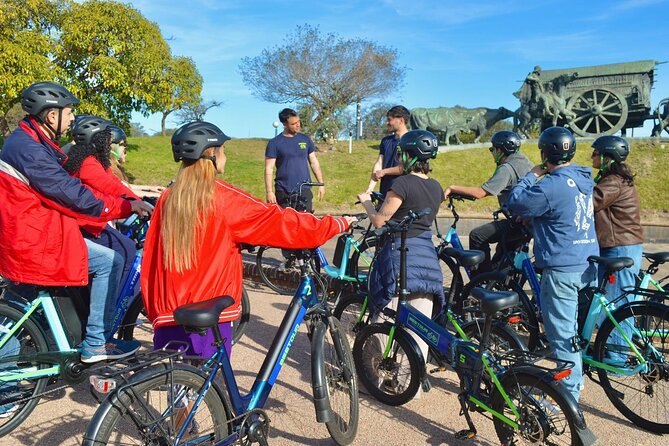
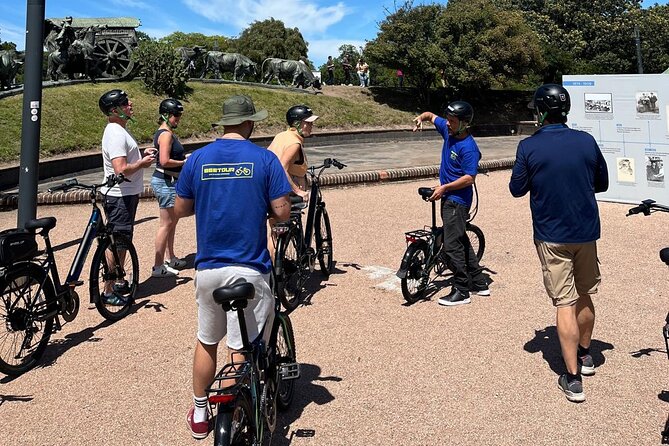
At La Carreta, you see one of Uruguay’s most recognizable monuments. The sculpture represents the country’s historic forms of transport and its rural past. It is a short stop, but a useful one because it connects the modern bicycle ride with older ways of moving across Uruguay.
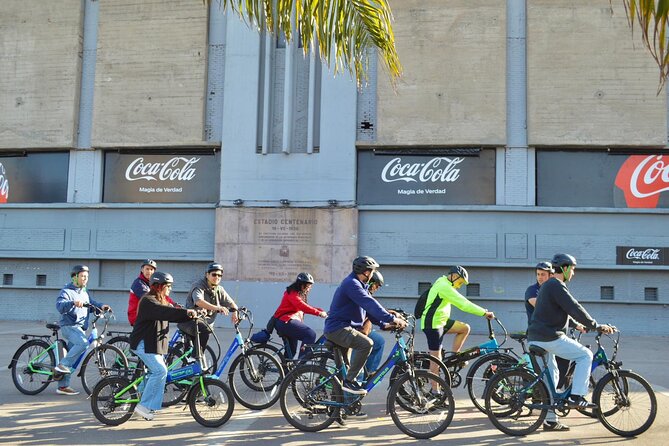
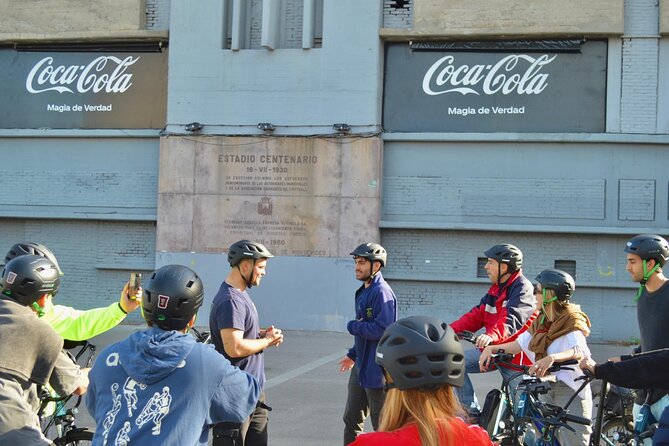
The next stop is Estadio Centenario, where the first Football World Cup was held in 1930. You have about ten minutes here, enough to take photographs and understand why football is woven so tightly into local identity. If you care about sport, this may be one of the morning’s most memorable stops.
The Municipal Velodrome follows naturally. It is used for cycling events and competitions, and its presence gives the route a nice bit of sporting logic. The stop is short, so think of it as a look and a photo rather than a stadium visit.
From the Obelisk to the heart of downtown
The Obelisco a los Constituyentes commemorates the assembly that produced Uruguay’s 1830 constitution. It is a compact monument, but the guide’s explanation helps place it within the country’s political story.
From here, the tour moves along Avenida 18 de Julio, Montevideo’s main central artery. This is one of the best parts of the route for seeing ordinary city life: shops, cafés, traffic, older façades, and people going about their morning.
The 30-minute stop here is longer than at most monuments. That gives the guide room to point out buildings and explain how the center works, rather than rushing you past a row of façades. The avenue also offers a taste of Montevideo’s art deco architecture, something easy to miss if you only visit the waterfront and Ciudad Vieja.
You then reach Plaza Independencia, the city’s major central square. It marks the transition between the newer central area and the Old City, with the monument to José Artigas at its center.
Palacio Salvo rises beside the square. It was once the tallest building in South America and remains one of Montevideo’s defining landmarks. You only stop for about five minutes, so this is not an interior visit, but the exterior is worth a close look.
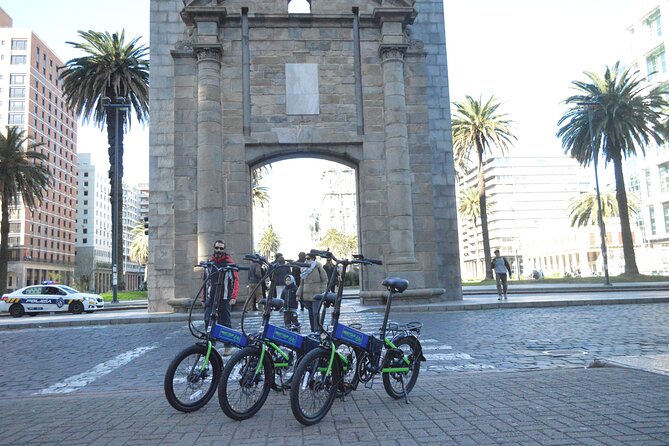
The Puerta de la Ciudadela is another quick stop. This surviving gateway recalls the fortified colonial city and provides a clear visual link between Montevideo’s earlier form and the modern streets around it.
Exploring Ciudad Vieja on two wheels
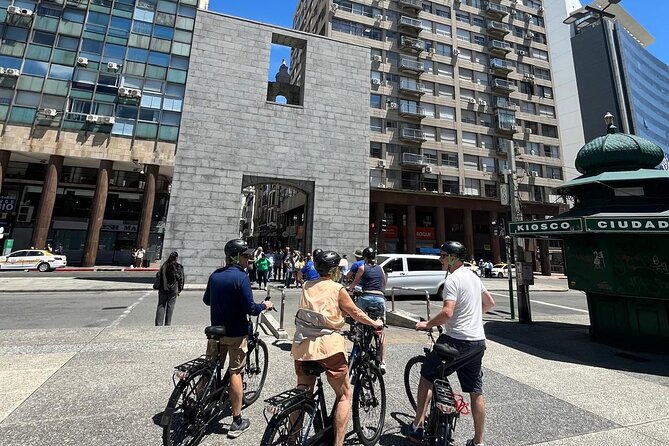
Pedestrian Sarandí leads into the older part of Montevideo. Shops, cafés, galleries, and street activity make this a good section for seeing the city at human scale.
Plaza Matriz is the oldest square in the country and has hosted major events across the eighteenth, nineteenth, and twentieth centuries. The ten-minute stop gives you time to look around without turning the tour into a long historical lecture.
The route also passes an important Latin American theater with notable architecture and a strong cultural program. The supplied route information does not name this stop, so you should treat it as a brief exterior point of interest rather than expect a performance or interior tour.
Ciudad Vieja is where the bicycle format proves especially useful. You can move between several landmarks without repeatedly returning to a vehicle, but you also need to stay alert around pedestrians and crossings. The guide manages the group through traffic lights and keeps riders together, a useful service in a busy central district.
Same roads, a different saddle:
- Ninh Binh Full-Day Tour from Hanoi to Hoa Lu, Tam Coc & Mua Cave Via Boat & Bike
★ 5.0 · 4,384 reviews - Small Group Guided Bike Tour of Amsterdam’s Hidden Gems
★ 5.0 · 3,936 reviews - 3-hour Complete Prague Bike Tour
★ 5.0 · 3,674 reviews - Bangkok: Temples, Canals & Local Life Bike Tour
★ 4.9 · 3,511 reviews
The Rambla and Montevideo’s coastal rhythm
The ride along the Rambla is the scenic centerpiece. This long coastal road follows the Río de la Plata and offers open water views, breezes, beaches, and plenty of room to appreciate Montevideo’s outdoor culture.
You spend about 30 minutes along this stretch, though the exact rhythm depends on traffic, photographs, and the group. The route includes several points of interest, and this is where you are most likely to feel the city rather than simply check off monuments.
The Rambla also shows why an e-bike works well here. You cover a substantial distance while staying close to the water, with less effort than a standard bicycle would require. A sunny day can make this the most enjoyable part of the tour, while cooler weather calls for an extra layer. A May or June morning may feel chilly even if the ride itself is comfortable.
The route continues toward Parque Rodó, one of Montevideo’s three major green lungs, along with Parque Rivera and the park in Prado. Gardens, lakes, and open spaces make it a natural place for a short break.
You also pass the headquarters of the regional bloc, a building connected with cooperation among South American countries. Another stop features an education building known for modern architecture and an active academic setting. The route includes an outdoor cultural space used for concerts and events, with an attractive layout and views.
These stops are not all long enough for a full visit. Their value is in showing you the range of Montevideo’s public spaces, from parks and universities to regional institutions and outdoor arts venues.
Punta Carretas, Pocitos, and the final viewpoint
At the Memorial to the Holocaust of the Jewish People, the tone changes. This is a quiet place of remembrance beside the coast, and the five-minute stop is brief but meaningful. The guide can provide context, while the setting allows a moment of reflection.
Punta Carretas brings you into a more polished residential and commercial district, with shops, cafés, and a pleasant waterfront. The former prison, now used as a shopping center, adds an unusual layer to the neighborhood. It is a good example of how Montevideo reuses older buildings while giving them a new role.
The Castillo del Alquimista, also known as Universo Pittamiglio, is one of the route’s more unusual sights. This eccentric building is tied to stories, symbolism, and local legends. You stop for about ten minutes, enough to appreciate its strange appearance and hear why it attracts attention.
Pocitos offers a different coastal mood. Its beach, restaurants, and relaxed residential setting show another side of Montevideo, one that feels less formal than the old center and more tied to daily life by the water.
The final stop is the Montevideo panoramic viewpoint and the large city sign. You have about 15 minutes for photographs and views across the Río de la Plata. It is a fitting finish because you can look back at the broad area covered during the ride.
Guides, bikes, and group experience
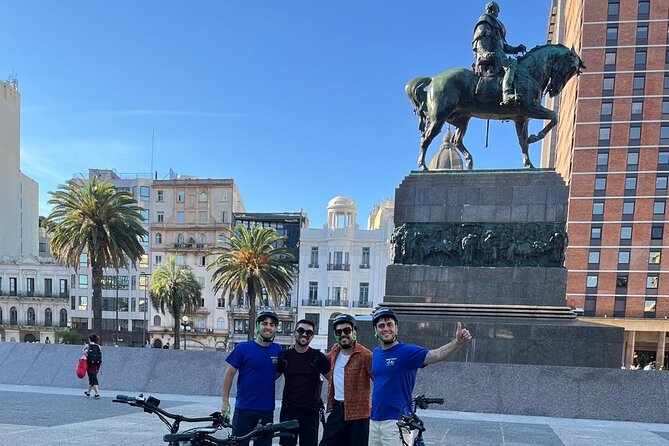
The guides are a central part of the tour. Santiago and Felipe are brothers who run the small company from their grandfather’s home, and their pride in Montevideo comes through in the way they explain neighborhoods, government, architecture, and local customs.
Fabiola is also part of the guiding team. English and Spanish are offered, and an audio guide is available in both languages. The live guide remains the more useful option for questions and local recommendations, but the audio support is helpful if you need repeated explanations.
The bikes receive unusually strong praise for comfort and power. Riders describe them as new or nearly new, easy to use, and suitable for a wide range of ages. Helmets and reflective vests are offered.
Safety is helped by Montevideo’s cycle lanes. Some run down the center of main roads and are clearly marked, which gives you a closer connection to the city while keeping you away from much of the traffic. That said, this is an urban ride, not a closed course. Follow the guide, watch intersections, and do not assume every section will feel as calm as the waterfront.
The activity is private, meaning only your group participates. That can make the pace more personal and gives you a better chance to ask questions or discuss places you want to return to later.
Is $59 a fair price?
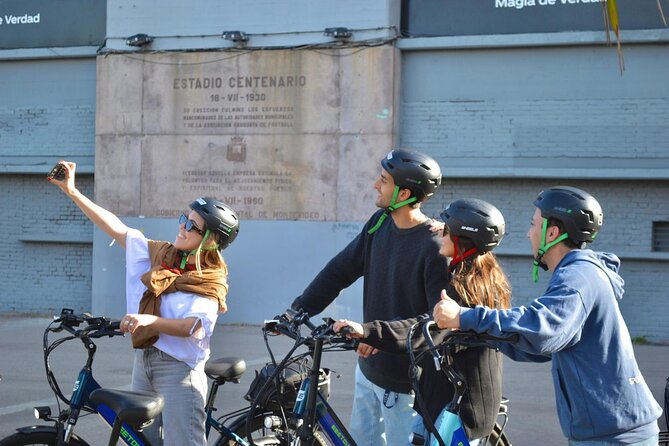
At $59 per person, this is not the cheapest way to get around Montevideo, but it offers more than a short bicycle rental. You receive a bike, helmet, reflective vest, English or Spanish guiding, audio support, and a route lasting about three hours and 15 minutes.
The real value is the distance covered. You can see the historic center, major avenues, parks, football landmarks, several coastal neighborhoods, and the Rambla in one morning. A taxi between all these areas would cost money and would give you less connection with the streets. A walking tour would require several separate outings.
The price makes the most sense if you have a short stay or want an orientation early in your visit. You can note the places that deserve a longer return visit, such as Ciudad Vieja, Palacio Salvo, Parque Rodó, Punta Carretas, or Pocitos.
Tips are not included. The tour begins and ends at La Gaceta 1282, and the address is near public transportation. Since the operation may look like a residential setup rather than a shop, check the confirmation details before setting out. Uber is another practical choice, especially from the cruise port or Ciudad Vieja.
Free cancellation is available until 24 hours before the 10:00 a.m. start time. Poor weather or an insufficient number of bookings can also cause cancellation, with a new date or full refund offered.
Who should book this Montevideo ride?
I would choose this tour if you want a broad first look at Montevideo and enjoy being active. It suits couples, solo visitors, families, and friends who want more range than a walking tour without sitting on a bus.
It is especially useful for cruise passengers or anyone with only a day or two in the city. The ride can also work well at the start of a longer visit, since the guide can point you toward places to explore later. Santiago has even provided follow-up suggestions based on what riders wanted to do after the tour.
I would think twice if you dislike bicycles, have trouble with moderate activity, or want long interior visits at each attraction. Most stops are short, and the goal is to see many parts of Montevideo rather than study one museum or monument in detail.
Should you book the Montevideo Electric Bicycle Tour?
Book it if you want to understand how Montevideo fits together. The route links football, politics, public parks, old streets, coastal neighborhoods, and the Rambla in a way that feels active but not exhausting.
The strongest reasons to go are the comfortable e-bikes, the careful route planning, the English and Spanish support, and the personal attention from guides such as Santiago and Felipe. The main tradeoff is the length of the ride and the need to manage city traffic.
For $59, you get a useful half-day orientation and a much wider view than you could gain on foot. If the weather is good and you are comfortable on a bicycle, this is one of the most efficient ways to meet Montevideo.
FAQ
How long is the Montevideo Electric Bicycle Tour?
The tour lasts approximately 3 hours and 15 minutes.
What time does the tour start?
The scheduled start time is 10:00 a.m.
Where does the tour begin and end?
It begins at La Gaceta 1282, 11300 Montevideo, Uruguay, and returns to the same meeting point.
How far do you ride?
The route covers roughly 18 to 19 kilometers, based on the distance described during recent rides.
Are bicycles and safety equipment included?
Yes. Bicycle use is included, and helmets and reflective vests are offered.
Is the tour available in English?
Yes. English and Spanish guiding are available, and an audio guide is offered in both languages.
Can I cancel for a refund?
You can cancel at least 24 hours before the local start time for a full refund. Cancellations or changes made less than 24 hours ahead are not refunded or accepted. If poor weather or an insufficient number of bookings cancels the tour, you will be offered another date or a full refund.
Newest rides we have reviewed in the world
- 1 Day Bike Tour to Hell’s Gate And Lake Naivasha★ 5.0 · 14 reviews
- Afternoon Adventure: Okinawa Local Cycling with Spectacular Views★ 5.0 · 92 reviews
- Zodiac Shrines and Naha Backstreets Cycling Tour★ 5.0 · 29 reviews
- PANORAMA TOUR OF NANTES by electric bike★ 5.0 · 33 reviews
- Guided E-bike Tour★ 5.0 · 33 reviews
- Authentic Mykonos bike tour★ 5.0 · 23 reviews
- City Bike and English Garden Tour★ 4.0 · 14 reviews
- Private Munich Bike Tour: Flexible Times & Beer Garden Stop★ 5.0 · 15 reviews
Tours, compared.
Big Bike tour Amsterdam – See all in 3 unforgettable hours
Read our review →
3-Hour Porto Highlights on a Electric Bike Guided Tour
Read our review →
Small Group Guided Bike Tour of Amsterdam’s Hidden Gems
Read our review →
Hills, Alfama, and Mouraria Tour by Electric Bike
Read our review →