
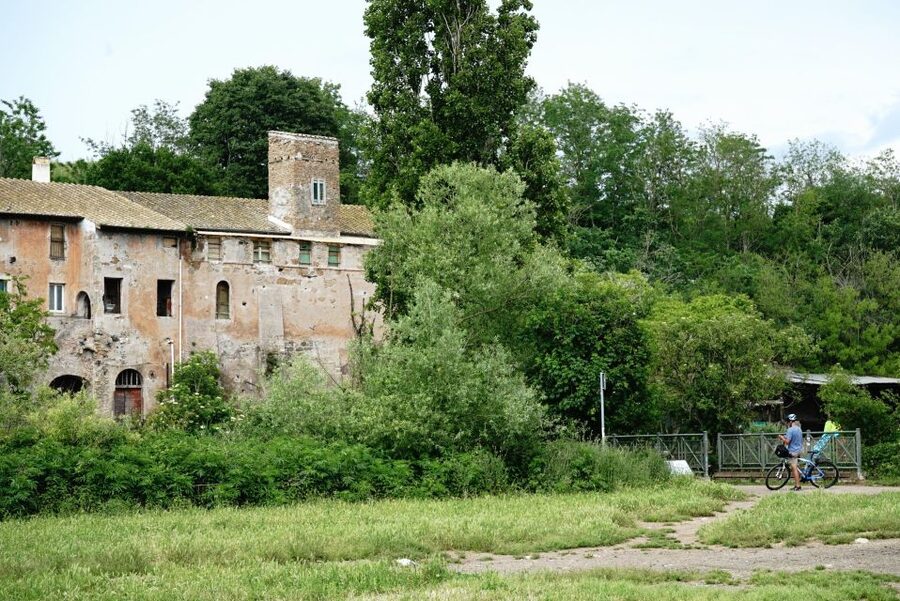
REVIEW · E-BIKE TOURS IN ROME
Rome: Appian Way, Catacombs & Roman Aqueducts Top EBike Tour
Rome’s ancient Appian Way is best understood at bicycle speed. This 27-kilometer ride carries you from the Colosseum area through city streets and into open parks, past tombs, villas, catacombs, and the huge arches of the Roman Aqueducts. You get a side of Rome that is hard to reach on foot.
I like the excellent route design and the way guides such as Fabio, Claudia, Megan, Zak, and Areia have handled busy intersections and nervous cyclists. I also like the Cannondale e-bikes, which make the long distance and rougher paths manageable. The catch is the 60 percent off-road route and intermediate rating. This is not a gentle spin around town, especially with a child seat or extension.
Key points to know before you book
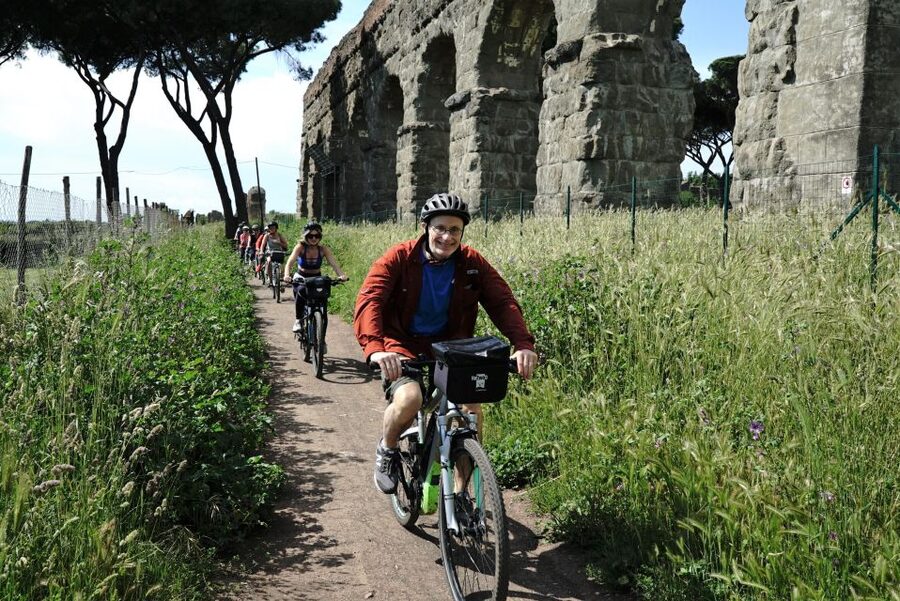
- The route covers 27 km: You will ride far beyond the central sights, with about 40 percent of the trip on city streets and the rest in parks or off-road areas.
- The six-hour version includes the catacombs: The shorter four-hour tour skips the underground guided visit.
- The Aqueducts Park is a major payoff: Towering Roman arches rise from open countryside, making this one of the most memorable parts of the ride.
- Safety is a serious part of the tour: Guides lead the group through traffic, help at intersections, and keep the pace together.
- The e-bikes are a real advantage: Cannondale electric mountain bikes have anti-puncture tires and comfortable saddles, useful on uneven paths.
- You need moderate cycling ability: The motor helps with hills and distance, but you still need to control a bicycle for several hours.
Why this is one of Rome’s best outdoor history tours
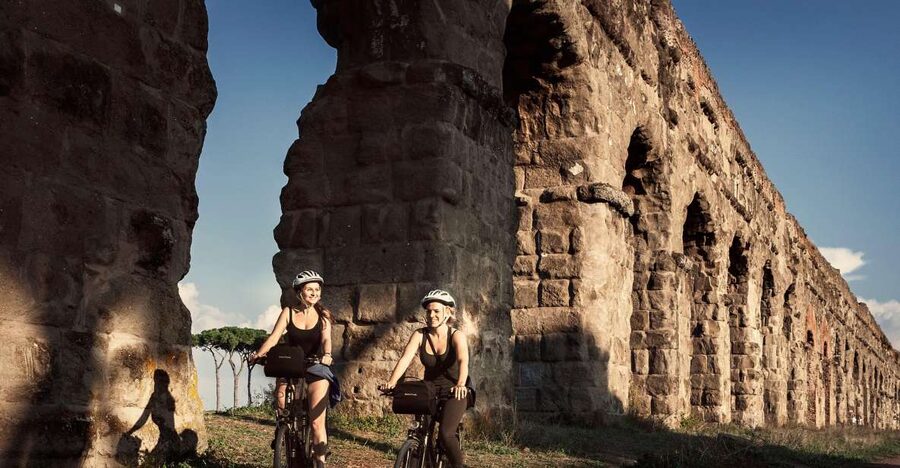
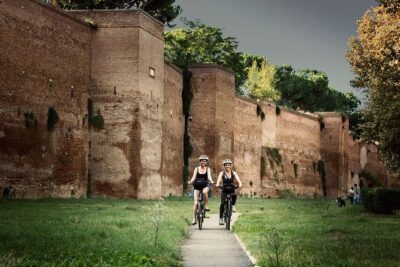
Rome can feel like a city of queues, polished marble, and crowded piazzas. This ride gives you a different view. You leave the center near the Colosseum, pass through the Aurelian Walls, and soon trade traffic and stone buildings for pine trees, fields, ruins, and long stretches of old Roman road.
I especially like the blend of movement and history. You are not simply being driven between monuments. You are following an ancient route and seeing how Rome gradually changes from dense city to open countryside. The e-bike lets you cover ground without turning the day into an endurance test.
The group is limited to 10 people, which matters on a route that includes traffic and uneven paths. A guide can see the whole group, give clear instructions, and stop without creating a large procession. The strongest praise has gone to guides who explain Roman history while also watching the road, including Claudia, Fabio, Megan, Zak, Areia, and Caterina.
At $100 per person, the price is reasonable for a four to six-hour guided outing that includes the e-bike, helmet, water, and, on the longer tour, a catacomb visit. It is not the cheapest way to see Rome, but you are paying for the bike, route planning, safety management, and access to several distant areas that would be awkward to connect on your own.
More E-Bike Tours in Italy
- Rome EBike Tour: Appian Way, Catacombs & Roman Aqueducts
★ 5.0 · 1,766 reviews - Rome: Top Highlights & Hidden Gems Tour by Cannondale E-Bike
★ 4.9 · 1,760 reviews - Rome: Appian Way & Aqueducts E-Bike Tour (Catacombs & Food)
★ 4.9 · 1,498 reviews
Starting near the Colosseum and the Aurelian Walls
You meet at Via Labicana 49, about a five-minute walk from the Colosseum. This is a practical starting point because you can reach it easily from the historic center, and the tour begins close to one of Rome’s main ancient zones.
After fitting the bike and helmet, you head toward the Aurelian Walls. These walls were built in the third century to protect Rome as the empire faced growing military pressure. The tour does not treat the walls as a separate museum stop. Instead, they form a useful transition between modern Rome and the archaeological countryside beyond.
The first city riding requires attention. About 40 percent of the full route uses carefully selected streets, but traffic cannot be avoided completely. Guides have been particularly praised for getting groups across busy junctions and keeping less confident cyclists calm.
If you rarely cycle in traffic, tell your guide at the start. The route is designed with safety in mind, but the city section still requires steering, braking, and awareness. The electric assistance helps you move off and handle hills, but it does not replace basic bike control.
Riding the 2,300-year-old Appian Way
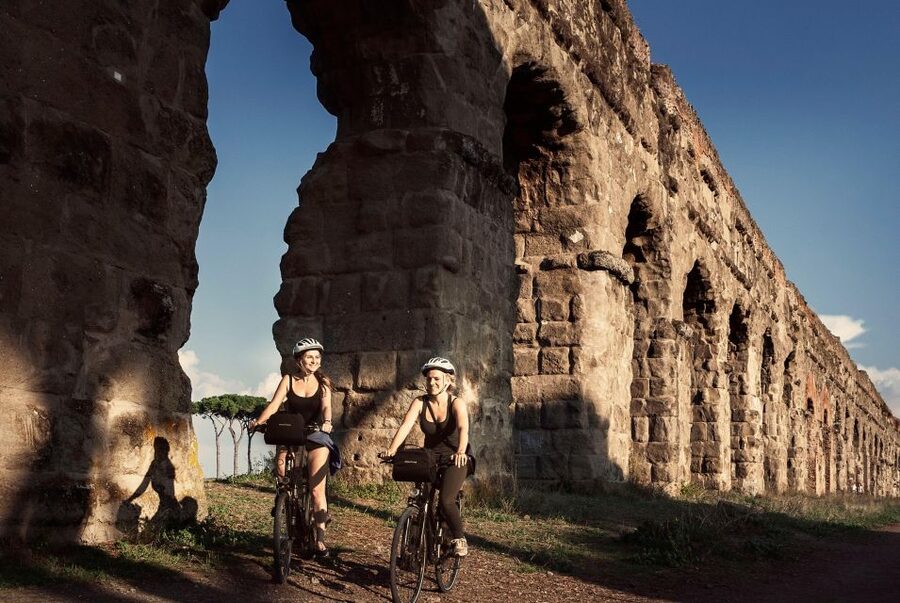
The Ancient Appian Way is the heart of the tour. Built around 312 BC, it was one of Rome’s most important roads, connecting the capital with southern Italy. Today, you ride along sections of the old route bordered by ruins, grasses, trees, and Roman tombs.
The surface is part of the experience and part of the challenge. Much of the ride away from the city is off-road, and the old stones and rough tracks can feel bumpy. The Cannondale e-mountain bikes have anti-puncture tires and comfortable saddles, which are helpful, but you should not expect a smooth cycle path.
The electric motor changes the rhythm of the day. You still pedal, but hills and long stretches do not demand the same effort as they would on a standard bicycle. One useful tip from an earlier departure was to make full use of the assistance settings. Even so, you should conserve energy and avoid treating the ride like a race.
Along the Appian Way, the guide brings the scattered ruins into focus. Tombs and mausoleums line the old road because Roman law generally required burials outside the city walls. Villas and other remains show how this route was not only a military and commercial highway, but also a prestigious road out of Rome.
Some stops may feel modest compared with the Colosseum or Pantheon. That is worth knowing before you book. The pleasure here comes from the setting and the continuous route, not from entering a succession of perfectly preserved interiors.
Catacombs: choose the six-hour version carefully
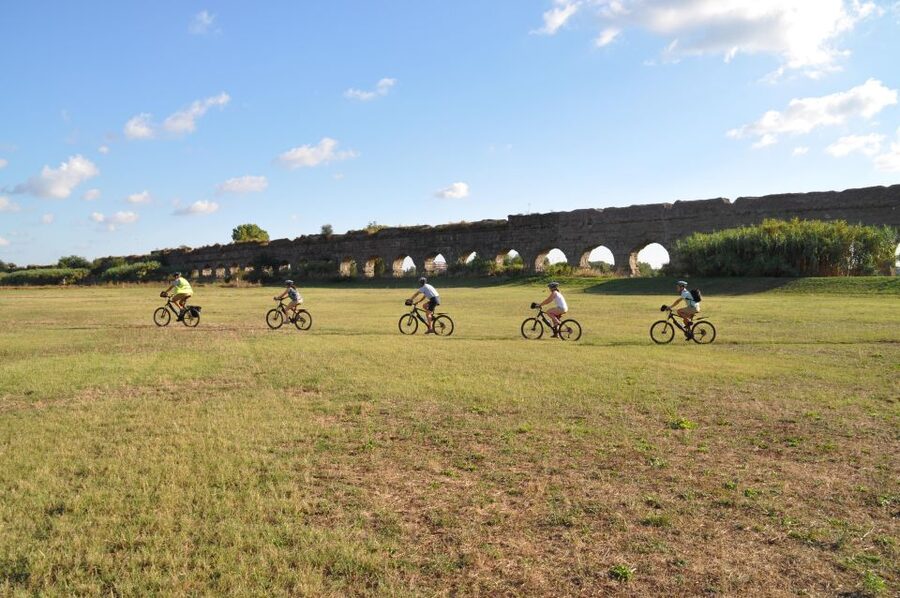
The catacomb visit is included only with the six-hour tour. It lasts about 45 minutes and takes you underground through the corridors used by early Christian communities. The guide-led visit gives the ride a more focused historical stop after the open-air remains of the Appian Way.
The underground section will appeal most to adults and older children who enjoy archaeology, religion, and Roman burial customs. It is quieter and more enclosed than the rest of the day, with a different mood from the parks and open roads.
I would think carefully about this choice if you are traveling with young children. One family found the catacombs boring for the children, even though they enjoyed the bike ride. That does not make the visit poor, but it shows that the six-hour option is not automatically better for every group.
If you want the fullest history experience, choose six hours. If your priority is cycling, scenery, and aqueducts, the shorter tour may suit you better. The longer option also gives you more time with the ancient sites, so check the exact departure duration before booking.
More E-Bike Tours in Rome
- Rome: Appian Way, Catacombs, & Roman Aqueducts E-bike Tour
★ 4.9 · 1,421 reviews - Rome City Small Group Bike Tour with quality Cannondale EBike
★ 5.0 · 1,380 reviews - Rome by Night – Ebike Small Group Tour – Food and Wine (Option)
★ 5.0 · 1,275 reviews - Rome by Night: E-bike Small Group Tour -Food & Wine (Option)
★ 4.9 · 1,233 reviews
Circus of Maxentius and the Tomb of Cecilia Metella
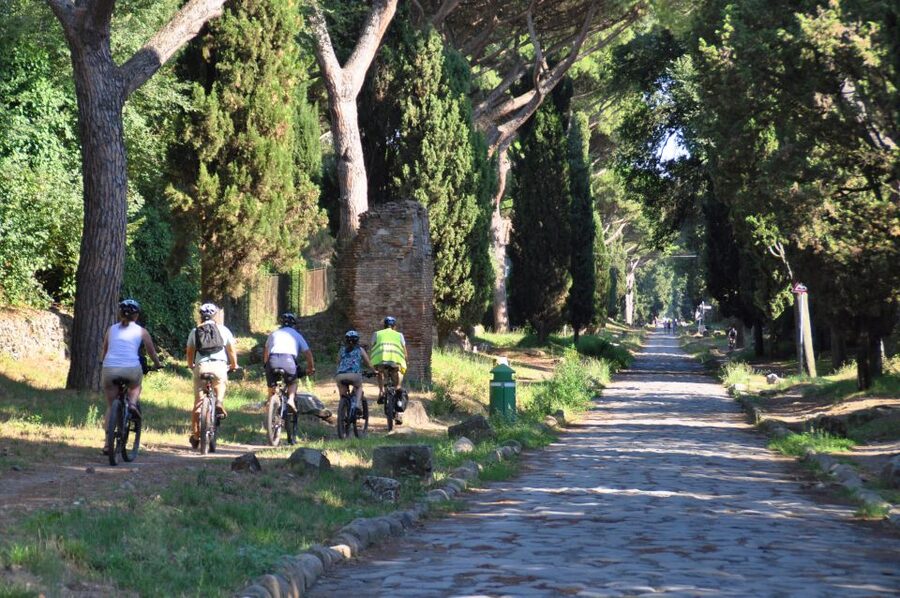
The route continues past the Circus of Maxentius, an imperial complex from the fourth century. Its name can be misleading if you expect the vast scale of the Circus Maximus. This was a smaller private complex connected with the emperor Maxentius, including a circus for chariot racing and nearby buildings.
The remains are valuable because they show the Appian Way as a district of imperial estates, monuments, and burial places. You see how Roman power extended beyond the city center, with grand projects placed along an important road.
The Tomb of Cecilia Metella is one of the most recognizable monuments on the Appian Way. Its large cylindrical form rises beside the road and gives you a clear picture of how wealthy Roman families marked their burial places. The exact visual impact depends on the light, weather, and pace of the group, but it is an important stop on this stretch.
You should not expect a long independent visit at every monument. This is a moving tour with several sightseeing pauses, not a full archaeological excavation visit. The guide’s explanation is what ties the stops together.
Villa dei Quintili and the open Roman countryside
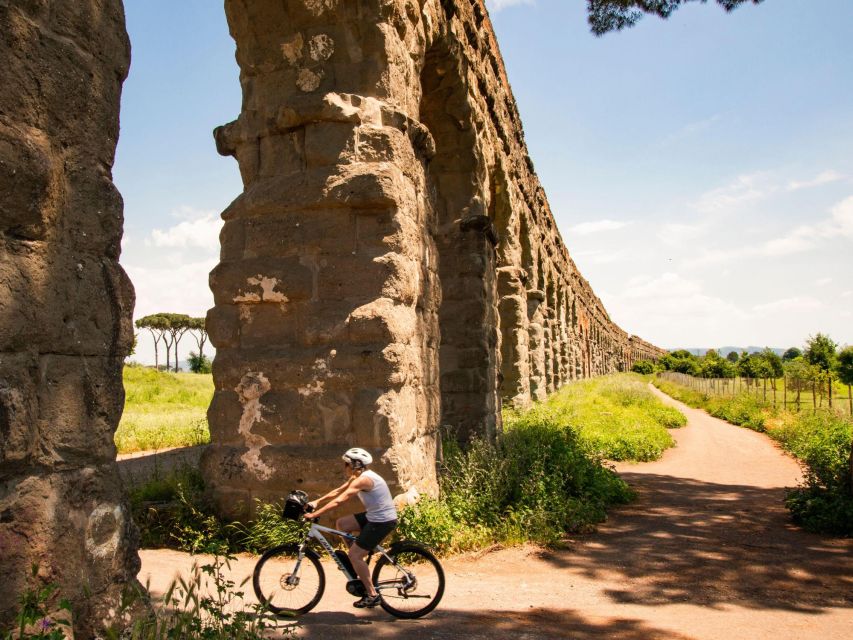
The Villa dei Quintili was a large country residence owned by two wealthy brothers before Emperor Commodus seized it. Its location shows why the ancient Appian Way was more than a transport route. Important Romans wanted estates outside the crowded capital, yet close enough to the road and city.
From the bike, you experience the area as a broad archaeological zone rather than a series of isolated ruins. You may find this more rewarding than rushing through indoor attractions because the land itself helps explain how the Romans lived, traveled, and displayed status.
The route can feel physically demanding here. You may ride over uneven ground for extended periods, and the full tour covers 17 miles. The electric motor reduces the strain, but the ride is still rated intermediate, and a child seat or child extension makes it harder.
The Aqueducts Park is the visual high point
The Park of the Aqueducts is the big scenic reward. Monumental arches cross the open space, remnants of the water systems that carried enormous quantities of water into ancient Rome. Their scale becomes easier to appreciate when you are outside the dense center, with long views and few modern buildings competing for attention.
This is where the tour feels most different from a standard Rome sightseeing day. You can stop beneath or near the aqueducts, take in the repeated arches, and understand the engineering as part of the countryside around Rome. The afternoon light can be especially attractive, though weather and timing will affect the view.
The park portion is also safer and more relaxed than the city connection. Once you are riding through the parks, there is no traffic. That makes it easier to enjoy the scenery, listen to the guide, and settle into the e-bike.
Several people have called the aqueduct section their favorite part of the outing. I can see why. The Appian Way offers the historical core, but the aqueducts provide the grand visual moment.
Returning through Caffarella Park
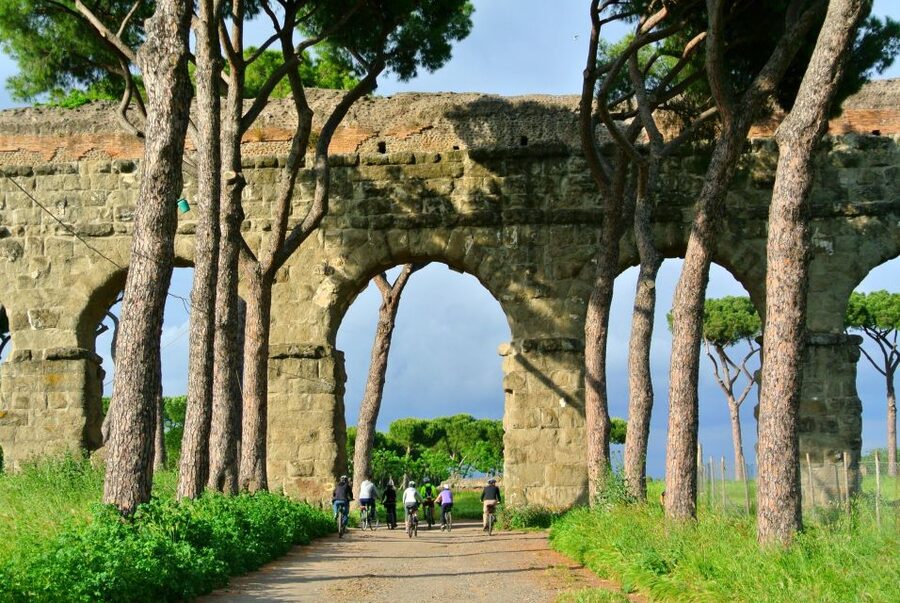
The return route passes through the Caffarella Valley, a rare patch of open countryside inside Rome. The park brings together fields, paths, and ancient remains, giving you a final change of pace before returning to the city.
Caffarella is valuable because it shows how much open space survives within Rome’s urban boundaries. You are still close to the city, yet the ride feels far removed from the Colosseum crowds. It is a good ending after the busier road sections and the concentrated ancient sites.
The tour also passes by the Baths of Caracalla on the return. You may see them as a final Roman landmark before reaching Via Labicana 49. Since the ride covers so many areas, the Baths function more as a sightseeing point than a full visit.
How difficult is the 27-kilometer ride?
The tour is officially intermediate. That rating is fair. You need to cycle for several hours, manage an e-bike on rough paths, and handle some city traffic. The route is not suitable for someone who cannot ride a bicycle confidently.
The e-bike makes the outing possible for a wider range of fitness levels. A 13-year-old and a 70-year-old have both completed the route successfully, and a rider who had not used an e-bike before found the bike easy to handle. Still, those examples should not persuade you to ignore the distance.
Children aged 1 to 4 can ride free in a child seat if they weigh under 22 kilograms. Children aged 5 to 8 use a child extension. Children aged 9 and older, and taller than 140 centimeters, can ride an e-bike. The equipment has a 300-pound, or 136-kilogram, weight limit.
Bring comfortable clothing, shoes suitable for cycling, and sun protection in warm weather. Summer departures can become hot, and there is no food included. The route has places where you can buy food and drinks, and one earlier group stopped for pizza, but you should not count on a scheduled meal.
Which version and season make the most sense?
Choose the four-hour option if you want the main riding experience, Appian Way, parks, and aqueducts without making the day too long. Choose six hours if the catacombs are important to you and your group enjoys a slower, more history-focused outing.
Spring and cooler months are likely to be more comfortable for a long ride. Summer can be warm, especially when you are out in open parks. The electric assistance helps, but it does not remove the effect of heat over 27 kilometers.
Wednesday departures may take up to 30 minutes longer than usual. The tour also has a minimum of four participants, so check the booking calendar and starting time before you make firm plans.
The tour is offered in English, Italian, Dutch, French, German, and Spanish. That makes it a useful choice for mixed-language groups, although the guide language you want should be confirmed when you select your date.
Should you book this Appian Way e-bike tour?
Book it if you want to combine Roman archaeology with fresh air and a real sense of distance. It suits couples, active families, and adults who want to get beyond the central monuments without arranging transport between scattered sites.
I would book the six-hour version for history lovers who want the catacombs, and the shorter ride for anyone mainly interested in the Appian Way and aqueducts. I would not choose it for a very young family that dislikes long rides, uneven surfaces, or underground visits.
The best reason to book is the route. You see ancient roads, imperial remains, burial monuments, aqueducts, and city parks in one continuous outing. The main caution is simple: this is a substantial bike ride, not a casual sightseeing loop. If you are comfortable with that, the $100 price offers strong value, particularly because the guides take safety seriously and the e-bikes make Rome’s outer archaeological zone much more reachable.
FAQ
Where does the Rome e-bike tour start?
The meeting point is the tour shop at Via Labicana 49, about a five-minute walk from the Colosseum.
How long is the tour?
The tour lasts four to six hours, depending on the option you choose. The six-hour version includes the catacomb visit.
How far do you ride?
The route covers 27 kilometers, or about 17 miles. Around 60 percent is off-road, and about 40 percent uses city streets.
Are the catacombs included on every tour?
No. The guided catacomb visit, which lasts about 45 minutes, is included only on the six-hour tour.
What kind of bike is provided?
You receive a Cannondale e-mountain bike with electric assistance, anti-puncture tires, and a comfortable saddle. A helmet and bottle of water are also included.
Is the tour suitable for children?
Children aged 1 to 4 can ride in a child seat if they weigh under 22 kilograms. Children aged 5 to 8 use a child extension, and children aged 9 or older who are taller than 140 centimeters can ride an e-bike. The ride is rated intermediate and becomes difficult with a child seat or extension.
Is food included?
No. Food and drinks are not included, but there are opportunities along the route to buy them.
Newest rides we have reviewed in Rome
- Rome: Guided eBike Evening Tour with italian Aperitif★ 5.0 · 16 reviews
- Rome: Villa Borghese E-Bike Tour (Small Group or Private)★ 4.9 · 92 reviews
- Rome: Taste of Rome by quality Cannondale E-Bike★ 5.0 · 12 reviews
- Rome: Appian Way, Aqueducts, & Catacombs E-Bike Guided Tour★ 4.9 · 54 reviews
- Rome: Villa Borghese, Villa Ada, and Coppedè E-Bike Tour★ 4.8 · 78 reviews
- Rome: Top 10 Highlights Guided Tour by Bike or E-Bike★ 4.4 · 15 reviews
- Rome: Panoramic Off-the-beaten-track Cannondale E-Bike tour★ 5.0 · 71 reviews
- Sunrise in Rome: Small Group E-Bike Tour & Italian breakfast★ 4.9 · 177 reviews
E-Bike Tours, compared.
3-Hour Porto Highlights on a Electric Bike Guided Tour
Read our review →
Hills, Alfama, and Mouraria Tour by Electric Bike
Read our review →
Athens Scenic Electric Bike Tour with optional Acropolis visit
Read our review →
City Highlights 3-Hour Guided Electric Bike Tour
Read our review →
Rome EBike Tour: Appian Way, Catacombs & Roman Aqueducts
Read our review →
Top Highlights & Hidden Gems Tour by Cannondale E-Bike
Read our review →Other lists this ride turns up in