
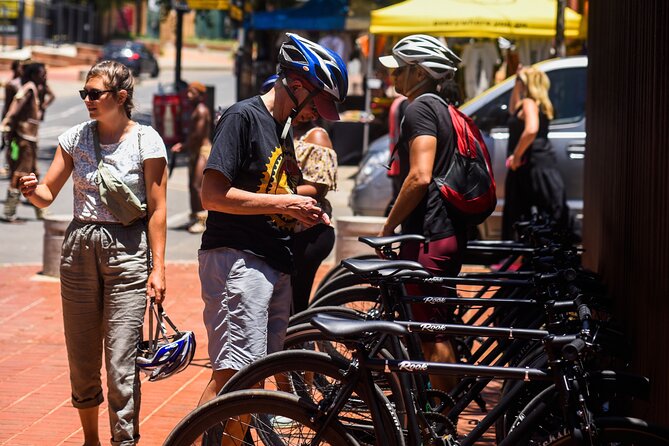
REVIEW · SOUTH AFRICA
Guided Bicycle Tour of Soweto with Lunch
Soweto’s story comes into focus when you ride through its streets rather than simply viewing it from a vehicle. This four-hour outing links Vilakazi Street, Mandela House, the Hector Pieterson Memorial, and Orlando Stadium with the everyday neighborhoods between them.
I like the direct local perspective, especially the attention given to Lillian Mgoyi and women’s resistance. I also like the kota lunch, a filling local sandwich that turns a history tour into a proper half-day experience.
The catch is the cycling. Soweto is hilly, and several people found the single-speed bikes hard work on climbs. Bring water, sunscreen, and a cap, and treat this as an active tour rather than an easy sightseeing ride.
Key details before you book

- You ride beyond the usual landmarks: The route links famous sites with residential streets, family stories, and places tied to domestic workers and women’s activism.
- The history is told locally: Guides including Themba, Thabo, Thato, Temba, and Mulalo lead the tours, with the strongest praise going to their warmth, humor, care, and clear explanations.
- A kota is included: This deep-filled local burger makes lunch substantial, not just a quick snack.
- You visit a former women’s hostel: Mzimhlophe adds an important perspective that many apartheid tours leave out.
- The ride has real hills: Bikes have reportedly been upgraded on some departures, but single-speed bicycles have also been used.
- Mandela House costs extra: Entry is not included, with the listed fee at R60.
Why a bicycle is a good way to see Soweto
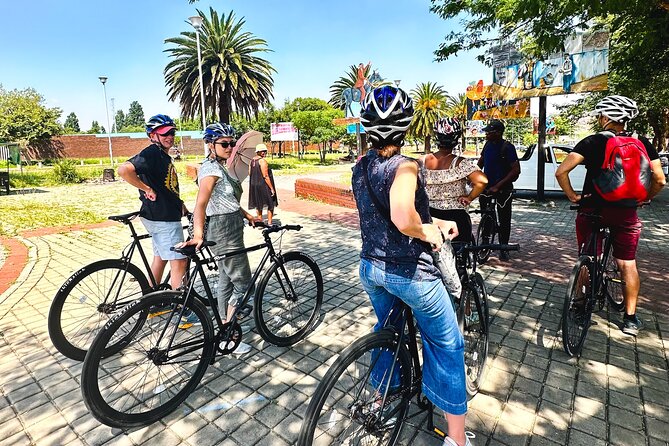
Soweto is too large to understand from one famous street. A walking tour can give you close contact with a small area, but a bicycle lets you connect several neighborhoods and landmarks in half a day.
That extra range matters. You move from family stories in Phomolong to the former Mzimhlophe hostel, then on to sites tied to the 1976 youth uprising and Nelson Mandela’s years in Orlando West. In between, you see ordinary streets and homes rather than only polished visitor stops.
The pace also keeps you near the ground. You can hear the guide while riding at a manageable speed, stop when the group reaches a point of interest, and get a better feel for the distances between places. People in the community may wave or greet the group as it passes, adding a social element that a closed vehicle cannot provide.
This is not a sleek city bike ride. The route includes hills, and some bicycles have only one gear. Several riders described it as a workout, though casual cyclists managed it with effort. If you are comfortable with a few climbs and want to cover more ground than your feet allow, the format works well.
More Rides with Lunch in South Africa:
- Soweto: Guided Bicycle Tour with Lunch
★ 4.9 · 292 reviews - Franschhoek: E-bike Tour with Wine Tasting and Lunch
★ 4.8 · 30 reviews - Electric Cycling Tour of Ubud with Free Hotel Transfer and Lunch
★ 5.0 · 1,397 reviews
Starting in Phomolong: apartheid through family stories
The tour begins at 7346 Kumalo Street in Orlando West and first stops in Phomolong. This opening is useful because it frames apartheid through the effect on families across generations, rather than treating the subject as a list of dates and political names.
You hear how apartheid shaped daily life and how Soweto has changed since those years. That local angle gives the rest of the ride a clear purpose. The sites ahead are not isolated museum pieces. They are part of a community where political decisions affected housing, work, movement, education, and family life.
The stop lasts about 15 minutes. It is short, but it sets the tone for a tour that tries to explain both the struggle and present-day Soweto.
Mzimhlophe hostel and the overlooked story of women
At Mzimhlophe, you visit the only former women’s residential hostel in Soweto. It housed domestic workers who worked in the suburbs of Johannesburg.
This is one of the tour’s most valuable stops. Apartheid history is often told through major male political figures, court cases, prisons, and protests. The hostel shifts attention to women whose working lives were shaped by the pass laws and the separation of families.
You get a more practical picture of how the system worked. Women employed as domestic workers could be separated from their homes and families while serving households elsewhere. The building helps connect policy with the daily movement, housing, and labor restrictions imposed on Black South Africans.
The stop lasts around 30 minutes. It is a good reason to choose this bike tour over a quick drive past the better-known landmarks.
Lillian Mgoyi’s home and the women’s march
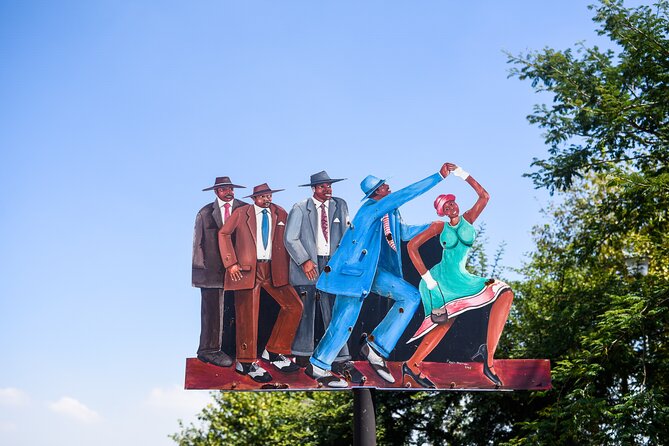
The visit to Mama Lillian Mgoyi’s home on Nkungu Street adds a personal name and place to the story of women’s resistance. Mgoyi was an anti-apartheid activist and president of the Women’s League.
She was also one of the women who led a march of 20,000 women to the Union Buildings in Pretoria. The protest challenged the apartheid government’s requirement that women carry passbooks under the pass laws.
This 10-minute stop is brief, but its subject is powerful. It reminds you that women were not only affected by apartheid rules. They organized, marched, and helped force the system into retreat.
I especially like that the route gives Lillian Mgoyi space alongside Nelson Mandela, Desmond Tutu, and Hector Pieterson. That broader view makes the political story more accurate and more human.
More Guided Rides in South Africa:
- Cape Town: Guided Bike Tour
★ 4.9 · 193 reviews - Soweto: Bike Tour with a Local Tour Guide
★ 4.7 · 114 reviews - Franschhoek: E-Bike Guided Winery Tour
★ 4.6 · 96 reviews - Stellenbosch: Wine Farm E-Bike Guided Tour
★ 4.6 · 88 reviews
Hector Pieterson Memorial and the 1976 uprising
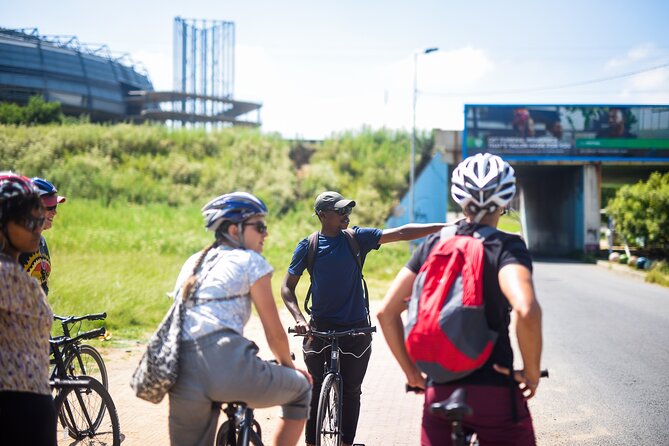
The Hector Pieterson Museum and Memorial focuses on the 1976 youth uprising. The event began with student protests against the apartheid education system and became one of the defining moments in the struggle.
The museum and memorial are among Soweto’s essential historical stops. The name Hector Pieterson became a symbol after the photograph of his injured body being carried through the streets was published around the world.
You spend about 30 minutes here. That is enough for an introduction, though not enough for an unhurried museum visit if you want to read every display. The bike tour gives you the setting and the main story, but anyone wanting a long museum session may prefer to return separately.
The emotional weight of this stop is real. The cycling and conversation beforehand can make the transition feel abrupt, so give yourself time to listen and take in the site.
Orlando Stadium and Soweto’s sporting identity
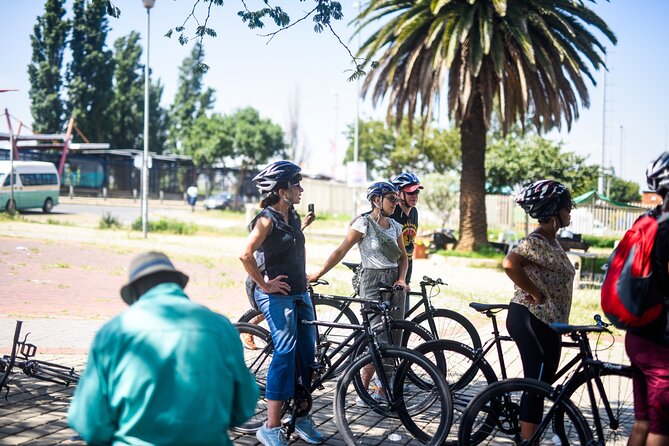
Orlando Stadium offers a change of subject. The venue dates back to 1959 and has long been tied to Soweto’s sporting life.
The rebuilt stadium can hold 37,139 people and includes hospitality suites, conference rooms, a gymnasium, and an auditorium. It is also associated with Orlando Pirates, one of South Africa’s major football clubs.
You spend about 10 minutes here. The stadium is more of an outside orientation stop than a full venue tour, and entry is not included. Its value lies in showing that Soweto’s identity is not defined only by hardship and protest.
Sport, music, and large public events are part of the area’s modern life. A quick look at Orlando Stadium helps balance the political history with a sense of community pride and popular culture.
Mandela House and Vilakazi Street
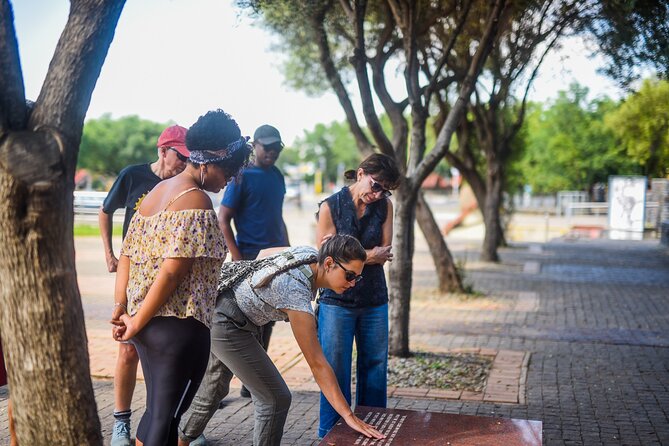
Mandela House is one of the best-known stops on the route. Nelson Mandela lived at the house on Vilakazi Street, and the building now offers a close connection to his personal life and political years.
Admission costs R60 and is not included in the tour price. The stop lasts about 30 minutes, so you should expect a focused visit rather than a long, detailed museum session.
Vilakazi Street follows or surrounds the Mandela House visit and receives about 40 minutes. It is famous as the street associated with two Nobel Peace Prize winners, Nelson Mandela and Desmond Tutu.
That distinction gives the street unusual symbolic weight. You are not just visiting a famous address. You are standing in a place tied to two major figures in South Africa’s transition away from apartheid.
The street is also a useful setting for the guide’s stories. The best guides, including Themba and Thabo, have been praised for mixing historical facts with local context, humor, and personal warmth. Some people described the experience as spending time with a local who was showing them around the neighborhood rather than being marched through a script.
That personal quality depends partly on your guide and group. With a maximum of 15 people, the outing is small enough for questions, though it is not a private tour.
Riding the streets between the landmarks
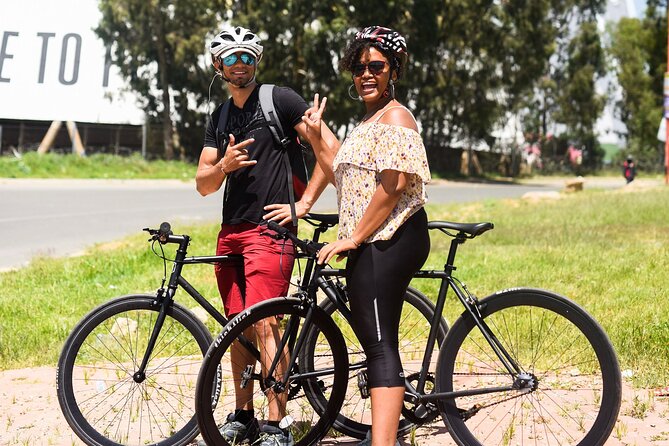
The sections between official stops are not dead time. They are where you see the scale of Soweto and how the major sites sit within ordinary neighborhoods.
You cycle through the township, passing homes and local streets while the guide explains what you are seeing. The route helps you connect the historical events to the place where people lived and worked.
Safety is a recurring strength of the guiding. Themba, Thabo, Temba, Thato, and Mulalo are all named as guides on different departures, and the strongest descriptions focus on guides who stayed alert, adapted to the group, and made riders feel welcome.
That does not remove the need for common sense. Stay with the group, follow the guide’s instructions, and pay attention to traffic and road conditions. The tour is designed for most people, but it is not a passive activity.
A note about the Orlando Police Department stop
The schedule also lists a stop called Orlando Police Department. The supplied description, however, refers to the Orlando Police Department in Florida, including details about its 1875 formation and more than 800 sworn officers. Those details do not fit a Soweto sightseeing route.
Because of that mismatch, I would treat this as a possible itinerary error and confirm the exact stop with One Day Africa before booking if it matters to you. The rest of the route clearly centers on Soweto history, but this particular entry should not be taken at face value.
Kota lunch: simple, local, and filling
Lunch is a local burger called a kota. It is a deep-filled sandwich and is included with the bicycle, helmet, and bottled water.
A kota is a good match for this tour. You have been riding uphill and walking around historical sites, so a light pastry or small snack would not be enough. The sandwich makes the experience feel connected to local food rather than built around a generic packed lunch.
The meal also gives the group time to relax and talk. One account described the lunch as fun and filling, with local beer available separately at the Soweto Brewery. Beer is not listed as included, so budget for it as an extra if offered.
Food preferences and specific kota fillings are not provided, so ask the operator about options if you have dietary restrictions. The tour price covers lunch, but not additional items.
Price, timing, and what you receive
At $45.70 per person, the tour is fairly priced if you want a guided introduction that combines transport within Soweto, historical interpretation, equipment, and lunch.
You receive:
- A bicycle
- A helmet
- Bottled water
- A guided route of about four hours
- Lunch in the form of a kota
- Visits to the listed historical and cultural stops
You do not receive pickup or drop-off. You must make your own way to 7346 Kumalo Street in Orlando West, and the tour finishes back there. The meeting point is near public transportation, which helps, but you should allow time to reach it.
The tour is offered in morning and afternoon versions. That flexibility is useful if you are fitting Soweto around another Johannesburg activity. A morning ride may be more comfortable in warm weather, while an afternoon departure can work well if you want a slower start.
Confirmation is provided at booking, and the maximum group size is 15. Free cancellation is available until 24 hours before the start time. Cancellations within 24 hours are not refunded, and late changes are not accepted.
Who will enjoy this ride most
I would choose this tour if you want history, local stories, and movement in one outing. It suits people who would find a standard sightseeing drive too distant and a long walking tour too limited in range.
It is also a strong choice if you want more than the usual Mandela stop. The women’s hostel and Lillian Mgoyi’s home add important subjects, while Orlando Stadium and the residential streets show a wider side of Soweto.
You should think twice if you dislike hills, have difficulty cycling for several hours, or want a slow museum-focused experience. The ride is manageable for casual cyclists according to the supplied experience, but the climbs can be demanding, especially on a single-speed bike.
Wear comfortable clothing and closed shoes. Bring sunscreen and a cap, and do not assume the included bottled water will be enough for you if you usually drink a lot during exercise.
Should you book the Soweto bicycle tour?
Book it if you want an active, human-scale introduction to Soweto and are ready for some uphill cycling. The strongest reasons are the local guides, the attention to women’s resistance, the chance to cover several parts of the township, and the substantial kota lunch.
Skip it if your priority is a relaxed vehicle tour, extensive time inside museums, or a private itinerary with no physical effort. Also confirm the Orlando Police Department entry before paying, since that part of the schedule appears inconsistent.
For the right visitor, this is good value: a small group, bicycle and helmet, four hours of guiding, major Soweto landmarks, local neighborhoods, and lunch for $45.70. Just bring energy for the hills and an open mind for a history that is still part of daily life.
FAQ
How long does the Soweto bicycle tour last?
The tour lasts approximately four hours and ends back at the meeting point in Orlando West.
Where does the tour start?
It starts at 7346 Kumalo Street, Orlando West, Johannesburg, 1804, South Africa.
Is lunch included?
Yes. A local kota burger, bottled water, a bicycle, and a helmet are included.
Is entry to Mandela House included?
No. Entry to Nelson Mandela House is listed separately at R60.
How many people can join the tour?
The maximum group size is 15 people.
Can I cancel for a full refund?
Yes, if you cancel at least 24 hours before the experience start time. Cancellations or changes made within 24 hours are not accepted, and the amount paid is not refunded.
Newest rides we have reviewed in South Africa
- bicycle tour soweto★ 4.5 · 20 reviews
- Cycling The Cradle of Humankind in Game Reserve★ 5.0 · 18 reviews
- Franschhoek Sip & Cycle Experience Full Day – Private Tour★ 5.0 · 14 reviews
- Franschhoek Cycle Experience Half Day – Private Tour★ 5.0 · 12 reviews
- Franschhoek Winelands Luxury EBike Tour★ 5.0 · 18 reviews
- Cape Town City and Woodstock Bicycle Tour★ 4.5 · 15 reviews
- Bicycle Township Tour in Cape Town★ 5.0 · 43 reviews
- Mountain Biking Table Mountain to Constantia Morning Ride★ 5.0 · 17 reviews
South Africa Cycling Tours, compared.
Stellenbosch: Historical Bike Tour & Wine Tasting
Read our review →

Other lists this ride turns up in