
REVIEW · SMALL-GROUP BIKE TOURS IN GERMANY
Berlin: Small Group Bike Tour Through City Center
Berlin’s story comes into focus on two wheels, beginning at Bornholmer Straße, where East and West Berliners first crossed freely when the Wall fell on November 9, 1989. From there, this 210-minute ride connects the city’s major sights with lively streets, broad parks, former border sites, and reminders of Berlin’s divided past.
I like the small group of no more than eight and the route’s wide sweep, from Prenzlauer Berg to Alexanderplatz and the Government Quarter. I also like the practical value: your bicycle and a rain poncho are included, and the $40 price is fair for three and a half hours of guided sightseeing. The main drawback is the pace. You cover a lot of ground, and there is no food or drink stop built in, so bring water and expect most stops to be brief.
Key points at a glance
- Start at a major Wall landmark: Bornholmer Straße gives the tour a strong Berlin focus from the first pedal stroke.
- See the city in contrasts: The route links former border sites, the modern Hauptbahnhof, the Reichstag, Museum Island, and East Berlin landmarks.
- Ride through Berlin’s central green space: Tiergarten offers a calmer stretch between the Government Quarter and Brandenburg Gate.
- Cover a remarkable number of sights: The route includes the Holocaust Memorial, Potsdamer Platz, Gendarmenmarkt, Bebelplatz, Berlin Cathedral, and Alexanderplatz.
- Benefit from a genuinely small group: With a limit of eight people, it is easier to hear the German-speaking guide and stay together.
- Plan for changing weather: The tour runs in all weather, with rain ponchos supplied when needed.
Why Bornholmer Straße is the right starting point
The tour begins at BBT Fahrradladen, Fahrradwerkstatt & Fahrradverleih, at 75 Bornholmer Straße in the northern district of Prenzlauer Berg. You meet 20 minutes before departure, which gives you time to get set up with the bicycle and hear the opening instructions.
This is not a random bike-shop meeting point. Bornholmer Straße was the first Berlin Wall crossing to open on the night of November 9, 1989. The place now known as the Place of November 9, 1989 recalls the moment when people from East and West Berlin joined together after decades of division.
That opening makes the ride feel more purposeful than a simple list of famous buildings. You begin with the collapse of the Wall, then cycle toward the united city that grew afterward. If modern European history interests you, pay close attention here. The first stop gives the rest of the tour a useful thread.
The meeting point is easy to reach. Björnsonstraße tram stop is about one minute away, served by M1, M13, and M50. Bornholmer Straße S-Bahn station is about a two-minute walk, with S1, S2, S8, S25, and S85 service. Schönhauser Allee, with S-Bahn and U2 connections, is roughly 10 minutes on foot.
More Small-Group Bike Tours in Germany
- Berlin Wall History Small Group Cycling Tour
★ 4.9 · 152 reviews - Small-Group Historical Bike Tour in Berlin
★ 4.5 · 103 reviews - Munich Small-Group Bike Tour
★ 4.5 · 510 reviews
Prenzlauer Berg, the New Synagogue, and Berlin’s changing center
The opening section moves through Prenzlauer Berg, an area often linked with the new Berlin. The tour later returns here, so you get a sense of the district as both starting point and home base.
The route then reaches the New Synagogue Berlin on Oranienburger Straße. Its ornate dome and detailed facade make it one of the most recognizable Jewish landmarks in the city. The stop also brings a sobering layer to the ride, since Berlin’s Jewish history cannot be separated from the destruction of the Holocaust and the city’s long effort to remember what happened.
Nearby, the Old Post Headquarters adds another piece of Berlin’s urban past. The Friedrichstadt-Palast is also included as a passing sight. You should expect to view these places from the bicycle rather than spend time inside them. That is a strength if you want broad coverage, but a limitation if your main goal is museum visits or extended time at individual sites.
From the Charité to the glassy Hauptbahnhof
The ride continues past the Charité, one of Berlin’s best-known medical institutions, and then to Berlin Hauptbahnhof. The contrast is sharp and useful. The Charité represents an older institutional Berlin, while the Hauptbahnhof is a large, modern transport hub built around glass, steel, and movement.
This stretch helps you see how quickly the city’s character can change from one block to the next. You are not just circling the postcard sights. You are also seeing the working city, its hospitals, rail connections, and newer public buildings.
The route works best when you treat these stops as a connected story rather than a series of photo opportunities. The guide can explain what you are looking at while you remain outside and continue riding. Still, do not expect long pauses at the Charité or station. The tour has a lot to cover.
The Reichstag and Berlin’s Government Quarter
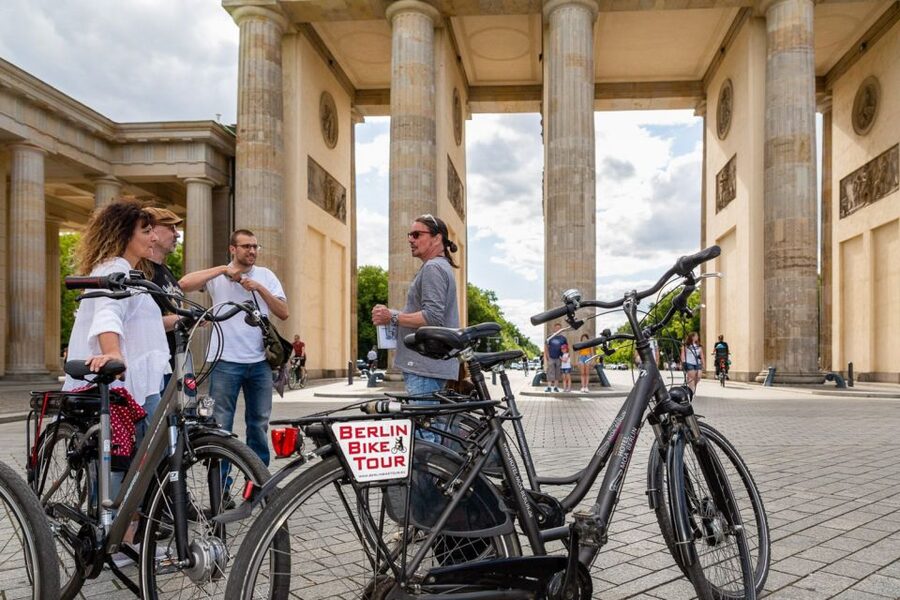
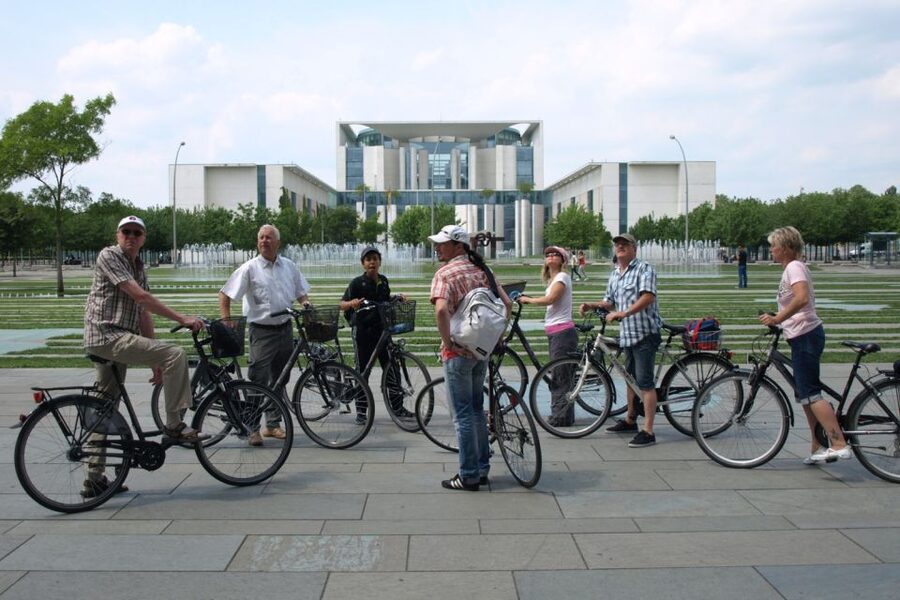
From Hauptbahnhof, the bicycle heads into the Government Quarter. The Marie-Elisabeth-Lüders-Haus is part of this modern parliamentary district, along with the Reichstag.
The Reichstag is one of Berlin’s most important symbols. It represents the German parliament and the political life of the reunited country. Its rebuilt exterior and famous glass dome have become familiar images, but seeing it as part of the Government Quarter gives the building more context.
You will see the Reichstag from the outside on this ride. Admission to the building or dome is not part of the experience, and no interior visit is promised. That is worth knowing before you book. The value here is the guide’s explanation and the chance to place the Reichstag within the wider route, not a museum-style visit inside.
The small group matters in this section. Berlin traffic and broad roads can make a large cycling group awkward. With up to eight people, the guide can keep the ride together more easily and speak to the group without shouting across a crowd.
More Small-Group Bike Tours in Berlin:
- Small Group Guided Bike Tour of Amsterdam’s Hidden Gems
★ 5.0 · 3,936 reviews - Rome City Small Group Bike Tour with quality Cannondale EBike
★ 5.0 · 1,380 reviews - Complete Cracow Bike Tour (small group of maximum 15 people!)
★ 5.0 · 1,322 reviews - Rome by Night – Ebike Small Group Tour – Food and Wine (Option)
★ 5.0 · 1,275 reviews
Tiergarten, Brandenburg Gate, and the Holocaust Memorial
The ride then enters Tiergarten, Berlin’s central park. This is one of the most pleasant parts of the route because it gives you a break from traffic and dense city blocks. You still remain close to the political center, but the surroundings become greener and calmer.
The park leads toward Brandenburg Gate, Berlin’s most famous landmark. The gate once stood near the city’s divided border and now serves as a strong symbol of reunification. Arriving by bicycle through Tiergarten gives the approach some sense of movement, rather than dropping you at the monument by train or taxi.
Near the gate, the tour visits the Holocaust Memorial. The field of concrete slabs is deliberately spare and unsettling. You will have time to see it as part of the route, but this is not a long guided memorial visit. If you want to walk through the memorial slowly or read every explanation, you may need to return later on your own.
Potsdamer Platz follows. Its modern towers and busy urban design show another side of Berlin’s rebuilding. The area was heavily damaged in the Second World War, cut by the Wall during the Cold War, and redeveloped after reunification. The contrast with the memorial and Brandenburg Gate is one of the most effective parts of the day.
Gendarmenmarkt, Bebelplatz, and Unter den Linden
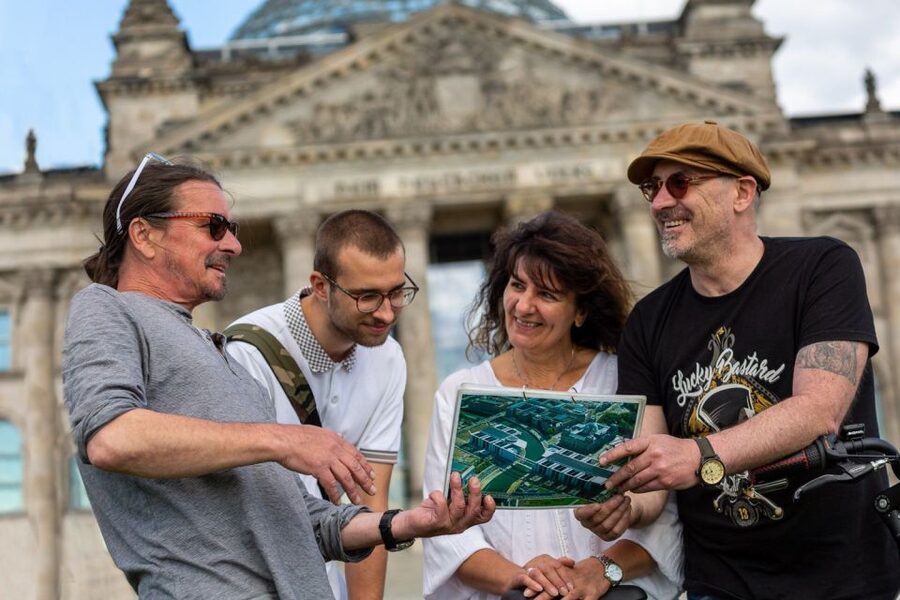
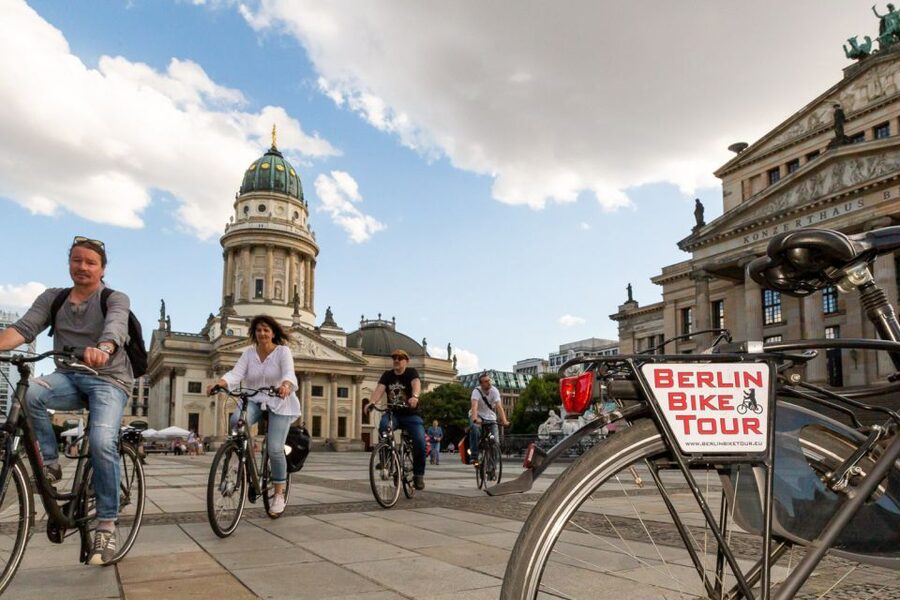
The route next moves through some of Berlin’s most elegant central squares and avenues. Gendarmenmarkt is framed by the German Cathedral and French Cathedral, with the Konzerthaus between them. The square gives you a polished architectural counterpoint to the rougher edges of Berlin’s divided past.
The German Cathedral and French Cathedral are sightseeing stops from the bicycle. You should not expect time inside either building. Still, their matching presence makes Gendarmenmarkt easy to understand even during a short stop.
At Bebelplatz, the tour enters a more serious chapter. The square is associated with the Nazi book burning of 1933. Nearby sites include Humboldt University of Berlin and Unter den Linden, the grand avenue that links several major landmarks in the historic center.
Cycling Unter den Linden is efficient because so many important places line the route. You pass from political history to university life, royal architecture, and monumental Berlin within a short stretch. The trade-off is that you cannot give each location the attention it deserves. I would treat this part as a well-guided introduction, then mark two or three places to revisit on foot.
Berlin Cathedral, Schlossplatz, and Nikolaiviertel
The ride continues toward Berlin Cathedral and Schlossplatz. The cathedral’s large dome makes it one of the city’s most memorable silhouettes, while Schlossplatz reflects Berlin’s shifting ideas about royal power, war, socialism, and reconstruction.
The nearby Nikolaiviertel offers a different feel. Its streets and buildings recall an older version of central Berlin, though much of the district has been reconstructed. It is a useful stop because Berlin’s center is not one uniform historic quarter. It is a collection of layers, some original, some rebuilt, and some newly designed.
You also pass through the area around Museum Island, though the listed stop is Berlin Cathedral rather than an interior museum visit. Do not book this ride expecting entrance tickets or quiet gallery time. Book it to understand how the central sights fit together geographically.
Red Town Hall, Neptune Fountain, and East Berlin landmarks
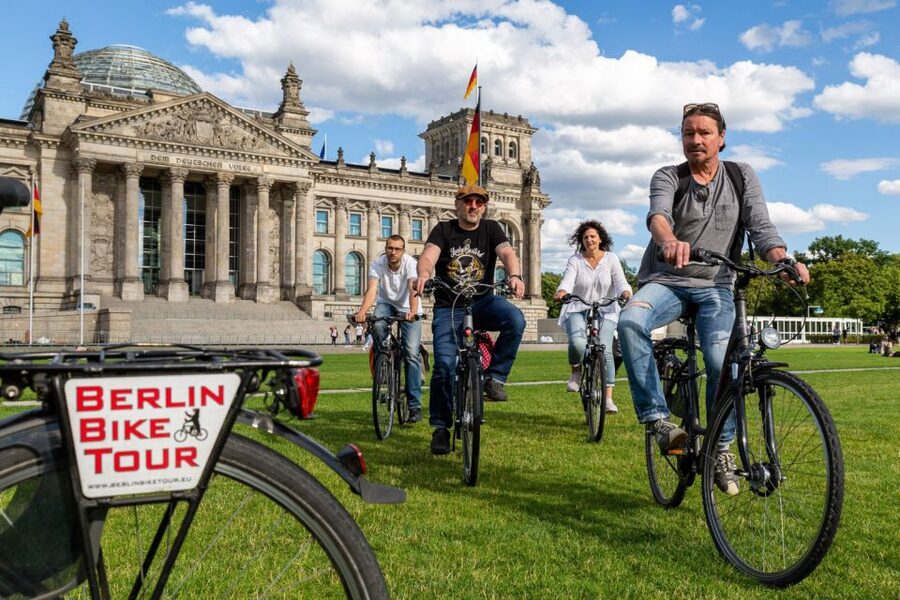
The final central stretch reaches the Red Town Hall, Neptune Fountain, St. Mary’s Church, Alexanderplatz, and the World Clock. These sights show East Berlin’s civic and public face.
The Red Town Hall is easy to recognize by its red brick exterior. Neptune Fountain and St. Mary’s Church sit within a central area where older landmarks and socialist-era planning meet. The World Clock is one of the route’s most distinctive stops. Its design reflects the international outlook promoted in East Germany, and it remains a popular meeting point.
Alexanderplatz adds another strong contrast. The square is closely tied to East Berlin, while the TV Tower rises above the entire center as one of the city’s most visible landmarks. The Park Inn by Radisson is also noted along this section, giving you a sense of the large-scale commercial architecture around the square.
This portion is especially useful if you want more than the standard Brandenburg Gate and Reichstag circuit. You see symbols from the former East Germany alongside the united city’s modern center. The route does not ask you to choose between the two Berlins. It puts them next to each other.
What three and a half hours on a bicycle feels like
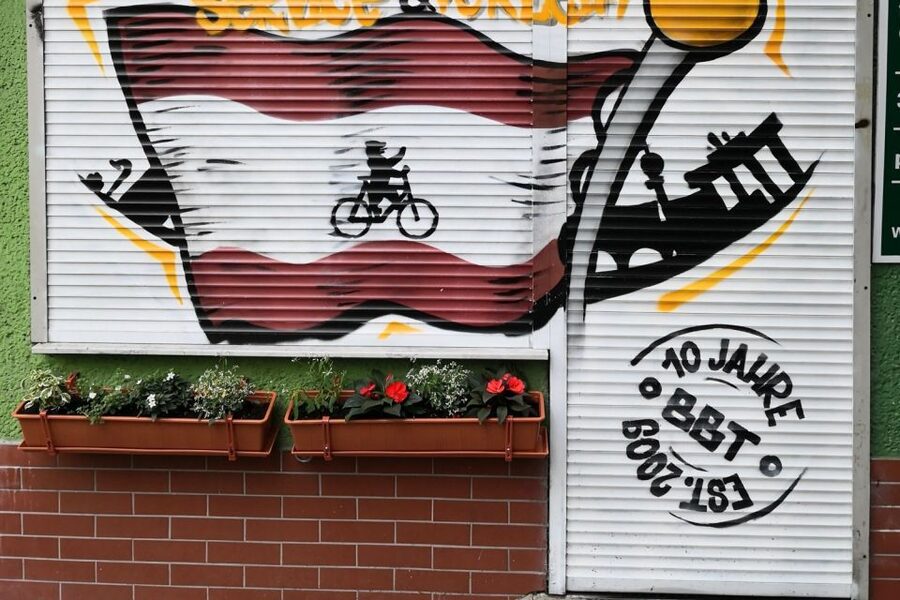
The tour lasts 210 minutes, or three and a half hours. That is long enough to cover an impressive amount of Berlin, but short enough to fit into a day that includes another major activity.
The bicycle gives you a better sense of distance than a bus. You move from one district to another, notice how the streets change, and avoid spending the whole morning underground. You also save time on short transfers between sights.
The pace is active. One person who took the tour said an extra one or two hours, perhaps with a break, would have been welcome. That is useful advice for anyone who prefers slow sightseeing. The route contains many stops, but it is not designed around long rests or meals.
Bring a water bottle, even though the official packing guidance lists identification, sunglasses, a sun hat, and a camera. Food and drinks are not included, and the route does not promise a café break. Large bags and luggage are not allowed, so leave suitcases at your accommodation.
You should also be comfortable cycling for several hours. The bicycle is included, but the information does not specify electric bicycles, child seats, helmet arrangements, or bicycle sizes. If one of those matters to you, confirm it before booking.
Guide style, language, and group size
The live tour is conducted in German. That makes this a clear choice for German speakers or anyone able to follow a German-speaking city tour. The supplied information does not promise English or another language.
A guide named Richard has led the route, and his approach has been described as personal, informative, and engaging. Other guides may lead the tour, so you should not book expecting Richard specifically unless the provider confirms it.
The group limit of eight is one of the strongest practical features. A small group gives you a better chance to hear explanations, ask a quick question, and stay close to the guide. It also avoids the slow, unwieldy feel that can come with a long line of rental bicycles.
At $40 per person, the price is reasonable for a 210-minute guided ride that includes the bicycle and a rain poncho when needed. It becomes especially good value if you want orientation on your first day in Berlin. It is less compelling if you already know the central sights or prefer to spend most of your time inside museums.
Weather, clothing, and booking details
The tour runs in all weather. Rain ponchos are provided on wet days, but you should still wear clothing that handles changing conditions. Sunglasses and a sun hat are sensible on bright days, and comfortable clothes make the ride easier.
Arrive at least 20 minutes early at 75 Bornholmer Straße. The location is well connected by tram and S-Bahn, so you do not need to arrange a private transfer. Arrival costs, food, and drinks are not included.
You can cancel up to 24 hours before the tour for a full refund under the general policy. For bookings with groups of three or more, the stated cancellation deadline is three days before the scheduled tour, so check the rule that applies to your booking. Reserve-now, pay-later availability can also help if your Berlin plans are still shifting.
Who should book this Berlin bike tour?
I would choose this ride if you want a broad first look at Berlin and are happy to see many places from the saddle. It suits adults and older children who can manage a long city ride, German speakers, and anyone who wants the Wall, reunification, government district, East Berlin, and central landmarks in one outing.
It is also a good pick for repeat visitors who have seen the headline sights but want to connect them by bicycle. The route adds Bornholmer Straße, the Old Post Headquarters, the Charité, the World Clock, and several central squares to the usual Brandenburg Gate circuit.
I would hesitate if you need an English guide, have limited cycling ability, are carrying luggage, or want interior visits at the Reichstag, cathedral, synagogues, or museums. I would also choose a slower walking tour if you prefer long conversations at each monument.
Should you book it?
Book this tour if you want efficient coverage with a personal feel. The small group, included bicycle, strong historical route, and fair $40 price make it a practical way to get your bearings across central Berlin.
Bring water, leave your large bag behind, and accept that the ride favors range over long visits. If you can follow German and enjoy an active day, this is a well-shaped introduction to Berlin’s divided past, rebuilt center, and modern identity.
FAQ
Where does the Berlin bike tour start?
The tour starts at BBT Fahrradladen, Fahrradwerkstatt & Fahrradverleih, at 75 Bornholmer Straße, Berlin 10439.
How early should I arrive?
You should be at the meeting point 20 minutes before the tour begins.
How long does the tour last?
The tour lasts 210 minutes, or three and a half hours.
How many people are in the group?
The group is limited to a maximum of eight participants.
What language is the tour conducted in?
The live tour guide speaks German.
Is a bicycle included?
Yes. A bicycle is included in the tour price.
Are rain ponchos provided?
Yes. Rain ponchos are provided when necessary, and the tour operates in all weather.
Is food or drink included?
No. Food and drink are not included, so you should bring water and plan for your own refreshments.
Can I bring luggage or a large bag?
No. Luggage and large bags are not allowed on the tour.
Newest rides we have reviewed in Berlin
- From Berlin: Gardens & Palaces of Potsdam Bike Tour★ 5.0 · 61 reviews
- Berlin: Green City Guided Bike Tour★ 4.6 · 29 reviews
- Berlin: Illuminated Berlin by Bike Taxi★ 4.8 · 162 reviews
- Berlin: 48-Hour or 72-Hour Bike Rental★ 5.0 · 14 reviews
- Berlin (E)Bike Tour Historical Highlights in Small groups★ 4.5 · 24 reviews
- Berlin: From East to West & Wall Tour by Bike with a Guide★ 4.8 · 171 reviews
- Berlin: 3-hour bike tour – A journey through time in the capital★ 4.8 · 24 reviews
- Small-Group Historical Bike Tour in Berlin★ 4.5 · 103 reviews
Small-Group Bike Tours, compared.
Small Group Guided Bike Tour of Amsterdam’s Hidden Gems
Read our review →
Rome City Small Group Bike Tour with quality Cannondale EBike
Read our review →
Complete Cracow Bike Tour (small group of maximum 15 people!)
Read our review →
Rome by Night – Ebike Small Group Tour – Food and Wine (Option)
Read our review →
Rome by Night: E-bike Small Group Tour -Food & Wine (Option)
Read our review →
Historic Athens: Small Group Electric Bike Tour
Read our review →Other lists this ride turns up in