REVIEW · COUNTRYSIDE CYCLING TOURS IN SIEM REAP
Cycle the Angkor Backroads with lunch / E-Bike or Tuk Tuk
Cycling Angkor gives you a cooler, quieter way to see Cambodia’s famous temples. Instead of moving from one parking area to the next, you travel on dirt lanes and paved roads, with jungle air, temple walls, and passing scenery unfolding at a slower pace. The route covers Bayon, Ta Prohm, Srah Srang, and Angkor Wat over about seven hours.
I like the small-group limit of 12 people and the practical package: bike, helmet, guide, water, snacks, lunch, and hotel transfers are included. Guide Son is praised for clear explanations and flexibility. The main catch is the heat, plus a 20 to 30 kilometer ride that calls for moderate fitness. Temple admission is extra.
Key points to know before booking
- You cover 20 to 30 kilometers: This is a proper day of riding, not a short pedal between two nearby sights.
- The group is limited to 12 people: That gives your guide more room to answer questions and adjust the pace.
- Guide Son may lead your ride: He is noted for strong temple and history explanations and for being flexible.
- Lunch comes by Srah Srang: You get a break beside the pond before the final visit to Angkor Wat.
- Temple tickets are not included: Budget separately for admission to the Angkor Archaeological Park.
- You can request family equipment: Kid-sized bikes, tag-alongs, and child seats are available.
Why see Angkor by bicycle?
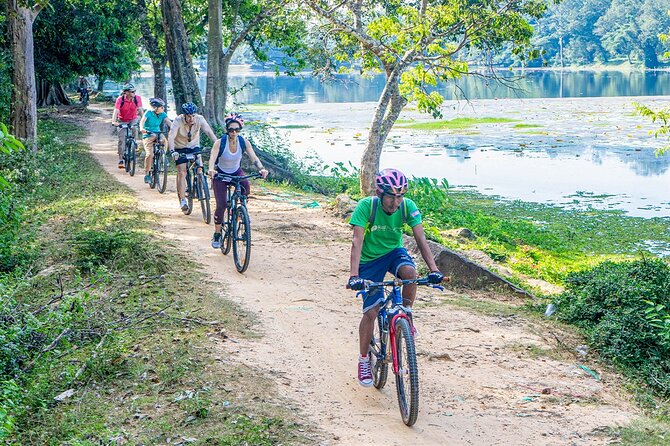
Angkor is enormous. A vehicle gets you efficiently from temple to temple, but a bicycle lets you feel the distance between them. You ride beneath trees, along the park’s lanes, and past the broad spaces that link the old Khmer capital together. That change of pace matters.
The ride also offers a break from the usual temple routine. After an hour of stone galleries and carved figures, you are back outside in open air. The bicycle becomes part of the sightseeing, not just transport.
This is especially useful if you want more than a quick photo at Angkor Wat. The route includes several major sites, but the movement between them is part of the experience. You get a better sense that Angkor was once a vast urban and religious center, not a single isolated monument.
The ride is not presented as a race. Still, 20 to 30 kilometers over a day is enough to make fitness relevant. You should be comfortable riding for extended periods, handling some dirt roads, and managing heat and humidity. If you rarely cycle, ask about the e-bike or tuk tuk option before booking.
More Countryside Cycling Tours in Cambodia
- Siem Reap Countryside Bike Tour / E-Bike or Tuk Tuk
★ 5.0 · 935 reviews - Siem Reap: Guided Countryside Bike Tour
★ 4.9 · 294 reviews - Siem Reap Countryside Guided Tour by Bike and E-Bike Private Tour
★ 5.0 · 157 reviews
Starting at 8:00 with a hotel pickup
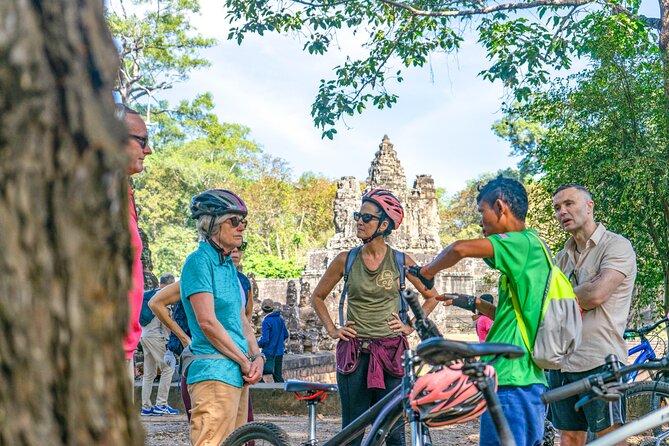
The day begins with hotel pickup at about 8:00 am. You are taken to the Siem Reaper Travel office, where you are fitted with a bicycle and helmet. Allow around 30 minutes for this opening stage.
This transfer is a useful part of the package. You do not need to find the starting point or arrange a separate ride to collect your equipment. It also gives the guide or staff a chance to check your bike before you enter the park.
Pay attention to the fit. A comfortable saddle and correctly adjusted handlebars matter after several hours. Tell the staff if the bicycle feels wrong before setting off. Water and snacks are provided, but you should still arrive ready for a warm day outside.
The tour includes an English-speaking cycle guide. Guide Son is specifically noted for explaining the temples and their history well, while also being flexible during the ride. Guide quality can shape a day like this, since the stones are impressive but the meaning behind them is what turns a stop into a lesson.
Bayon and the gates of Angkor Thom
The morning ride takes you toward the Angkor Archaeological Park and Angkor Thom. Entering the old city through its ancient gate is an impressive start. The gate is decorated with elephants and four giant faces, giving you an immediate sense of the scale and symbolism of the site.
Bayon is the main stop in this part of the morning. Its towers carry the famous carved faces that look out across the temple. You can expect time to walk around and examine the stonework rather than simply stopping for a quick photograph.
The Bayon section and the Angkor Thom area receive about three hours in the stated plan. That is a substantial portion of the day, and rightly so. There is enough here to keep you moving between courtyards, towers, gates, and carved surfaces.
Cycling helps with the larger setting. You are not limited to the temple interior, since the ride through Angkor Thom forms part of the visit. The old roads and tree-lined routes provide a useful pause between dense stonework.
Your guide’s commentary is important here. A good explanation can help you read the faces, entrances, and layout instead of seeing them as disconnected ruins. Son is praised for giving plenty of information about the temples and their history, though guide confidence can vary from one departure to another. One aspect that may feel less polished is help with taking photographs, so you may need to choose your own angles and timing.
Temple admission is not included. You will need the required pass for the Angkor complex, and the tour price does not cover it. Check that you have arranged this before the day begins, since the ride itself includes multiple temple entries.
Ta Prohm beneath the trees
From Bayon, the route continues to Ta Prohm. This is the temple most closely associated with giant trees, crumbling stone, and the Tomb Raider film. The jungle growth gives the site a different mood from Bayon’s towers and open courtyards.
You get about two hours here. That allows time to walk through the temple, look at the carved details, and see how roots and masonry occupy the same space. Ta Prohm is visually dramatic, but the uneven ground and crowded passageways mean you should stay aware of your footing.
The bicycle ride to Ta Prohm is part of the appeal. You leave the denser temple spaces, return to the road, and approach the site with fresh air around you. That rhythm keeps the day from becoming a nonstop sequence of interior visits.
I also like that the route does not treat Ta Prohm as a quick add-on. Two hours gives you a chance to slow down. The drawback is that the most famous tree-covered areas can be busy, and cycling does not guarantee solitude at the temples themselves. The quieter feeling comes mainly from the ride between stops and the small-group format.
Same roads, a different saddle:
- Angkor Sunrise Bike Tour / E-Bike or Tuk Tuk
★ 5.0 · 615 reviews - Phnom Penh Silk Island Bike Tour/ E-Bike or Tuk Tuk
★ 5.0 · 495 reviews - Siem Reap: Bike the Angkor Temples – Full-Day 30km Tour
★ 5.0 · 463 reviews - Siem Reap: Angkor Wat Sunrise Bike Tour & Jungle Breakfast
★ 5.0 · 415 reviews
Lunch beside Srah Srang
Srah Srang provides the day’s natural pause. This large pond, bordered by a tropical garden, is the lunch stop. You have about an hour to eat, rest, and look across the water before continuing.
A lunch break is more valuable than it sounds on a hot cycling day. You need time to cool down, drink water, and let your legs recover. The pause also breaks up the temple schedule, so Angkor Wat does not arrive when you are already worn out.
Lunch is included, along with bottled water and snacks. A vegetarian option is available, but you need to request it when booking. The information provided does not specify the exact menu, so do not book this expecting a particular Cambodian dish.
Srah Srang is also a good reminder that Angkor is not only about buildings. Water management was central to the old city, and a pond stop helps you see the temples within their wider setting. You are not just checking off monuments. You are seeing how sacred spaces, roads, trees, and water fit together.
Ending at Angkor Wat
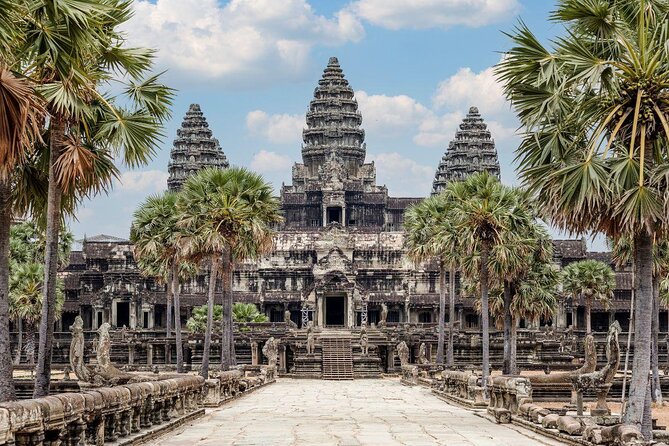
After lunch and a rest, the ride heads to Angkor Wat. The final stop receives about two hours, which gives you time to explore the world’s largest religious monument and one of Cambodia’s most important national symbols.
Angkor Wat is vast and detailed. Its galleries, towers, bas-reliefs, and long approaches reward a slower visit. A guide can point out elements of its symbolism and history, helping you make sense of a complex site that can otherwise feel overwhelming.
Ending here works well. You have already seen Bayon’s faces and Ta Prohm’s tree-covered ruins, so Angkor Wat arrives as a different kind of monument. Its formal plan and scale make a strong finish to the day.
The timing also deserves attention. This is a morning-start tour that finishes after the Angkor Wat visit, not a sunrise tour. If your priority is a dawn view, this experience is not designed around that. Its strength is the full-day route, the ride between sites, and the lunch break before the final temple.
You should also plan for temple dress. Shoulders and knees need to be covered, especially at Angkor Wat. Lightweight clothing that meets this rule will make the ride more comfortable while respecting local expectations.
What the $55 price really covers
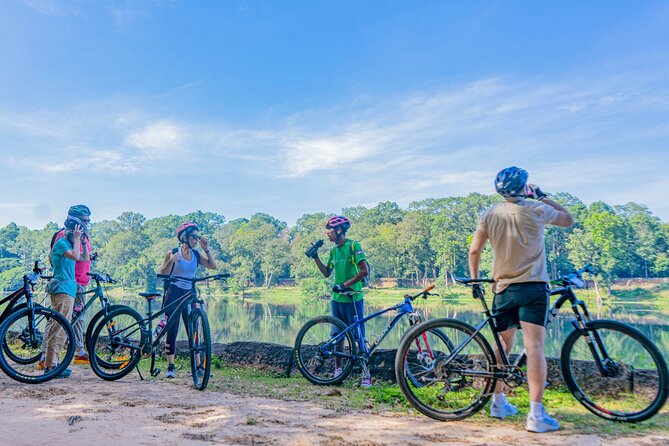
At $55 per person, the tour includes several costs that can add up on your own: hotel pickup and drop-off, bicycle use, helmet, an English-speaking cycling guide, bottled water, snacks, and lunch.
The value depends on how much you want the cycling element. If you already have transport and only want a guide at the temples, this may not be the cheapest way to visit Angkor. But if you want a planned route, bike rental, support, food, and transfers in one day, the price is reasonable.
The temple pass is the major extra expense. Since it is not included, factor it into your total budget before booking. Personal expenses are also separate.
Small-group size adds value here. With a maximum of 12 people, the guide can usually speak to the group without the day feeling like a large convoy. It also makes it easier to hear commentary and ask questions at the stops.
The tour is commonly booked around 18 days ahead. That does not guarantee every date will sell out, but it is a useful reason to reserve early if your Siem Reap schedule is fixed.
Bike, e-bike, or tuk tuk?
The core plan uses a Trek mountain bike and helmet. You should be comfortable with a full day of riding and a total distance of roughly 20 to 30 kilometers. The roads include dirt lanes and paved sections, so this is not a purely smooth-surface city ride.
The experience also offers an e-bike or tuk tuk choice. The supplied details do not spell out every difference between these options, so confirm the arrangement when you book. An e-bike may suit you if you want to pedal but worry about heat or distance. A tuk tuk is the safer choice if cycling is not realistic for you.
Families can request kid-sized bikes, tag-alongs, and child seats. That is helpful, but the overall schedule remains long. A child who is fine with a short cycle may not enjoy seven hours in the heat, so consider the child’s stamina rather than relying only on the equipment.
You should bring practical clothing, sun protection, and a way to carry small personal items. The required temple dress means no bare shoulders or knees at the main monuments. Comfortable shoes are also useful because the bicycle only takes you to the site entrance, not through the temple grounds.
Heat, fitness, and guide quality
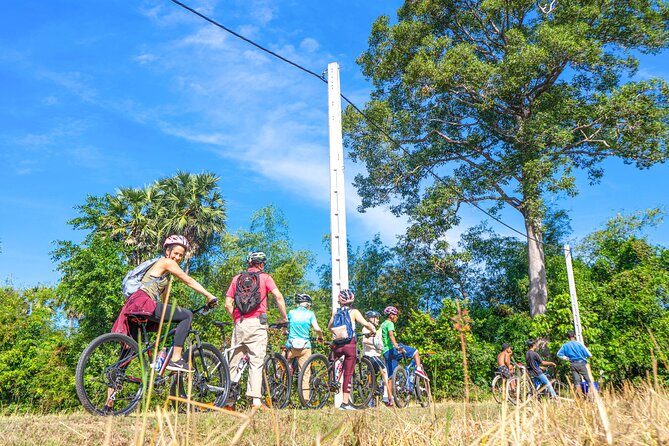
The biggest physical issue is Cambodia’s heat and humidity. One part of the experience is the exertion of riding. The other is walking around large temple compounds after you park the bicycle. The lunch and rest stop help, but they do not remove the need to pace yourself.
You should choose this tour if you are reasonably fit and comfortable on a bicycle. It is not ideal if you want a low-effort sightseeing day. The tuk tuk option may make it more accessible, but confirm exactly how that version works before paying.
Guide Son receives particularly strong praise for clear information and flexibility. That matters when a group has different cycling speeds or wants to spend more time at one temple. At the same time, you should keep expectations realistic about photography assistance. Guidance on where to take pictures may not always feel polished, even when the temple commentary is strong.
The tour has a 98 percent recommendation rate and a five-star rating based on 124 reviews. Those figures point to a consistently well-received experience, but the practical details are more useful than the headline score: hot weather, extra temple fees, a demanding distance, and occasional uneven guide presentation are the points to weigh.
Who should book this Angkor cycling tour?
I would choose this for an active visitor who wants Angkor to feel like a place, not just a sequence of car stops. It suits couples, friends, solo visitors comfortable joining a small group, and families who can manage a long day outdoors.
It is also a good fit if you care about the transition between temples. The ride gives you fresh air and a closer look at the roads and surroundings inside the park. You get the major names, but the day does not feel entirely built around standing in lines and taking the same entrance photographs.
I would hesitate if your priority is maximum comfort, a slow pace, or a guaranteed focus on photography. You may also prefer another plan if 20 to 30 kilometers sounds tiring before you even begin. The e-bike or tuk tuk version could change that calculation, but confirm the details first.
Cancellation is flexible up to 24 hours before the start time for a full refund. Changes or cancellations made inside that window are not accepted for a refund.
Should you book it?
Book this tour if you want an active, well-organized way to connect Angkor Wat, Angkor Thom, Bayon, Ta Prohm, and Srah Srang in one day. The included lunch, equipment, guide, water, snacks, and hotel transport make the $55 cost easier to justify, even with temple admission still to pay.
Skip it if you dislike cycling in hot weather or want to spend the day entirely inside the monuments. For everyone else, this is a strong choice for seeing Angkor at human speed, with enough structure to keep the day simple and enough road time to make the park feel larger than its famous photographs.
FAQ
What time does the tour start?
The tour starts at 8:00 am, with hotel pickup included.
How long does the experience last?
The tour lasts approximately seven hours.
How far do you ride?
The stated cycling distance is about 20 to 30 kilometers.
Which temples and sites are included?
The route includes Bayon, Angkor Thom, Ta Prohm, Srah Srang, and Angkor Wat.
Are temple entrance fees included?
No. Entrance fees to the Angkor temple complex are not included in the tour price.
Is lunch included?
Yes. Lunch, bottled water, and snacks are included. A vegetarian option is available if requested at booking.
Can children join the tour?
Yes. Kid-sized bikes, tag-alongs, and child seats are available. Participants should have a moderate level of physical fitness.
More Rides with Lunch in Cambodia
- Angkor Wat: Guided Sunrise Bike Tour w/ Breakfast and Lunch
★ 4.8 · 48 reviews - Electric Cycling Tour of Ubud with Free Hotel Transfer and Lunch
★ 5.0 · 1,397 reviews - Bangkok: Bike and Canal Boat Tour with Lunch
★ 4.9 · 1,350 reviews - Cat Ba: Lan Ha, HaLong bay full day- biking, kayaking, lunch
★ 4.8 · 1,166 reviews
More E-Bike Tours in Cambodia
- From Siem Reap: Angkor Wat Sunrise and Temples E-Bike Tour
★ 5.0 · 52 reviews - Cycle Angkor Backroad Bike Tour / E-Bike or Tuk Tuk
★ 4.9 · 16 reviews
Newest rides we have reviewed in Cambodia
- Cycle Angkor Backroad Bike Tour / E-Bike or Tuk Tuk★ 4.9 · 16 reviews
- Ho Chi Minh City: 2-Day Bike & Kayak Mekong Delta Tour★ 4.9 · 64 reviews
- From Siem Reap: Angkor Wat Sunrise and Temples E-Bike Tour★ 5.0 · 52 reviews
- Explore the Village &Countryside By Bicycle-Half Day Morning★ 4.8 · 13 reviews
- Small Group Countryside Sunset Bike Tours★ 5.0 · 39 reviews
- Angkor Wat: Guided Sunrise Bike Tour w/ Breakfast and Lunch★ 4.8 · 48 reviews
- Siem Reap: Angkor Wat Sunrise Bike Tour & Jungle Breakfast★ 4.9 · 141 reviews
- Siem Reap Countryside Guided Tour by Bike and E-Bike Private Tour★ 5.0 · 157 reviews
Countryside Cycling Tours, compared.
Windmill, Cheese, and Countryside E-Bike Tour
Read our review →
Siem Reap Countryside Bike Tour / E-Bike or Tuk Tuk
Read our review →
Mekong Day Trip Explore Village Bicycle CookingClass Group 12 Pax
Read our review →
Hoi An Countryside: Guided Morning or Afternoon Bicycle Tour
Read our review →
Rice Terraces & Villages Half-Day Fat Tire E-Bike Tour
Read our review →