
REVIEW · CAPE TOWN
Cape Town City and Woodstock Bicycle Tour
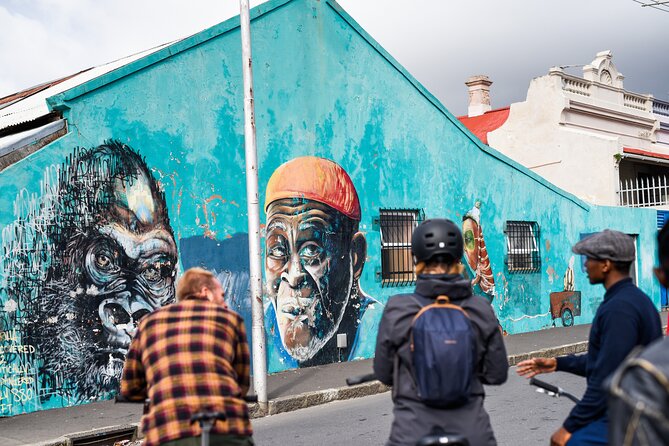
Cape Town’s story is written across its walls, streets, gardens, and old buildings, and this three-hour bicycle tour lets you cover a lot of it without spending the day on foot. Starting in Woodstock, you pedal through street-art areas and central landmarks, with history woven into the ride.
I like the route for two clear reasons: the Old Biscuit Mill and Woodstock add a local, creative edge, while stops such as District Six, the Castle of Good Hope, and City Hall give the tour real historical weight. I also like that a bike, entrance fees, and a small-group format are included. The main trade-off is pace. Three hours is enough for an overview, but not enough for long visits at every stop.
Key points at a glance
- Woodstock sets the tone: Begin at the Old Biscuit Mill, a former biscuit factory now filled with shops, food, art, and street murals.
- History is part of the ride: District Six, the Castle of Good Hope, Grand Parade, and City Hall connect Cape Town’s past to its present.
- Bo-Kaap adds color and culture: The neighborhood’s painted houses reflect its links to Muslim communities and freed slaves.
- You cover more ground than on foot: The route links Woodstock with the central city in about three hours.
- Small groups keep it personal: No more than 15 people are allowed, and guides such as Sipho and Terrence have been praised for their storytelling and local insight.
- The price is reasonable for an active overview: At $54.83 per person, the package includes bicycle use and an entrance fee.
Starting at Woodstock’s Old Biscuit Mill
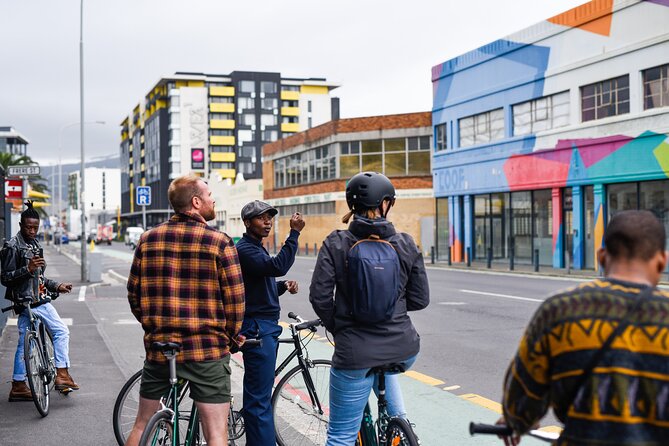
The meeting point is Shop 5 at the Salt Circle Arcade, 374 Albert Road in Woodstock. The tour ends back there, so you do not need to arrange a separate return trip from the city center.
Starting in Woodstock is one of the best features of the route. Many first-time visitors focus only on central Cape Town and miss this suburb’s art and design scene. The ride begins near the Old Biscuit Mill, a former factory that has been turned into a shopping, dining, and arts center.
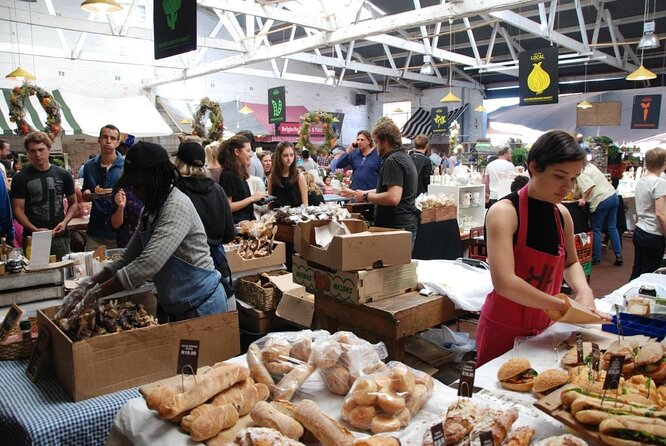
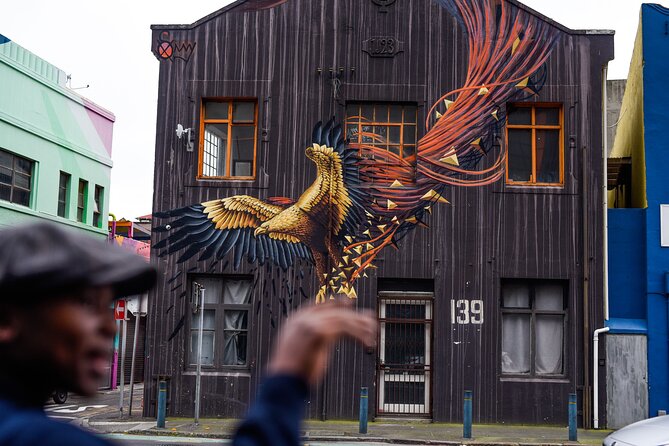
The Old Biscuit Mill is a useful first stop because it shows a different side of Cape Town. Its walls carry work by local and international artists, and the complex has boutiques, stores, and places to eat. On weekends, the Neighbourgoods Market adds more food and shopping activity.
You should think of this as a look rather than a full market visit. The tour lasts only about three hours, so there may not be time to browse every shop or eat a full meal. If the market matters to you, check the day of your booking and consider returning on your own later.
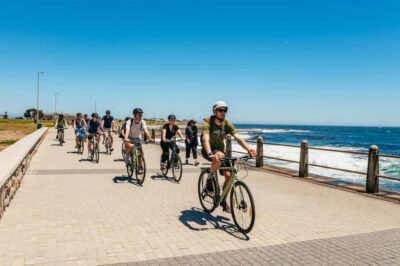
The bikes are included, which removes one common problem with city cycling tours. You do not need to find a rental shop, work out a drop-off point, or bring equipment from home. The group can have up to 15 people, large enough to offer company but still manageable for a guide moving through city streets.
More Cycling Trips in Cape Town:
- Cape Town City Cycling Tour
★ 5.0 · 199 reviews - Cape Town: Guided Bike Tour
★ 4.9 · 193 reviews - Cape Town: E-Bike City Tour
★ 4.8 · 76 reviews
District Six and the cost of Cape Town’s past
The ride continues toward District Six, one of the most important historical areas on the route. In the 1960s, the government forcibly removed roughly 60,000 nonwhite residents from their homes after the area was declared for white occupation. Their former neighborhood was destroyed, and many people were sent to distant townships with poor living conditions.
The District Six Museum was founded in 1994 to honor the people who were removed. An entrance fee is included in the tour, which gives this part of the ride more substance than a quick pass by a sign or street corner.
I consider this one of the most valuable stops because it gives context to the city you are seeing. Cape Town can appear polished and picturesque, but its streets also carry the marks of forced separation and loss. A guide can help connect the museum’s story with the surrounding city.
Do not expect a long museum visit. The tour also includes many outdoor landmarks, and the full route must fit into three hours. Still, even a focused visit can help you understand why District Six matters and why its memory remains part of Cape Town’s public life.
Grand Parade, City Hall, and Mandela’s public return
Grand Parade adds another layer of history. The Dutch built their first fort here in 1652, and the square later became a site connected with slavery, punishment, markets, parking, and public gatherings.
Its most famous modern moment came in 1990, when Nelson Mandela addressed the nation from the balcony of the Old Town Hall after his release from prison. The square is not preserved as a quiet museum space. It is used for everyday city activity, which makes the history feel close to present life rather than sealed behind glass.
The Old Town Hall itself is an impressive Edwardian building dating from 1905. Seeing the balcony where Mandela spoke gives the stop a clear visual focus. You are not simply hearing a date and a name. You are looking at the place where a major public moment happened.
The route may include other nearby stops depending on the guide’s chosen path. That wording matters. The exact order can vary, and not every listed location is guaranteed on every departure. Ask your guide at the start which stops are planned if a particular building is important to you.
Bo-Kaap’s painted streets and layered identity
Bo-Kaap sits on the slopes of Signal Hill, just outside the central city. Its brightly painted houses make it one of Cape Town’s most recognizable neighborhoods, but the colors are only the beginning of the story.
The area was one of the early settlements of freed slaves and Muslim immigrants in South Africa. Its cultural links include Malay, Indian, Sri Lankan, and African communities. The result is a neighborhood with a strong sense of place and a history that cannot be reduced to a photo stop.
A bicycle is useful here because you can see Bo-Kaap in relation to the rest of central Cape Town. At the same time, cycling through a residential neighborhood calls for care. You will be moving through lived-in streets, not a film set. Follow the guide’s pace, keep your attention on traffic, and give people space.
Bo-Kaap is also a good example of why a guide adds value. A quick visit alone might leave you with colorful houses and a few photographs. A good explanation connects the architecture with migration, religion, slavery, and the city’s changing identity.
Same roads, a different saddle:
- Cape Town: Guided eBike Tour with Signal Hill and Clifton …
★ 4.9 · 71 reviews - Cape Town: E-Bike Cape Peninsula Tour
★ 4.7 · 54 reviews - Bicycle Township Tour in Cape Town
★ 5.0 · 43 reviews - Cape Town’s Finest City Bike Tour
★ 5.0 · 43 reviews
Company’s Garden, Greenmarket Square, and St George’s Mall

Company’s Garden offers a welcome green break in the middle of the city. The Dutch East India Company planted it after arriving in 1652 to help feed the settlement. It remains a public park and a favorite place for both residents and visitors.
I like this stop because it shows how practical decisions from the colonial period still shape modern Cape Town. The garden is not just decoration. It began as part of the settlement’s food supply and became a public space over time.
Greenmarket Square brings you back into the city’s commercial life. The cobbled plaza was once associated with slavery and later became a produce market. Today, vendors sell painted fabrics, jewelry, and other handmade goods, while performers provide music and dance.
You should be ready for a shopping atmosphere here. Some people enjoy browsing and bargaining; others may find the sales activity distracting. The tour gives you a taste of the square, but a short stop is not the same as taking time to inspect every stall.
St George’s Mall offers a different kind of city scene. The former traffic street is now pedestrian-only, with coffee shops, restaurants, buskers, dancers, drummers, and street artists. It is a useful place to see how central Cape Town functions during an ordinary day.
These three locations work well together. Company’s Garden gives you open space, Greenmarket Square shows the old market tradition, and St George’s Mall brings you into the city’s modern pedestrian life.
Long Street and the Castle of Good Hope
Long Street cuts through the heart of Cape Town’s central business district and continues toward Kloof Street. It has long been a major cultural and social street, drawing both local people and international visitors.
On a bicycle, you can understand its position within the city more quickly than you might on foot. You also get a stronger sense of how close the historic center, shopping streets, residential areas, and Woodstock are to one another.
The Castle of Good Hope provides the route’s strongest military landmark. Built by the Dutch in the 17th century, it was originally near the shoreline of Table Bay. Land reclamation later left it inland, a detail that shows how much Cape Town’s waterfront and city edges have changed.
The Castle was declared a historical monument in 1936. An entrance fee is included, though the available information does not specify how much time the tour spends inside. If you want a full castle visit, check with the guide before booking or plan a separate visit.
The route information also refers to the Cape of Good Hope. Do not confuse that with the Castle of Good Hope. The Cape of Good Hope is the famous peninsula destination far beyond central Cape Town, while the Castle is a city fort. The stated route focuses on Woodstock and central city sights, and the exact stops can vary with the host and route.
What the guide adds to the ride
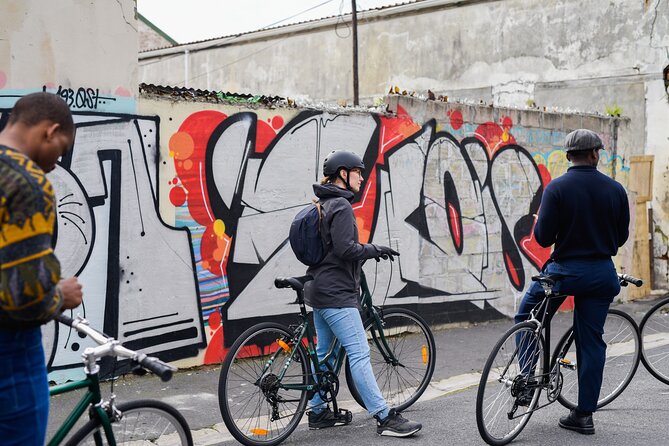
The guide is the heart of this experience. The route includes many places that you could locate on a map, but the value comes from understanding how they connect.
Sipho is described as friendly and able to balance culture and history with local recommendations. Terrence is especially associated with street art, neighborhood stories, and detailed explanations of the art along the route. Those names are useful when you receive your booking details, since the guide assigned to your departure may affect the tone of the ride.
I would choose this tour for someone who likes to ask questions. The format leaves room for conversation, and the guide can help explain why a mural, square, neighborhood, or building matters. It is not simply a bike rental with a route sheet.
The small group limit of 15 helps. That is not an ultra-small private tour, but it is far better than being one cyclist in a large convoy. You should still expect to stop and start as the group gathers, especially in busy central areas.
Is $54.83 good value for three hours?
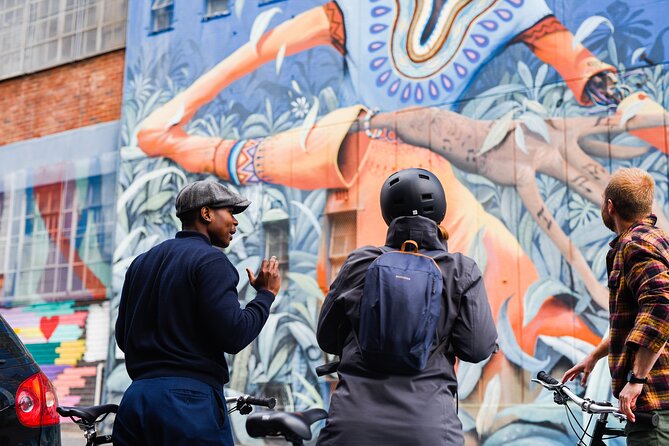
At $54.83 per person, the tour is priced above a basic bicycle rental but includes more than a bike. You are paying for a guide, the route planning, bicycle use, and an entrance fee. You also cover several parts of Cape Town in one outing.
The value is strongest if you have limited time in the city. A walking tour covering Woodstock, District Six, Bo-Kaap, Company’s Garden, Greenmarket Square, Long Street, and the Castle would require more time and energy. Cycling links these areas in a practical way.
The value is weaker if you want long museum visits, extended shopping, or a slow photo tour. Three hours passes quickly, and the route has a lot to cover. You may leave with a strong overview but a list of places you want to revisit.
The experience is rated 4.7 out of 5, with 93 percent recommending it. That matches the tour’s strongest qualities: the guides, the mix of art and history, the quality of the bikes, and the chance to see parts of Cape Town that are easy to miss from a standard sightseeing route.
Who should book this Cape Town bike tour?
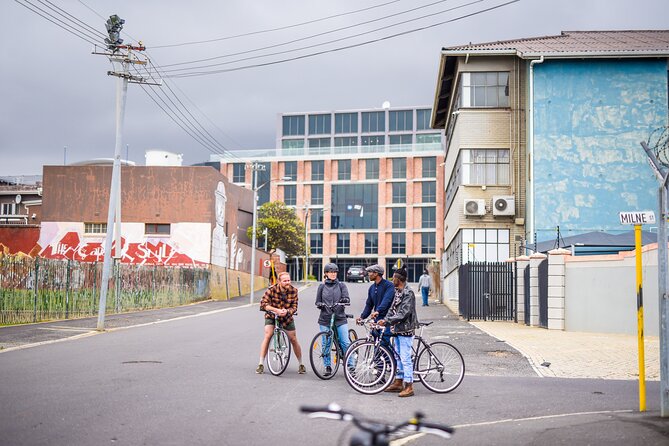
I would choose this ride for a first visit, especially if you want an introduction before exploring individual neighborhoods on your own. It suits active visitors who enjoy seeing a city at street level and do not want to spend the whole day inside museums or on a bus.
It is also a strong choice for anyone interested in street art, urban history, apartheid-era displacement, colonial buildings, and local communities. Families and mixed-age groups may appreciate the short length, though every participant must be comfortable cycling as part of a group.
You should think twice if you want a private experience, a very slow pace, or a detailed visit at every museum. The maximum group is 15, the exact route may change, and some stops are viewed from outside or visited briefly.
Good weather is required. If poor weather forces cancellation, you can receive a different date or a full refund. You can also cancel for a full refund up to 24 hours before the start time. Confirmation is provided at booking, and the meeting point is near public transportation.
Should you book it?
Book this tour if you want a fast, thoughtful introduction to Cape Town by bike, with street art and difficult history given equal attention. The best parts are the Old Biscuit Mill, District Six, Bo-Kaap, the Mandela landmarks, and the guides’ local storytelling.
Skip it if you want a full-day Cape Peninsula outing or extended time inside each attraction. For everyone else, $54.83 is a fair price for a guided route that shows how Woodstock and central Cape Town fit together.
FAQ
How long does the Cape Town City and Woodstock Bicycle Tour last?
The tour lasts approximately three hours.
Where does the tour start?
It starts at Shop 5 in the Salt Circle Arcade, 374 Albert Road, Woodstock, Cape Town, 7925, South Africa.
Where does the tour end?
The activity ends back at the meeting point in Woodstock.
Is bicycle use included?
Yes. Use of a bicycle is included in the price.
What is the maximum group size?
The tour has a maximum of 15 participants.
Can I cancel for a full refund?
Yes. You must cancel at least 24 hours before the experience start time for a full refund. If poor weather causes the operator to cancel, you will be offered another date or a full refund.
Newest rides we have reviewed in Cape Town
- Bicycle Township Tour in Cape Town★ 5.0 · 43 reviews
- Mountain Biking Table Mountain to Constantia Morning Ride★ 5.0 · 17 reviews
- Cape Town’s Finest City Bike Tour★ 5.0 · 43 reviews
- Private Cycling Tour of The Cape Peninsula from Cape Town★ 5.0 · 14 reviews
- Half-Day Winelands E-Bike Tour with Wine Tasting★ 4.2 · 13 reviews
- Cape Town: E-Bike Cape Peninsula Tour★ 4.7 · 54 reviews
- Cape Town: Cultural Cycling Tour★ 4.8 · 19 reviews
- Cape Town: Peninsula Road Bike Tour★ 5.0 · 23 reviews
Cape Town Cycling Tours, compared.
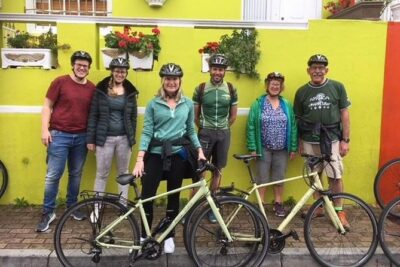


Guided eBike Tour with Signal Hill and Clifton …
Read our review →


Other lists this ride turns up in