
REVIEW · BERLIN
Alternative Berlin Bike Tour – Off the Beaten Tracks in Small Groups
Berlin’s alternative side is best understood from a bike seat. This ride takes you beyond the usual postcard circuit, through Friedrichshain and Kreuzberg, where Soviet apartment blocks, street art, old railway yards, parks, clubs, and political history sit close together. You may hear personal stories from guides such as Anna, Marcus, Paul, or Maria, depending on the day.
I like the small maximum group of 14, which means fewer pauses while the guide gathers the group. I also like the blend of city riding and short stops, especially the contrast between Karl-Marx-Allee’s formal Soviet architecture and the rough creative energy of RAW Tempel. The main drawback is traffic: Berlin is fairly flat, but roads can feel demanding, especially for a younger cyclist or anyone uneasy in city traffic.
- Ride through Friedrichshain and Kreuzberg, two districts known for alternative culture, street art, clubs, parks, and layered political stories.
- See Karl-Marx-Allee, where grand Socialist Classicist blocks meet the architectural ideas of Prussian designer Karl Friedrich Schinkel.
- Stop at RAW Tempel, a former railway site now used for art, markets, bars, clubs, and community projects.
- Cross or view Oberbaum Bridge and the East Side Gallery, key places for understanding Berlin’s divided past and changing present.
- Use a bike and helmet at no extra charge, with an English-speaking local guide leading the way.
- Expect about three and a half hours of riding, starting and ending at Berlin on Bike near Kulturbrauerei.
Why this bike ride shows a different Berlin
This is not a greatest-hits tour with a quick photo stop at the Brandenburg Gate. It is aimed at the parts of Berlin that explain how the city lives now: alternative art spaces, former industrial sites, everyday neighborhoods, political graffiti, large public parks, and the remains of the Wall.
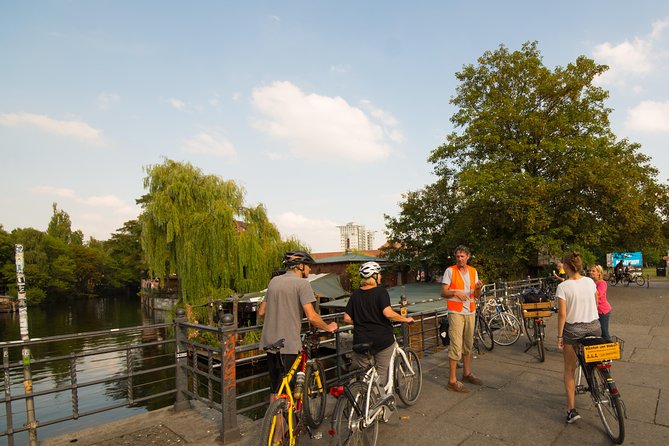
The route focuses on Berlin’s eastern and southeastern districts. You begin near Kulturbrauerei in Prenzlauer Berg, then ride toward Friedrichshain and across into Kreuzberg. Along the way, the guide connects architecture and street scenes to the city’s divided past, reunification, club culture, squatting, artistic communities, and changing neighborhoods.
That mix is the tour’s strongest feature. You are not simply looking at buildings. You are learning why a former railway yard became a cultural site, why Karl-Marx-Allee looks so different from the rest of Berlin, and how the Wall became both a memorial and a giant public art surface.
Meeting at Kulturbrauerei at 3 pm
The tour starts at Berlin on Bike, at Knaackstraße 97 beside Kulturbrauerei. The depot is near public transportation, and the experience ends at the same place, so you do not need to arrange a second pickup.
A 3 pm start works well if you want a slower morning or plan to visit a museum first. It also places much of the ride in the later afternoon, when the streets and public spaces may feel more active. Give yourself enough time to reach the depot, choose your bike, and settle in before departure.
The bikes and helmets are included. That matters in Berlin, where renting a suitable bicycle separately can add both cost and planning. The tour does not include food, drinks, hotel pickup, or drop-off, so eat beforehand and carry water.
More Hidden Gems Bike Tours in Berlin:
- Berlin: Top secret bike tour and hidden gems of the city
★ 4.8 · 411 reviews - Small Group Guided Bike Tour of Amsterdam’s Hidden Gems
★ 5.0 · 3,936 reviews - Bangkok: Temples, Canals & Local Life Bike Tour
★ 4.9 · 3,511 reviews
Kulturbrauerei: an industrial beginning
Kulturbrauerei is more than a meeting point. This 25,000-square-meter complex is one of Berlin’s best-preserved late 19th-century industrial sites, with brick buildings, courtyards, and distinctive architectural details.
It has been protected since 1974 and now serves as a cultural center. You only spend about five minutes here during the listed route, so do not expect a full architectural tour. Still, it gives you an early clue about the experience: Berlin’s culture often grows from old industrial spaces rather than purpose-built attractions.
The short introduction also helps set up the larger theme of the ride. You will keep seeing places where the city’s past has been reused instead of erased.
Volkspark Friedrichshain and the rhythm of city riding
From the depot, the route heads toward Friedrichshain and its public parks. Volkspark Friedrichshain was created in 1846 as Berlin’s first municipal green area. It remains an important recreation space, offering a break from the traffic and dense blocks around it.
The park section helps vary the pace. This is not three and a half hours of nonstop pedaling. The route includes time to stop, listen, and take in the surroundings, with a balance of riding, neighborhood exploration, and short historical talks.
You should still expect a real ride. One person described the route as fairly flat but longer than expected, which is a useful distinction. You do not need to climb hills, but you do need enough stamina for a half-day cycling tour.
Karl-Marx-Allee and East Berlin’s grand scale
Karl-Marx-Allee is one of the most striking parts of the route. Its broad avenue is lined with large apartment blocks and towers built in a blend of Socialist Classicism and the Prussian Schinkel School.
The architecture feels formal and monumental. It was designed to project confidence and order, a sharp contrast with Berlin’s later reputation for improvised clubs, graffiti, and alternative art. Your guide can use the avenue to explain East Berlin’s built environment and the political ideas behind it.
This is also one of the places where a bicycle helps. On foot, the scale of the avenue can make the buildings feel scattered. From a bike, you move through the sequence of blocks and see how the street works as a whole.
The stop is brief, about five minutes in the listed schedule, so expect an overview rather than an extended architectural lecture. If you care deeply about design, you may want to return later for a longer walk along the avenue.
More Cycling Trips in Berlin:
- Berlin: Sights and Highlights Bike Tour with a Local Guide
★ 4.8 · 2,698 reviews - Berlin Highlights 3-Hour Bike Tour
★ 5.0 · 948 reviews - Berlin City Bike Tour with Beer Garden Stop
★ 5.0 · 917 reviews - Berlin Highlights: 3-Hour Bike Tour
★ 4.9 · 809 reviews
RAW Tempel and Berlin’s creative edge
RAW Tempel occupies a former railway area and now provides space for intercultural projects, exhibitions, markets, bars, and clubs. It is one of the clearest examples of Berlin’s ability to turn rough, leftover urban space into something useful and unpredictable.
The name is often linked with the former Reichsbahnausbesserungswerk railway repair grounds. On this tour, the important point is how the place functions today. It is not polished in the conventional tourist sense, and that is precisely why it belongs on an alternative Berlin route.
Your guide may discuss street art crews, community projects, squatter culture, nightlife, or the tensions that come when a once-independent area becomes more popular. The details can change over time, so the guide’s current local perspective is valuable here.
You get a short stop rather than a dedicated night out. If RAW Tempel catches your interest, make a note of it and return independently after the tour. The route gives you an introduction, not enough time to explore every courtyard, exhibition, bar, or club.
The East Side Gallery and the Wall’s changing meaning
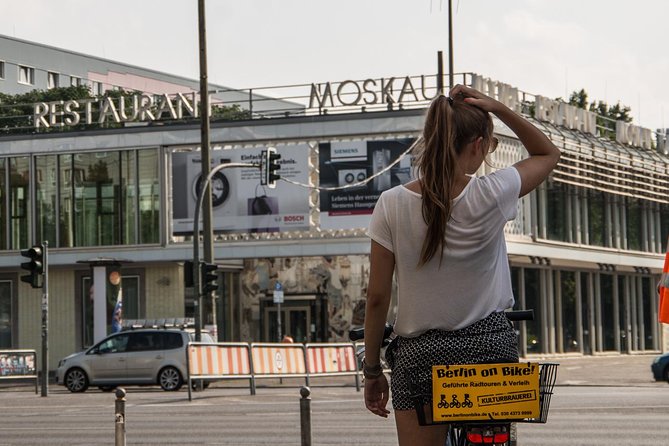
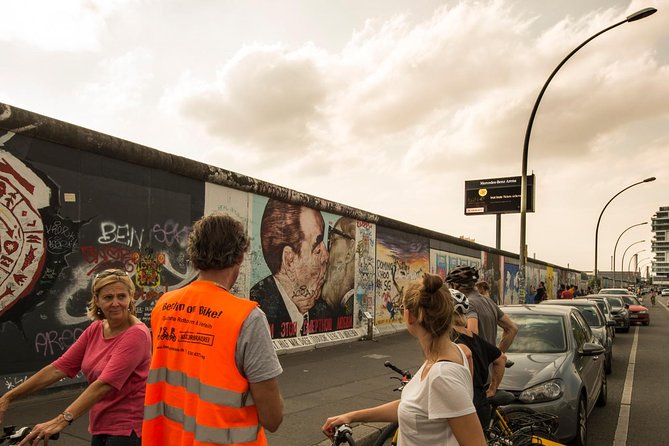
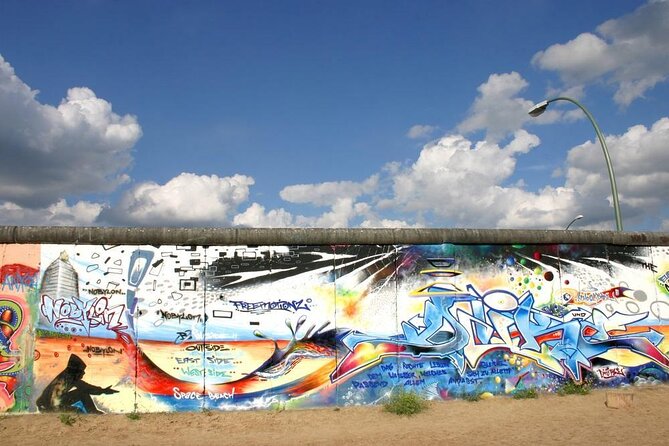
The East Side Gallery is a permanent open-air gallery on the longest remaining section of the Berlin Wall. It runs along Mühlenstraße between Ostbahnhof and Oberbaum Bridge beside the Spree.
The painted Wall is one of Berlin’s most famous sights, but seeing it as part of this route gives it a different setting. You approach it after riding through neighborhoods shaped by East Berlin, alternative culture, and post-reunification change. The Wall becomes part of a continuing urban story rather than a single memorial stop.
Your guide may also discuss lesser-known Wall stories and how the area has changed. Do not expect to examine every mural in detail. The gallery is long, and the tour has several other stops. If you want close-up photographs or time with individual paintings, return later on your own.
Oberbaum Bridge and the move into Kreuzberg
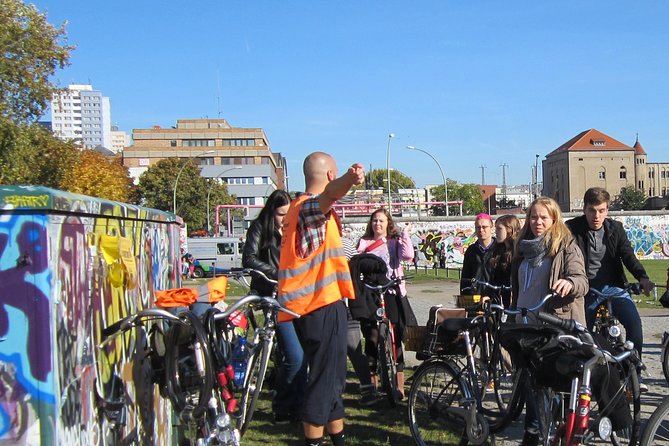
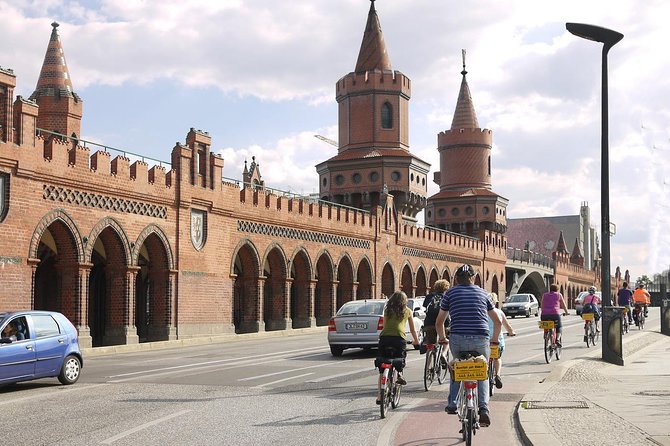
Oberbaum Bridge is one of Berlin’s most recognizable bridges and the landmark of the Friedrichshain-Kreuzberg district. Its red brick towers and arches connect the two districts across the Spree.
The bridge is more than a handsome crossing. It links two neighborhoods with different identities and a shared reputation for creativity, nightlife, political debate, and rapid change. Crossing it by bicycle gives you a clear sense of that connection.
The route may also bring you near Berghain, Berlin’s famous techno club, and other nightlife landmarks. The tour is not a club tour, and you will not be visiting venues for performances. Instead, these places help explain why Friedrichshain and Kreuzberg attract artists, night owls, independent businesses, and curious visitors.
Traffic can be the most stressful part of this section. Berlin is generally manageable by bike, but busy streets include cars, other cyclists, and pedestrians. Listen closely to the guide, keep a safe distance, and do not treat the ride like a casual stroll.
A short look at modern visual art
The route includes a center for modern visual arts with exhibitions, workshops, and an artist-in-residence program. The supplied schedule does not name the center or promise entry, so treat this as an exterior or brief orientation stop rather than a full gallery visit.
That uncertainty is worth noting when you plan your expectations. The tour’s purpose is to show how art fits into Berlin’s neighborhoods, not to replace a museum visit. You get context and a sense of the local scene, while a separate museum visit would provide more time with the work itself.
Görlitzer Park and Kreuzberg’s everyday life
Görlitzer Park is one of Kreuzberg’s major green spaces. It was created in the late 1980s and early 1990s after the railway facilities of the old Görlitzer Bahnhof were removed.
The park illustrates how Berlin has reused former transport and industrial sites. It is also a good place to see ordinary city life, not just formal monuments. You may notice the mix of recreation, local activity, social problems, and competing views about how public space should be managed.
The stop is listed at about five minutes, so the guide will keep the discussion focused. That is enough to understand the park’s origins and role in Kreuzberg, but not enough to wander through the entire area.
Guides who make the route personal
The quality of this tour depends heavily on the guide. Several named guides have led it, including Anna, Paul, Marcus, George W., Lauren, Klaus, Edgar, and Maria. You should not assume which guide you will get, but the range of names shows that the experience is not tied to a single personality.
Anna receives especially strong praise for combining local knowledge with personal stories and for engaging both adults and younger cyclists. Marcus is noted for bringing the city to life through stories, while Paul is associated with a small group and good local stops. Other guides are described as friendly, entertaining, and strong on art, neighborhoods, and Berlin’s lesser-known history.
The best guides here do more than recite dates. They explain how Berlin’s creative scenes developed, how former Wall areas changed, and why certain streets or buildings matter. Personal experience can make the tour lively, but it can also mean the emphasis varies from one departure to another.
Group size, pace, and physical demands
The maximum group size is 14. That is small enough for the guide to remember names, answer questions, and keep the ride moving without long regrouping pauses.
You should have moderate physical fitness. The route is mostly flat, but it lasts roughly three and a half hours and includes city traffic. A 14-year-old enjoyed the experience, and an 11-year-old completed it with help from the guide, but the traffic felt more demanding for the younger child.
The tour is offered in English. One departure was able to take place in French when circumstances allowed, but you should book this experience expecting English rather than a guaranteed second language.
The company says it operates in all weather, while the cancellation terms also note that poor weather can cause a cancellation. Dress for changing conditions and understand that a wet or windy day could affect the experience. Comfortable clothing, shoes suitable for cycling, and a light rain layer make sense.
Is $43.54 a fair price?
At $43.54 per person, the price is reasonable for a three-and-a-half-hour guided ride that includes a bicycle, helmet, and local guide. You are paying for both equipment and a route that would be difficult to assemble efficiently on your own.
The value is strongest if you want interpretation. You can cycle past Karl-Marx-Allee, RAW Tempel, the East Side Gallery, Oberbaum Bridge, and Görlitzer Park independently, but you may miss the links between them. The guide turns separate locations into a story about East Berlin, reunification, art, public space, and modern city life.
The value is weaker if you want a relaxed, museum-like outing or a detailed stop at every attraction. This is an active overview. You will see many places, but most stops are short, and the route keeps moving.
The 97 percent recommendation rate and 4.8 rating from 99 ratings suggest a consistently well-liked experience, though the traffic and physical effort remain real considerations. Free cancellation is available until 24 hours before the 3 pm start, which gives you some flexibility when planning several days in Berlin.
Who should book this alternative Berlin ride?
I would choose this tour if you have already seen Berlin’s main monuments or want your first visit to include more than the standard center. It suits you if you like street art, urban change, architecture, clubs, parks, political stories, and neighborhoods that feel lived-in rather than staged.
It is also a good choice for families with older children and teenagers who can manage a longer ride. The route has enough variety to hold attention, and the guide can make the stories personal. Younger children may find the traffic tiring or unsettling.
You should think twice if you dislike cycling in cities, want a slow walking tour, or have limited stamina. The bikes are provided, but there is no promise of electric bicycles, and the activity requires moderate fitness.
Should you book it?
Book it if you want to see why Berlin feels culturally restless and historically layered beyond the central monuments. The combination of Karl-Marx-Allee, RAW Tempel, the East Side Gallery, Oberbaum Bridge, and Görlitzer Park gives you a strong view of Friedrichshain and Kreuzberg in one afternoon.
I would especially recommend it early in your Berlin stay. The ride can help you get your bearings, identify places to revisit, and understand how the city’s past still shapes its clubs, art spaces, parks, and neighborhoods.
Skip it if traffic makes you nervous or if you want long visits inside museums and monuments. For most active visitors, though, the small group, included equipment, flat route, and personal guiding make this a good-value way to meet Berlin away from its usual tourist center.
FAQ
How long is the Alternative Berlin Bike Tour?
The tour lasts approximately 3 hours and 30 minutes.
What time does the tour start?
The listed start time is 3 pm.
Where does the tour begin?
It begins at Berlin on Bike, Kulturbrauerei, Knaackstraße 97, 10435 Berlin, Germany.
Where does the tour end?
The activity ends back at the same meeting point.
Is bicycle use included?
Yes. Use of a bicycle and helmet is included in the price.
What language is the tour offered in?
The tour is offered in English.
How many people can join the tour?
The maximum group size is 14 people.
Does the tour include food or drinks?
No. Food and drinks are not included.
Can I cancel for a full refund?
Yes, if you cancel at least 24 hours before the experience start time. Cancellations made less than 24 hours before the start are not refunded. Poor weather or failure to meet the minimum number of participants may lead to a different date, another experience, or a full refund.
Newest rides we have reviewed in Berlin
- Berlin Wall and Cold War Bike Tour in Small Groups★ 5.0 · 114 reviews
- Berlin : The best bike tour with a Berlin guide and insider tips★ 5.0 · 14 reviews
- Berlin: Guided Private Bike Tour to Explore the Highlights★ 5.0 · 12 reviews
- Potsdam Bike Tour with Rail Transport from Berlin★ 4.5 · 81 reviews
- Berlin: Guided Bike tour of the Berlin Wall and Third Reich★ 5.0 · 160 reviews
- Berlin : Guided Private Sightseeing Tours with Funbikes, Teambikes★ 5.0 · 20 reviews
- Berlin: Guided Bike Tour to Explore the Highlights★ 5.0 · 159 reviews
- 3-Hour Bike Tour of Tiergarten and Berlin’s Hidden Places★ 5.0 · 26 reviews
Hidden Gems Bike Tours, compared.
Small Group Guided Bike Tour of Amsterdam’s Hidden Gems
Read our review →
Top Highlights & Hidden Gems Tour by Cannondale E-Bike
Read our review →
Barcelona 3-hour Bike or E-Bike Tour: Highlights and Hidden Gems
Read our review →
Other lists this ride turns up in