
REVIEW · PRIVATE CYCLING TOURS IN BERLIN
Berlin: Private Bike Tour of the Berlin Wall and Third Reich
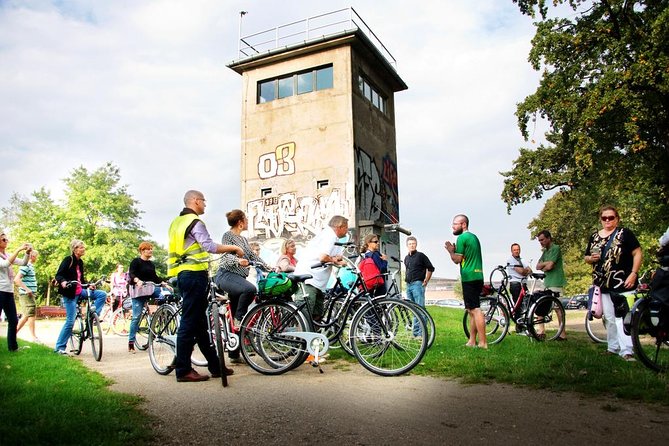
Berlin’s difficult past makes more sense from a bicycle. In three hours, you can connect the Wall, Nazi Berlin, the Holocaust memorials, and today’s government district without spending half the day walking between them. The route includes Checkpoint Charlie, the Wall Memorial, Hitler’s bunker site, and the Reichstag.
I like two things here. First, a private guide can shape the ride around your interests instead of giving every group the same script. Second, the bicycle lets you cover ground quickly, which matters in a city where key sites are spread across several neighborhoods. The main consideration is the minimum of four people, and the $107.42 per person price is a serious spend for a three-hour outing.
Key points at a glance
- The bicycle saves time: You can link central Berlin’s Wall and Nazi-era sites far more efficiently than on foot.
- The route has unusual stops: The Günter Litfin Memorial, Invalidenfriedhof, and Humboldthain Flak Tower add depth beyond the standard sights.
- You ride privately: Only your own group takes part, with room to adjust the route to your interests.
- The history is handled on location: The tour connects places with events, including the rise of Hitler, the Berlin Wall, deportation, and the Cold War.
- Checkpoint Charlie depends on language: It is included on the English version, while other languages are available by request.
- The tour works for families: Children are welcome, infant seats can be requested, and helmets and bicycles are supplied.
Why a bike works so well for Berlin’s divided past
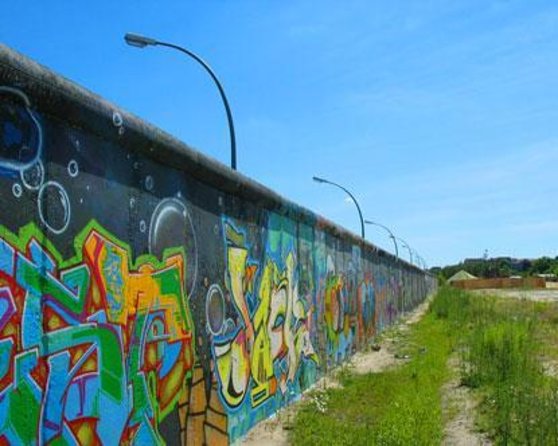
Berlin is broad and spread out. A walking tour can explain one district well, but it takes time to reach the next chapter. This ride links Nikolaiviertel, the Wall sites around Bernauer Strasse, the government quarter, the Holocaust Memorial, and former Cold War border points in one outing.
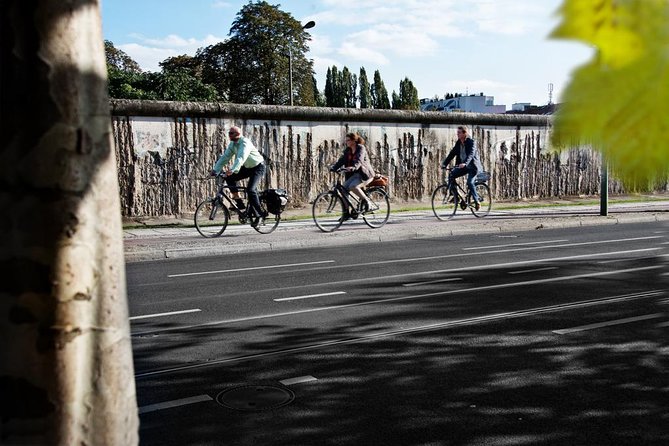
That movement is not just practical. The Wall once cut through streets, cemeteries, railway lines, and neighborhoods. Seeing those places in sequence helps you understand that it was not one isolated strip of concrete. It was a system that controlled movement and reshaped daily life.
The tour lasts about three hours and is private, so your pace should be more personal than on a large group ride. You still need to keep moving, since many stops are planned for around 5 to 15 minutes. That format suits you if you want a strong overview with regular explanations, rather than long museum visits.
Bikes, helmets, and the guide are included. Hotel pickup is not, and the ride begins and ends at Free Berlin Bike Tours & Rental, Poststraße 11, in central Berlin.
More Private Cycling Tours in Berlin
- Private Berlin Street Food Tour by Bike
★ 5.0 · 87 reviews - The Beauty of Berlin by Bike: Private Tour
★ 5.0 · 59 reviews - Private Berlin Street Food Bike Tour
★ 4.9 · 42 reviews
Nikolaiviertel and the synagogue’s story of civil courage
The first stop is Nikolaiviertel, described as Berlin’s only real old town. It is a useful opening because it raises an important question: how much of old Berlin survived the bombing of the Second World War?
You get about 10 minutes here. That is enough for orientation and context, but not for a full architectural tour. The stop works best as a reminder that Berlin’s historic center is partly reconstructed and that the city’s past is not always visible in an untouched form.
Next comes the Stiftung Neue Synagoge Berlin, also known as the Centrum Judaicum. The stop is short, around five minutes, but the subject is powerful. You hear about a police officer who protected the building during Kristallnacht, the Night of Broken Glass, when Jewish businesses, homes, and synagogues were attacked.
This is one of the tour’s better choices because it brings individual courage into a period often explained only through dates and political decisions. Do not expect to go inside as part of the stated tour. The value is in the guide’s account outside the building.
The Berlin Wall where its machinery becomes clear
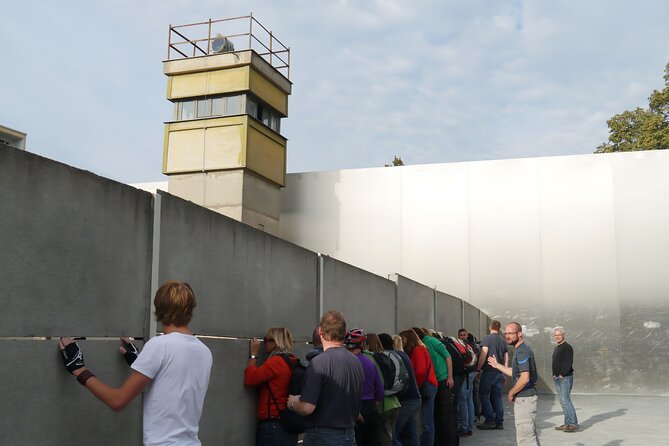
The Memorial of the Berlin Wall is the historical center of the ride. The tour describes this as the place where you can best understand how the Wall functioned, rather than simply seeing a remaining slab of concrete.
You have around 10 minutes here, so the guide must make the physical layout count. The Wall was not only a barrier. It involved guarded zones, control points, and a system designed to prevent people from leaving East Germany. Being on a bicycle helps you grasp the scale of the former border area.
Mauerpark follows. Today it is widely associated with the Sunday flea market, but the historical meaning is more severe. The area reflects repeated attempts by East German authorities to create what they considered a secure border.
This contrast is useful. You see how a place once shaped by division can become a public park and market. At the same time, a 10-minute stop cannot explain every stage of the border’s development, so you will get a focused account rather than a full Wall seminar.
Flak towers, escape attempts, and a divided cemetery
Humboldthain Flak Tower adds a strong visual link to the Nazi period. The huge structure served as a fortress and air-raid shelter, and the stop offers a panoramic view along with an explanation of Nazi architecture.
The tower is important because it shows how ideology could become concrete and steel. It was built for war, protection, and military power, not for ordinary city life. The stated stop lasts about 10 minutes. The panoramic view is a bonus, but the main reason to stop is the building itself.
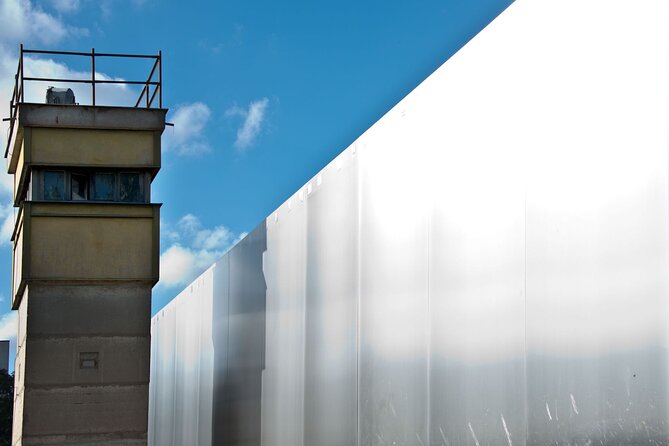
At the Günter Litfin Memorial, the history becomes personal. The preserved original watchtower commemorates Günter Litfin, identified here as the first person shot at the Wall.
This is the sort of stop that can get lost between the better-known Checkpoint Charlie and East Side Gallery. Its smaller scale is part of its value. You are not simply hearing that people died trying to cross the border. You are given a name and a specific place connected to that death.
Invalidenfriedhof offers another unusual angle. The cemetery was created for figures from German military history, but the Wall once cut through it. Some people buried there are presented as important to remember rather than honor.
That distinction matters. A memorial tour should not turn every historical figure into a hero. Here, the cemetery lets the guide discuss military memory, political judgment, and the physical damage caused when the border ran through a burial ground.
Same roads, a different saddle:
- Berlin: Sights and Highlights Bike Tour with a Local Guide
★ 4.8 · 2,698 reviews - Berlin Highlights 3-Hour Bike Tour
★ 5.0 · 948 reviews - Berlin City Bike Tour with Beer Garden Stop
★ 5.0 · 917 reviews - Berlin Highlights: 3-Hour Bike Tour
★ 4.9 · 809 reviews
From Albert Speer’s grand plan to modern Berlin
At Spreebogenpark, you get a broad view of Germany’s government district. The site also opens a discussion of Albert Speer, Hitler’s architect, and the plan for a Great Hall large enough to hold 180,000 people.
This is a useful point in the ride because you can compare the city that exists today with the city Nazi planners wanted to build. The government quarter is not just a collection of modern buildings. It also sits near plans and decisions that would have changed Berlin on a massive scale.
The Reichstag is the next major stop. The guide explains Hitler’s seizure of power and Germany’s democratic history from outside the building. There is no time to go inside, so you should not book this tour expecting a Reichstag interior visit or a dome reservation.
Still, the exterior stop earns its place. The building links imperial Germany, the Nazi period, the divided city, and the present federal government. At around five minutes, this is a quick historical briefing, not a full visit.
Holocaust memorials and the empty site of Hitler’s bunker
The route includes one of the memorials for major victim groups of the Holocaust, followed by the Memorial to the Murdered Jews of Europe near Brandenburg Gate. The latter receives about 10 minutes.
The memorial’s field of concrete blocks is deliberately difficult to read at a glance. Its scale and layout create a physical experience, but your guide’s explanation is important because the site alone does not tell you everything about its purpose or the people it remembers.
The itinerary also refers to other memorials for major victim groups. These are valuable additions because Nazi persecution targeted more than one community. The exact time at each brief stop is limited, so you may want to ask your guide which memorials will be covered in your chosen route.
The Fuhrerbunker site offers a sharp contrast. Hitler spent the final weeks of the war there and died by suicide, but today you see a parking lot. The guide explains why the bunker is not presented as a preserved attraction.
That absence is the point. Leaving the site unmarked in the usual tourist fashion avoids turning Hitler’s final headquarters into a shrine. You get the historical facts without a theatrical display.
Checkpoint Charlie and the Cold War flash point
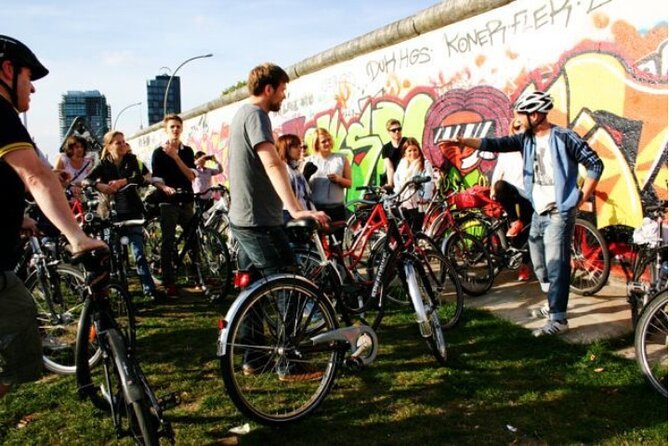
Checkpoint Charlie is included on the English version of the tour. It was the best-known crossing point associated with the American and Soviet sectors, and the tour explains how a confrontation there came close to a much wider Cold War crisis.
The stop lasts about 10 minutes. Checkpoint Charlie today is heavily associated with tourism, so the guide’s historical framing is especially useful. You can separate the modern commercial display from the serious role the crossing played during Berlin’s divided years.
The tour highlights East Side Gallery as another significant Berlin Wall stop, though the detailed route does not assign it a separate timed visit. Because the Free Berlin concept allows the guide to design each route, ask in advance if seeing the gallery matters to you. Customization is one of the strongest reasons to choose a private ride, but you should confirm your priorities before setting off.
What the three-hour format really gives you
You are not getting long indoor visits, museum time, or a leisurely stop at every site. Most locations receive five or ten minutes, with 15 minutes at Spreebogenpark. This is a moving history tour built around outdoor explanation.
That format has clear strengths. You can see a lot of Berlin in a short period, and the bicycle prevents the day from becoming a series of long walks. One review specifically praised the bikes for making the route much faster than covering the same sights on foot. The same feedback also noted that the guide’s English was clear and easy to understand, an important detail for a tour dealing with names, dates, and political terms.
The trade-off is depth at each stop. If you want to spend 30 minutes at the Wall Memorial, enter the Neue Synagoge, or tour the Reichstag, this ride will feel too brief. If you want the city’s major themes tied together with some less familiar locations, the pace is sensible.
The route is private, so you can tell the guide if you care most about the Wall, Nazi architecture, Jewish history, Cold War politics, or modern democracy. The stated Free Berlin concept means each guide designs a route, so no two rides need to be identical. That also means you should not assume every possible sight receives equal attention.
Price, group size, and who gets good value
At $107.42 per person, this is not a budget sightseeing ride. The minimum group size is four people, and group discounts are listed, so the value improves if you are traveling with family or friends and can share the private format.
You are paying for more than a rental bicycle. The fee includes a professional guide, a bike, a helmet, and a route designed for your group. The main financial advantage is time: you can cover several parts of Berlin without arranging multiple transit connections or walking long distances between sites.
Still, price matters. For a solo visitor or a couple who mainly want to rent bikes, this will be poor value. For four or more people who want history explained in English and prefer a private outing, it becomes easier to justify.
The tour is recommended for most participants, but children must be accompanied by an adult. Infant seats can be provided on request. Since it operates in all weather, wear clothing suited to rain, wind, or cooler temperatures. You will be riding outdoors for roughly three hours, so comfort matters more than dressing up for central Berlin.
English and German are available. Dutch, French, and Spanish may be possible by request. Remember that Checkpoint Charlie is specified for the English version, so ask about the route if that stop is essential to you.
Should you book this Berlin bike tour?
Book it if you want a private, efficient introduction to Berlin’s Wall and Third Reich sites, especially if you have four or more people. It is a strong match for history-focused visitors who want both famous places and less obvious stops such as the Günter Litfin Memorial, Invalidenfriedhof, and Humboldthain Flak Tower.
I would choose it early in a Berlin stay, since the ride can help you understand how the city fits together. Tell the guide your top priorities, and ask whether East Side Gallery can be included if it matters to you.
Skip it if you need extensive time inside museums, a Reichstag visit, or a slow walking tour with long pauses. At $107.42 per person, the experience earns its price through private guiding and efficient coverage, not through entry tickets or lavish extras. Free cancellation is available until 24 hours before the start time, which gives you some useful flexibility when planning.
FAQ
How long does the private bike tour last?
The tour lasts approximately three hours.
Where does the tour start and finish?
It starts and ends at Free Berlin Bike Tours & Rental, Poststraße 11, 10178 Berlin, Germany.
Is bicycle use included?
Yes. The bicycle and helmet are included in the tour price.
Is this a private experience?
Yes. Only your group participates in the activity.
What languages are available?
The tour is offered in English and German. Dutch, French, and Spanish may be possible on request.
Is Checkpoint Charlie included?
Checkpoint Charlie is included on the English version of the tour.
Can children join the tour?
Yes. Children are welcome, but they must be accompanied by an adult. Infant seats can be provided on request.
Newest rides we have reviewed in Berlin
- From Berlin: Gardens & Palaces of Potsdam Bike Tour★ 5.0 · 61 reviews
- Berlin: Illuminated Berlin by Bike Taxi★ 4.8 · 162 reviews
- Berlin: Green City Guided Bike Tour★ 4.6 · 29 reviews
- Berlin: Small Group Bike Tour Through City Center★ 4.9 · 64 reviews
- Berlin (E)Bike Tour Historical Highlights in Small groups★ 4.5 · 24 reviews
- Berlin: From East to West & Wall Tour by Bike with a Guide★ 4.8 · 171 reviews
- Berlin: 48-Hour or 72-Hour Bike Rental★ 5.0 · 14 reviews
- Berlin: 3-hour bike tour – A journey through time in the capital★ 4.8 · 24 reviews
Private Cycling Tours, compared.
Private Self-Guided E-Bike Ride in Tuscany with Vineyard Visit
Read our review →
Guided Highlights Small Group or Private E-Bike Tour
Read our review →
Florence Vintage Bike Tour–guided, small group or private option
Read our review →
Bike Tour Copenhagen. Private Guide, Concierge Service, Small Grp
Read our review →
Prague Bike City Tour with Small Group or Private Option
Read our review →
Other lists this ride turns up in