
REVIEW · MADRID
Madrid: Street Art Bike Tour
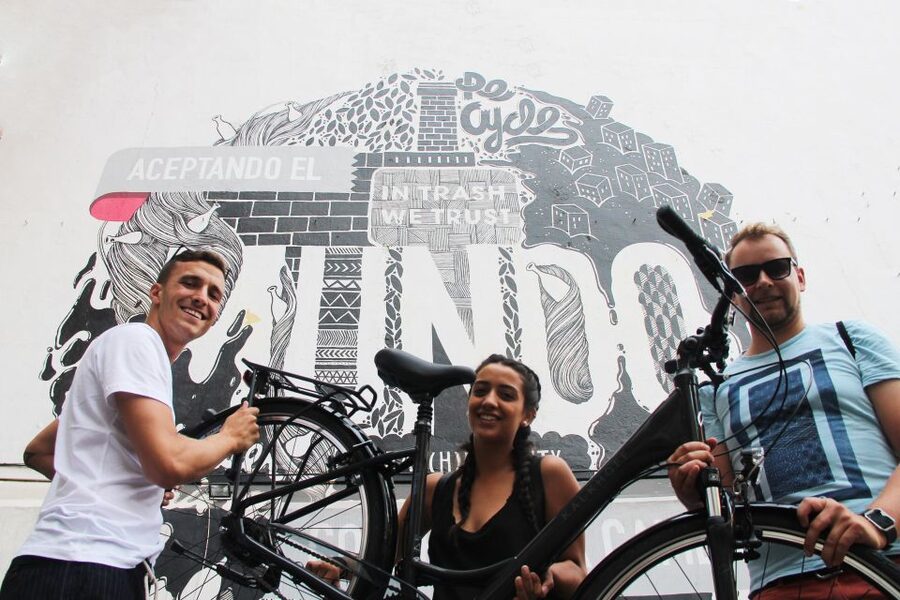
Madrid’s street art is not tucked away in a museum. It covers shutters, traffic posts, garden walls, and old urban spaces. This bike tour takes you from Muelle’s preserved 1989 tag to festival work in Malasaña and community-built art sites in Lavapiés, with a local graffiti artist explaining what you are seeing.
I like the mix of street art and recent Madrid history, and I like that the route includes ordinary neighborhood corners rather than only polished attractions. The chance to see work by Boa Mistura, El Rey de la Ruina, Cassassola, Ze Carrión, and others gives the ride real substance.
The main consideration is cycling ability. Madrid traffic and one uphill section can make this a poor fit if you are not comfortable riding in a city. The guide can adjust the pace, but you will get more from the tour if city cycling feels familiar.
Key points at a glance
- Muelle’s 1989 tag: See one of Madrid’s earliest surviving graffiti marks and learn about the young artist who helped start the city’s graffiti movement.
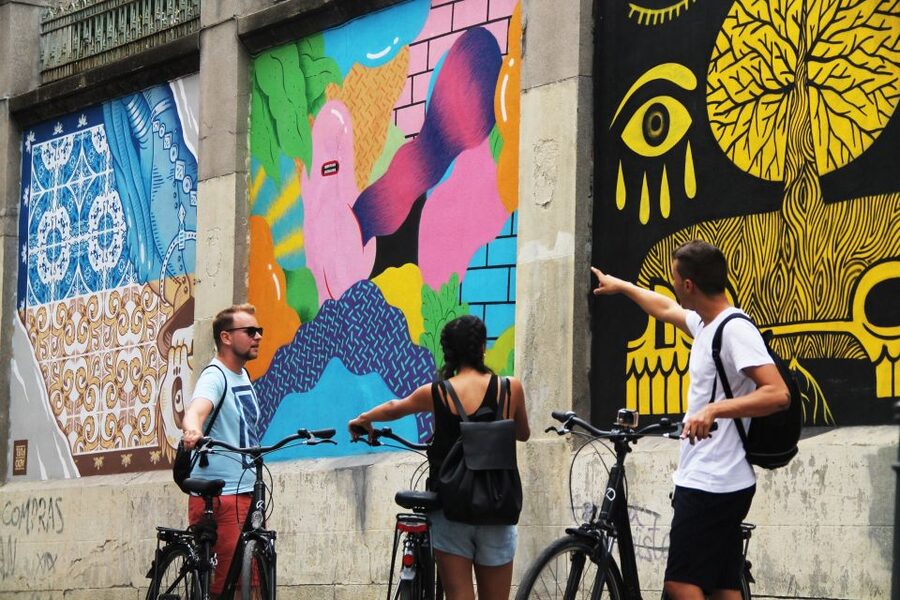
- Malasaña by bicycle: Ride through the district linked with Pinta Malasaña, including Plaza Dos de Mayo and its playful traffic-post artwork.
- Lavapiés community projects: Visit Solar Antonio Grilo and Esto es una Plaza, former abandoned spaces turned into neighborhood gardens and art hubs.
- Local artist as guide: Get explanations of graffiti methods, artists, and Madrid’s street-art culture in English or Spanish.
- Madrid’s biggest central mural: The route includes a chance to see the largest mural in the Center District.
- Good value for active visitors: At $46 per person, the price covers the bike, helmet, lock, map, restroom break, and live guide.
Starting near Sol and Gran Vía
The tour begins at the entrance to the Carrefour Express at C/Montera 32, close to both Gran Vía and Sol metro stations. That puts you in central Madrid, where it is easy to arrive by public transport and simple to pair the ride with other sightseeing.
Allow enough time to find the meeting point. C/Montera is a busy central street, so arriving early will help you locate the small supermarket without rushing. The tour ends back at the same place, a useful detail if you have dinner plans or another booking afterward.
Before setting off, you receive bicycle safety instructions. You also get a helmet and lock, plus a Madrid city map. A restroom break is included, but beverages are not, so bring water if you need it during the ride.
The activity is listed as 2.5 hours. The practical information also describes it as a three-hour, medium-level activity, so I would keep roughly three hours free. Starting times vary, and you need to check availability for the exact option on your date.
More Street Art Bike Tours in Madrid:
- London Bike Tour: Landmarks, Secret Gems, Pub Stop & Street Art
★ 5.0 · 943 reviews - Barcelona Street Art and Graffitti Bicycle Tour
★ 5.0 · 361 reviews - London: Landmarks & Secrets Bike Tour with Pub & Street Art
★ 4.9 · 314 reviews
Muelle and the beginning of Madrid graffiti
The first historical stop focuses on Muelle, whose name means spring of a mattress. He is considered a pioneer of Madrid’s graffiti movement, and one of his tags from 1989 is still preserved.
This is a useful starting point because it shows that Madrid’s graffiti culture did not appear overnight as a tourism trend. Muelle was a very young artist when he helped form a new cultural movement in the city. His tag gives you a direct link to the early days of local graffiti, before the large festival murals and organized street-art projects seen later in the tour.
Your guide also explains how artists work on walls, metal shutters, and other city surfaces. That makes the stops easier to read. You begin noticing the difference between a tag, a larger painted piece, a designed mural, and an intervention that uses an existing urban object.
The tour is led by a local graffiti artist, rather than a guide who simply points at painted walls. That matters here. Street art often changes or disappears, and understanding the methods and local context helps you appreciate work that might otherwise look like decoration.
Alonso Martínez and Boa Mistura’s first piece
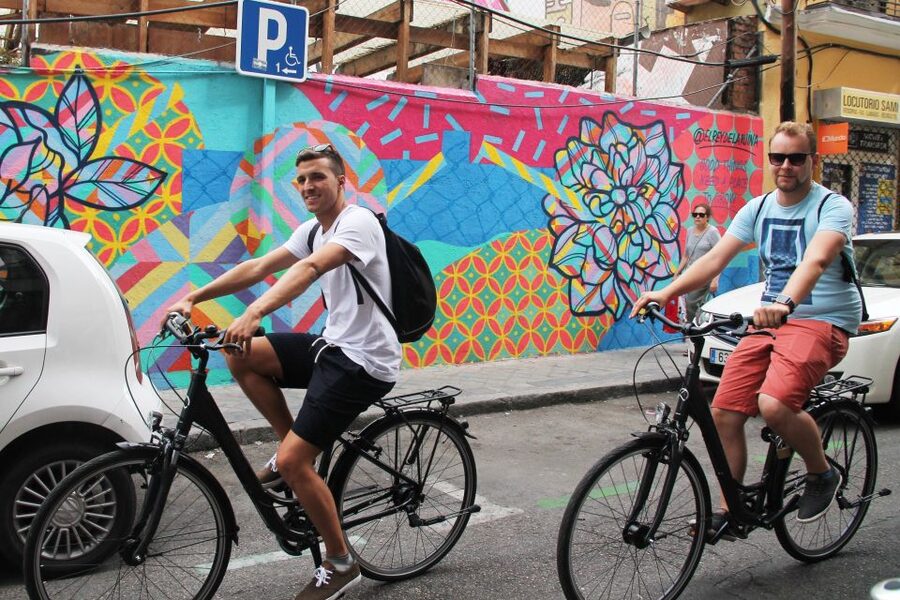
After the initial introduction and safety briefing, the group rides toward Alonso Martínez. Here you see the first piece created by Boa Mistura, a Madrid crew formed in the city’s outskirts.
Boa Mistura later worked on street-art projects around the world and became one of Spain’s best-known design groups. Seeing an early piece gives you a more grounded view of their development. You are not only looking at a famous name. You are seeing where that work began in Madrid.
This stop also shows one advantage of using a bicycle. You move between districts without spending the tour underground on the Metro or simply walking along the most obvious streets. The bike connects separate examples of art into a story about the city.
The route is not a race. There is time to stop, look, and take photographs. Still, you should be ready to ride in central Madrid. One participant found the traffic and uphill sections challenging for weaker cyclists, even though the guide adjusted the tour as much as possible. That is an important warning for families and mixed-ability groups.
Malasaña and the Pinta Malasaña festival
The route continues into Malasaña, one of Madrid’s best-known neighborhoods for independent shops, nightlife, and creative projects. The tour focuses on artwork made by Spanish artists during the 2017 edition of Pinta Malasaña.
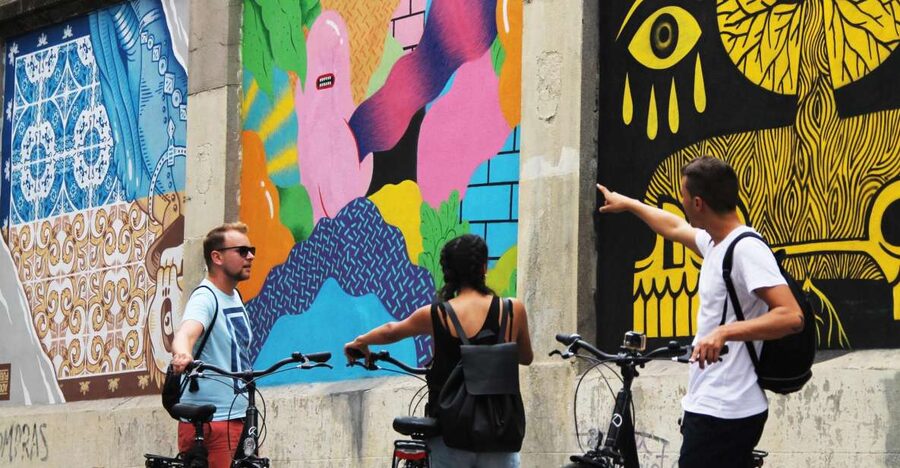
Pinta Malasaña transforms the neighborhood during April, bringing art onto walls, shutters, and other surfaces. The work is spread through the district, so cycling lets you cover more ground than you would on foot. You also get a sense of how street art fits into daily neighborhood life rather than appearing only in a dedicated gallery.
Plaza Dos de Mayo is the center of this part of the route. One particularly playful work is Bolardo Voy, Bolardo Vengo, which turns traffic-control posts into colorful pieces of public art. It is a small example with a big lesson: street art can change how you see objects you normally ignore.
Malasaña is a lively area, and city riding here requires attention. You may need to share space with traffic and pedestrians. The benefit is that you see the neighborhood at street level, with the art placed in the same setting where residents encounter it every day.
More Cycling Trips in Madrid:
- Madrid Highlights Bike Tour
★ 5.0 · 1,731 reviews - Best of Madrid: 3-Hour Guided Bike Tour in Small Groups
★ 4.8 · 1,417 reviews - Madrid: City Highlights Guided Vintage Bike Tour
★ 4.9 · 1,159 reviews - Madrid: 3 hour Guided Highlights Bike Tour with Optional Tapas
★ 5.0 · 443 reviews
Solar Antonio Grilo and the community side of street art
The tour then heads toward Solar Antonio Grilo and Esto es una Plaza. These are former abandoned spaces that became community gardens and local gathering points in the Noviciado and Lavapiés areas.
They add an important layer to the tour. Not all urban art is made for a formal festival or commissioned by a major organization. These sites were created for and by local communities, and their gardens combine public use with street art.
You will see how neglected urban spaces can be given a new purpose. The sites are also presented as examples of hybrid economy systems, where community activity, shared resources, and creative work meet. That makes the visit more than a photo stop. It gives you a look at how residents can reshape unused parts of their neighborhood.
The art here includes work by El Rey de la Ruina, Cassassola, Ze Carrión, Por Favor, and other artists. Because the spaces are community hubs, the atmosphere and artwork may feel less polished than a large festival mural. That is part of their appeal, but it also means you should come expecting an evolving urban setting rather than a fixed exhibition.
Lavapiés is one of the best places in Madrid to see this connection between neighborhood life and public art. Riding between the stops helps you understand how the projects fit into the surrounding streets.
The biggest mural in Madrid’s Center District
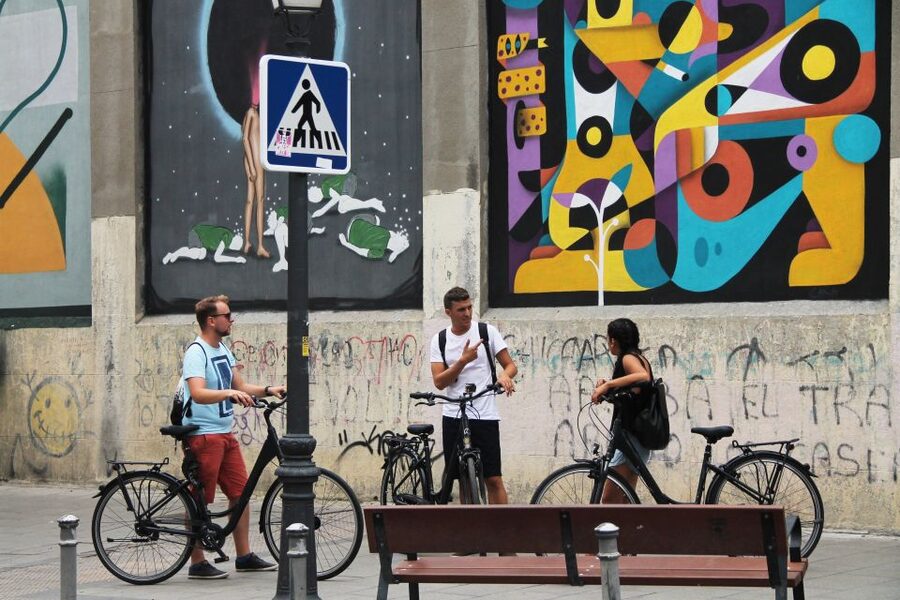
A key highlight is the chance to see the largest mural in Madrid’s Center District. The tour does not treat street art as a collection of isolated walls. It shows how scale changes the effect of a piece, especially when a mural fills a central building or public surface.
Large work is easy to admire, but the guide’s explanations help put it in context. You learn how artists use walls, shutters, and other urban elements, and how a piece can alter the feel of an entire street.
The route also includes work by both national and international artists who took part in Madrid’s major street-art festivals. That range makes the tour useful for first-time visitors and for anyone who already follows graffiti and mural art. You get local beginnings, established Spanish crews, festival work, and community projects in one outing.
What the cycling is really like
This is a medium-level bike activity, not a sightseeing ride where you can coast without thinking. The route includes city traffic and one uphill section. The guide provides safety instructions and can adapt the tour when possible, but you should be comfortable controlling a bicycle around other road users.
A seven-year-old child completed the route on their own bike with a family group, so the tour can work for children who already ride confidently. The important point is ability, not simply age. A child who is nervous in traffic may find the experience tiring.
Comfortable shoes are recommended. Bring identification, as a passport or ID card is listed among the items to carry. You may also want water, since beverages are not included.
The bike is a practical tool, not just a novelty. It lets you link Malasaña, Noviciado, and Lavapiés in a short time and gives you a closer view of Madrid’s smaller streets. On the other hand, cycling can reduce the time you have to stop at each artwork compared with a walking tour focused on one neighborhood.
Guide quality and the human side of the tour
The guide is central to the experience. You are not only renting a bike and following a route. You are hearing about techniques, local artists, festival projects, and the changes that shaped Madrid’s street-art culture.
One guide named Javier received especially warm praise for being friendly, experienced, and good with families. A family group found the booking, bike rental, and ride easy to manage, and appreciated that the route showed both street art and less obvious urban areas.
The guide’s ability to adjust the ride is also important. When some cyclists struggled with traffic and hills, the pace was adapted as much as possible. That does not remove the need for basic city-cycling skills, but it suggests that the experience is not run as a rigid race from one stop to the next.
English and Spanish tours are available. If the guide is the part of the experience you value most, check the language and time when you book. The stated rating is 4.5 from 21 ratings, with praise focused on the guide’s explanations, the fun of the ride, and the look at Madrid’s recent history.
Is $46 a fair price?
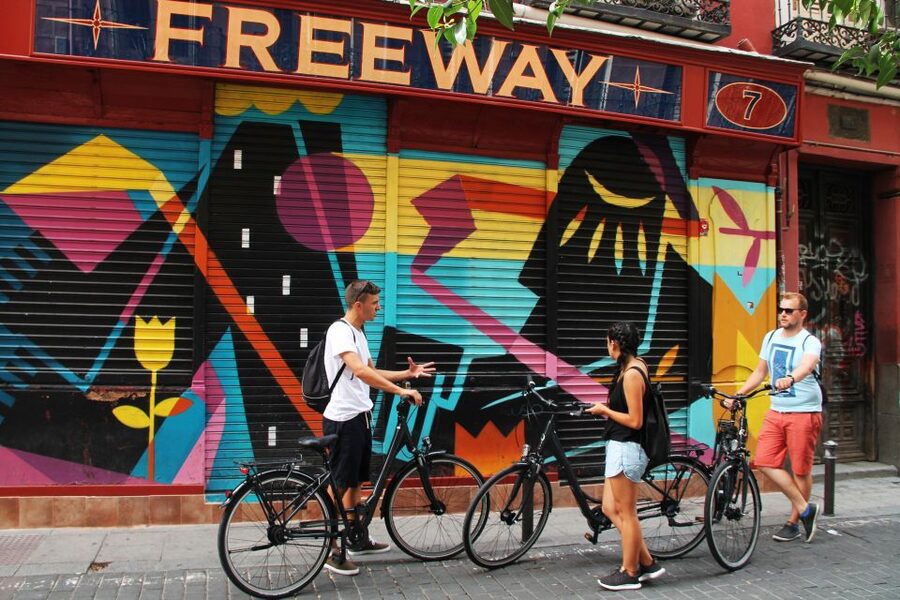
At $46 per person, the price is reasonable if you want a guided introduction to several art districts in one outing. You are paying for more than bicycle use. The package includes the bike, helmet, lock, city map, live guide, and a restroom break.
The value is strongest for first-time visitors who want a structured way to see Malasaña and Lavapiés. You could visit some of these areas independently, but you would need to find the artworks, understand the festival connections, and make sense of the artists on your own.
The price is less compelling if you already know Madrid well, cycle confidently around the center, and prefer to explore at your own pace. Street art changes, and some pieces may not look exactly as expected over time. A guided route still gives you context, but it cannot guarantee that every work remains untouched.
Free cancellation up to 24 hours before the activity and the option to reserve now and pay later make the booking less rigid. These policies are helpful if your Madrid schedule is still shifting.
Who should book this ride?
I would choose this tour if you want to combine sightseeing with light exercise and have a real interest in how cities use public space. It is particularly suitable for visitors who like local neighborhoods, modern culture, and guided experiences that move beyond the standard monuments.
Families can consider it if children are confident cyclists. The family experience with a seven-year-old shows that young riders can take part, but the traffic and uphill section still matter.
I would skip it if you are uncomfortable cycling in a city, have limited balance, or want a slow walking tour with long periods at each artwork. You should also think twice if you need a strictly timed two-and-a-half-hour activity, since the practical information describes the outing as lasting up to three hours.
Should you book the Madrid Street Art Bike Tour?
Book it if you want a compact look at Madrid’s graffiti culture, festival art, and community projects, with a local artist explaining what the paint means and how it is made. The route has a clear progression: Muelle’s early tag, Boa Mistura’s beginnings, Pinta Malasaña, and the gardens and murals of Lavapiés.
The best reason to go is the combination of art and neighborhoods. You are not simply collecting mural photographs. You are seeing how Madrid’s creative life appears on shutters, bollards, walls, and reclaimed public spaces.
Skip it if city cycling feels stressful. For confident riders, $46 buys a useful introduction to parts of Madrid you might otherwise pass without understanding.
FAQ
How long does the Madrid Street Art Bike Tour last?
The activity is listed as 2.5 hours. The practical information also describes it as a three-hour, medium-level activity, so you should allow up to three hours.
Where does the tour start?
It starts at the entrance of the Carrefour Express at C/Montera 32, near the Gran Vía and Sol Metro stations.
Where does the tour finish?
The tour ends back at the original meeting point on C/Montera 32.
What languages are available?
The live guide is available in English or Spanish.
Is bicycle rental included?
Yes. The bicycle, helmet, and lock are included in the price.
Is a city map provided?
Yes. A Madrid city map is included.
Are drinks included?
No. Beverages are not included.
What should I bring?
Bring a passport or ID card and comfortable shoes. You may also want water because beverages are not provided.
Is the tour suitable for children?
The activity can suit children who are confident riding their own bikes. One family completed it with a seven-year-old child riding independently, but the route includes city traffic and one uphill section.
Can I cancel for a full refund?
Yes. You can cancel up to 24 hours in advance for a full refund. You can also reserve now and pay later.
Newest rides we have reviewed in Madrid
- Bike Rental Madrid (full day)– Discover the city your way★ 5.0 · 31 reviews
- Self Guided Bike Tour at The Retiro Park at Your Own Pace★ 5.0 · 41 reviews
- Electric Bike Rental with Phone Holder and Self Guided Tour★ 5.0 · 18 reviews
- Madrid Parks & Riverside Bike Tour★ 5.0 · 26 reviews
- City Bike Rental with Phone Holder and Self Guided Tour★ 5.0 · 39 reviews
- Private customizable bike tour Madrid★ 5.0 · 12 reviews
- All Madrid: Private City Electric Bicycle Tour★ 5.0 · 13 reviews
- Private Madrid City Tour | Regular Bike/E-Bike | Groups from 32€★ 5.0 · 26 reviews
Street Art Bike Tours, compared.
London Bike Tour: Landmarks, Secret Gems, Pub Stop & Street Art
Read our review →
Barcelona Street Art and Graffitti Bicycle Tour
Read our review →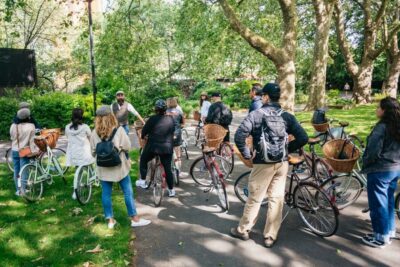
Landmarks & Secrets Bike Tour with Pub & Street Art
Read our review →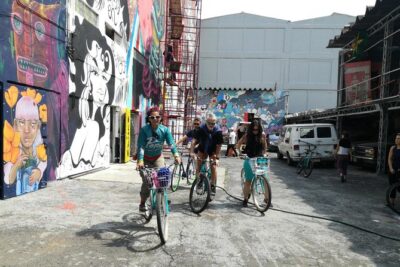
Mexico City; ART NACO : Murals & Street Art Bike Tour
Read our review →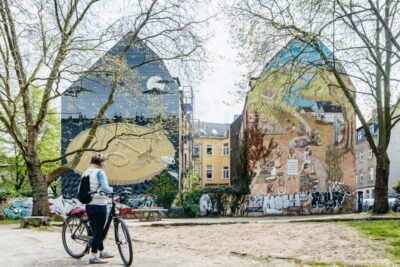
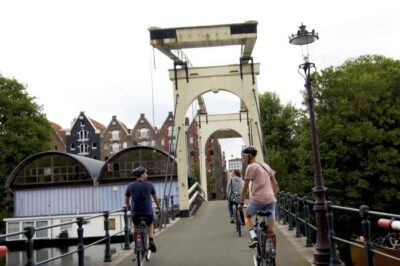
Urban Adventures Amsterdam Bike Tour, Graffiti and Magnet Fishing
Read our review →
Guided Asheville E-bike Tour of River Arts, Mountains and Murals
Read our review →Other lists this ride turns up in